
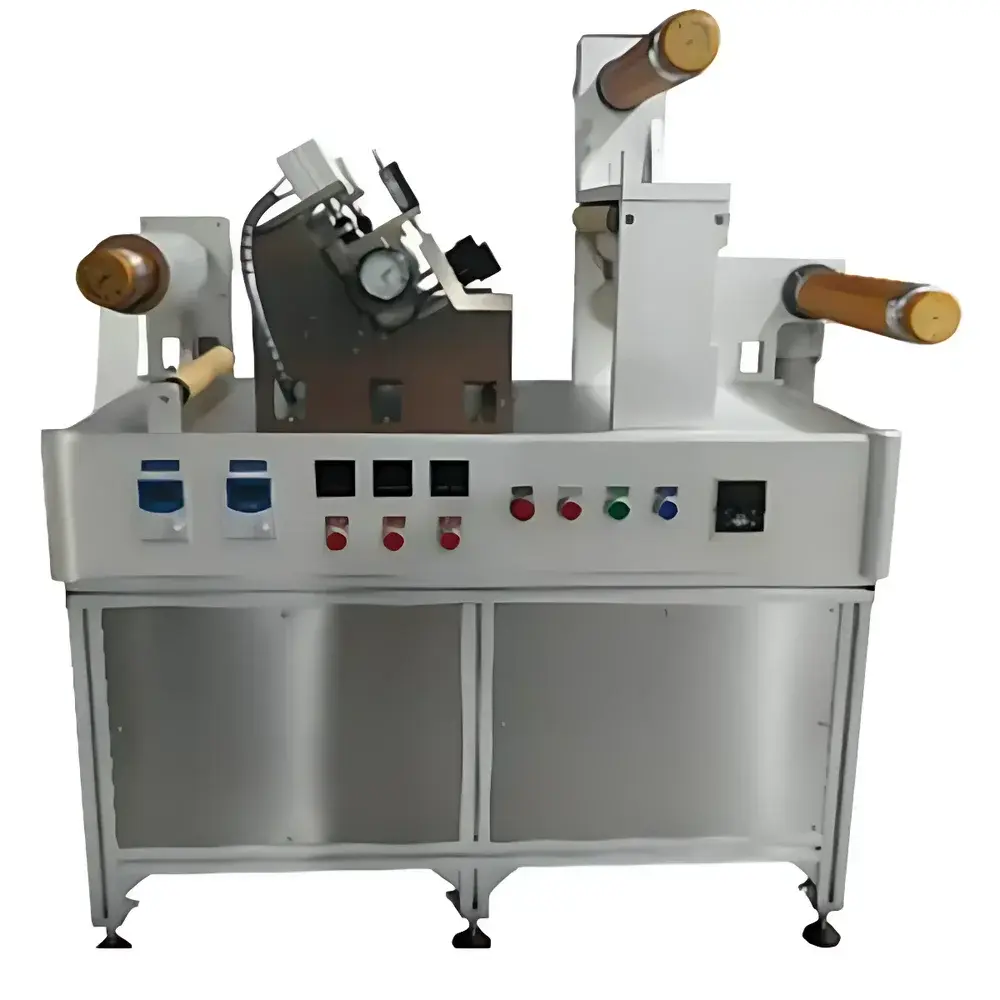
Yuelian PW-RT300 Continuous Laboratory Coating Machine
| Brand | Yuelian / PW |
|---|---|
| Origin | Guangdong, China |
| Manufacturer Type | Authorized Distributor |
| Country of Origin | China |
| Model | PW-RT300 |
| Application | Laboratory-scale continuous hot-melt adhesive coating and laminating |
| Coating Method | Heated comma doctor blade |
| X-axis (Coating Travel) | 300 mm (effective) |
| Coating Thickness Range | 0.1–5 mm (uniformity ±4%) |
| Coating Speed | 0.5–5 m/min (adjustable per adhesive drying kinetics) |
| Blade Actuation | Pneumatic auto-lift |
| Thickness Adjustment | Manual micrometer fine-tuning |
| Temperature Control | Thermocouple-sensed PID touchscreen controller (max. 200 °C) |
| Web Tension Control | Adjustable unwind tension (1–25 N) |
| Unwind Roll Capacity | Ø200 mm, max. 100 kg |
| Rewind Roll Diameter | Ø200 mm |
| Frame Construction | Electroplated steel frame + anodized aluminum structural modules + 304 stainless steel outer panels |
| Heating System | Calrod electric heating elements |
| Laminating Module | Integrated automatic lamination station |
| Core Type | 3-inch pneumatic expanding shaft (tapered mandrel) |
| Drive System | Inverter-controlled AC motor |
| Power Supply | 220 V AC, 50/60 Hz |
| Total Rated Power | 5 kW (nominal) |
| Compressed Air Requirement | 0.55–0.7 MPa |
Overview
The Yuelian PW-RT300 Continuous Laboratory Coating Machine is a precision-engineered, modular pilot-line system designed for controlled deposition of thermoplastic hot-melt adhesives (HMAs) onto flexible substrates under reproducible process conditions. Based on Couette-flow-assisted comma doctor blade coating—a well-established rheological coating method—the PW-RT300 enables quantitative evaluation of adhesive rheology, wet film formation, thermal stability, and interfacial bonding behavior during continuous web processing. Its architecture supports both direct coating onto heat-resistant carriers (e.g., PET, PI, metal foils) and transfer coating via release liners—critical for developing pressure-sensitive adhesive (PSA) tapes, medical dressings, battery separator laminates, and functional barrier films. The system operates within ISO 17025-aligned laboratory environments and is routinely deployed in R&D labs conducting ASTM D3359 (adhesion), ISO 2582 (peel strength), and TAPPI T494 (coating weight uniformity) test development.
Key Features
- Modular station-based design allows reconfiguration for single-layer coating, dual-layer co-extrusion simulation, or inline lamination—supporting DOE-driven process optimization.
- Heated comma doctor blade (up to 200 °C) with pneumatic vertical actuation ensures repeatable gap control and minimizes thermal drift during extended runs.
- Electroplated steel frame and 304 stainless steel enclosure provide corrosion resistance and compliance with ISO 14644-1 Class 8 cleanroom-compatible surface finish requirements.
- Inverter-controlled drive system delivers stable line speed from 0.5 to 5 m/min with <±0.3% speed deviation across load variations—essential for correlating dwell time with adhesive crosslinking kinetics.
- Integrated tension control (1–25 N range) maintains substrate dimensional stability during thermal expansion, reducing edge curl and thickness variation in thin-film (<100 µm) applications.
- Touchscreen HMI with data-logging capability records temperature setpoints, line speed, tension values, and actuator status—enabling traceable parameter archiving per GLP/GMP documentation protocols.
Sample Compatibility & Compliance
The PW-RT300 accommodates a broad spectrum of substrate formats including paper, nonwovens (non-stretch), PET, BOPP, aluminum foil, and metallized films up to 300 mm wide and 200 mm in roll diameter. It supports solvent-free HMAs (EVA, PO, APAO), reactive polyurethane (RPU), and UV-curable acrylic dispersions. All electrical components conform to IEC 61000-6-3 (EMC) and IEC 61000-6-4 (immunity); mechanical safety complies with ISO 13857 (safe distances) and EN 60204-1 (electrical equipment of machines). Optional validation packages support IQ/OQ documentation aligned with FDA 21 CFR Part 11 requirements for electronic records and signatures.
Software & Data Management
The embedded control system features timestamped parameter logging at 1 Hz resolution, exportable in CSV format for post-run statistical process analysis (SPC). While no proprietary cloud platform is included, the RS-485 Modbus RTU interface enables integration with third-party MES/LIMS systems (e.g., LabVantage, Thermo Fisher SampleManager) for automated metadata capture—including batch ID, operator ID, environmental humidity/temperature (via optional external sensor input), and coating weight calibration logs. Audit trails are retained locally for ≥90 days and support manual export for regulatory submission.
Applications
- Rapid prototyping of PSA formulations for automotive trim bonding and electronics shielding tapes.
- Development of low-VOC, high-solids barrier coatings for food packaging laminates.
- Process validation of thermal lamination parameters for flexible printed circuit (FPC) coverlays.
- Accelerated aging studies of adhesive-substrate interfaces under controlled dwell-time/temperature profiles.
- Calibration reference tool for gravimetric coating weight measurement (per ASTM D374) and optical thickness mapping (via OCT or ellipsometry).
FAQ
What substrates can be processed on the PW-RT300?
Standard substrates include paper, nonwoven fabrics (non-elastic), polyester (PET), polypropylene (BOPP), aluminum foil, and metallized films—provided they maintain dimensional stability at temperatures up to 200 °C and tolerate tension loads between 1–25 N.
Is the comma blade heated independently from the main oven zone?
Yes—the blade assembly incorporates dedicated calrod heaters with independent thermocouple feedback and PID regulation, enabling precise thermal management of the shear zone without affecting upstream web temperature.
Can the system be validated for GMP-compliant production trials?
While classified as a laboratory instrument, the PW-RT300 supports IQ/OQ execution through its deterministic control architecture, full parameter logging, and mechanical repeatability (thickness CV ≤4% over 30-min continuous run). Full GMP qualification requires site-specific risk assessment and integration into a validated facility environment.
What maintenance intervals are recommended for pneumatic and thermal subsystems?
Pneumatic filter-regulator-lubricator units require quarterly inspection; heater elements and thermocouples should be calibrated annually against NIST-traceable references; blade edge geometry should be verified every 200 operational hours using optical profilometry.
Does the machine support offline thickness measurement integration?
Yes—standardized mounting brackets allow retrofitting of beta-backscatter gauges (e.g., Fischer FMP series) or laser displacement sensors (e.g., Keyence LK-G series) directly above the coating nip, with analog signal inputs configurable in the HMI.



