
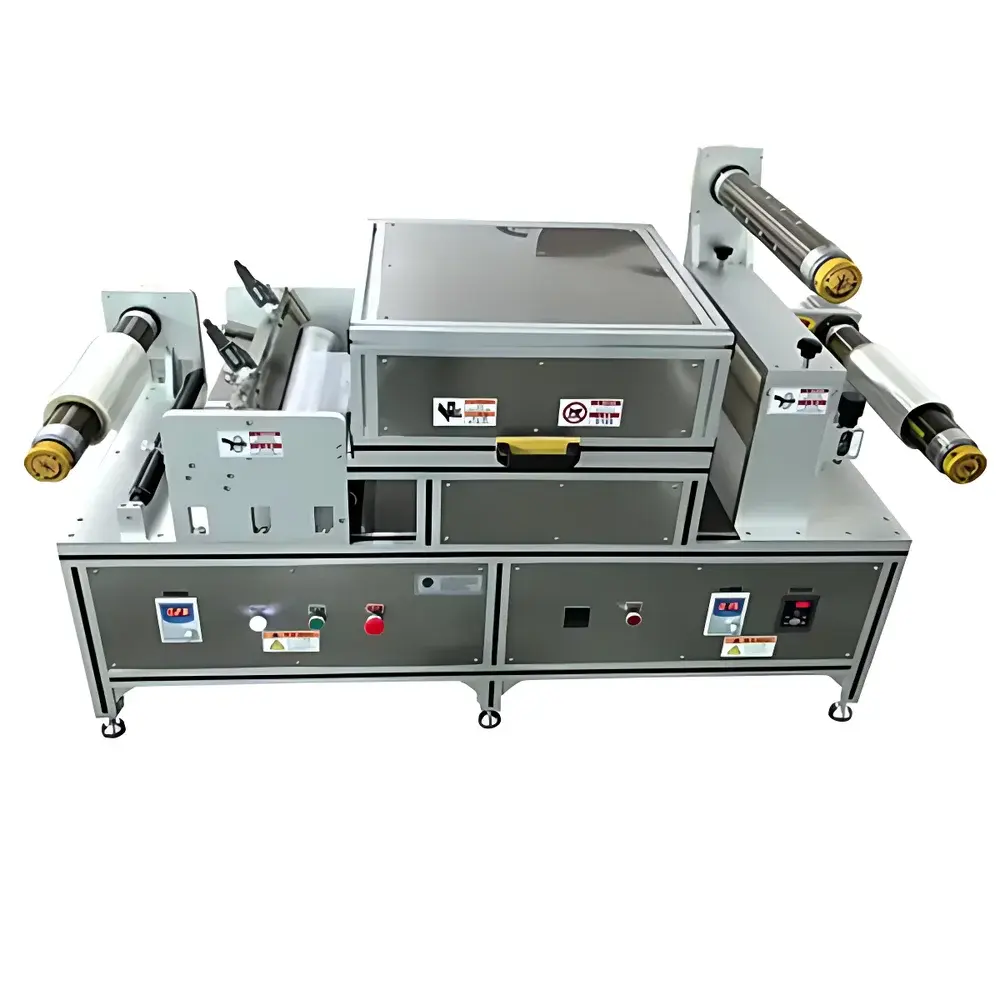
Yuelian PW-RT380 Continuous Hot-Air Oven Integrated Laboratory Coating System
| Brand | Yuelian (PW) |
|---|---|
| Origin | Guangdong, China |
| Manufacturer Type | Authorized Distributor |
| Country of Origin | China |
| Model | PW-RT380 |
| Coating Width | 380 mm (effective) |
| Coating Methods | Wire-Bar & Doctor Blade |
| Adhesive Delivery | Manual |
| Coating Thickness Range | 0.01–1 mm (±3 µm accuracy) |
| Thickness Adjustment | Micrometer Dial |
| Rewinding Motor | Variable-Frequency Drive (VFD) |
| Tension Control | Adjustable |
| Line Speed | 0.5–3 m/min |
| Oven Length | 0.5–6 m (configurable) |
| Power Supply | 220 V AC |
| Total Power Consumption | 6 kW |
| Application Scope | R&D and QC coating trials for thin-film functional materials |
Overview
The Yuelian PW-RT380 Continuous Hot-Air Oven Integrated Laboratory Coating System is an engineered platform designed for controlled, reproducible thin-film deposition in research laboratories and pilot-scale quality assurance environments. Unlike batch-mode coaters, this system integrates precision web-handling mechanics with a thermally stabilized convection drying zone—enabling real-time solvent evaporation, film consolidation, and dimensional stability assessment under defined thermal profiles. Its operational principle centers on gravure-adjacent metering (via wire-bar or doctor blade) combined with continuous substrate transport and inline thermal conditioning. This architecture supports the development and validation of functional coatings where thickness uniformity, interfacial adhesion, and post-drying morphology are critical—such as electrode slurries for lithium-ion batteries, barrier layers for flexible packaging, conductive polymer films, and pharmaceutical film-coated tablets.
Key Features
- 380 mm effective coating width accommodates standard laboratory-grade substrates including PET, aluminum foil, copper foil, release liners, and nonwovens.
- High-resolution micrometer-based thickness adjustment (±3 µm repeatability) ensures deterministic control over wet-film build-up prior to drying.
- Variable-frequency drive (VFD) rewinding motor enables stable line-speed regulation from 0.5 to 3 meters per minute—critical for matching shear-dependent rheology of shear-thinning formulations.
- Modular hot-air oven section (0.5–6 m length, configurable) delivers uniform convective heating with independent temperature zoning; typical operating range: ambient to 150 °C.
- Dual-coating-head compatibility (wire-bar and doctor blade) allows rapid method switching without mechanical recalibration—supporting both low-viscosity dispersions and high-solids pastes.
- Manually operated adhesive delivery system permits precise volumetric dosing control during formulation screening, minimizing material waste during early-stage R&D.
- Adjustable web tension control maintains substrate flatness and prevents edge curl or slippage during coating and drying—essential for defect-free film formation.
Sample Compatibility & Compliance
The PW-RT380 accommodates roll-to-roll substrates with thicknesses ranging from 12 µm (e.g., PET film) to 200 µm (e.g., battery separator or paperboard). It supports aqueous, solvent-based, and UV-curable formulations commonly used in academic labs and industrial innovation centers. While not certified for GMP manufacturing, the system’s design aligns with GLP-aligned documentation practices: all adjustable parameters (speed, temperature setpoints, tension, thickness setting) are manually recorded and traceable. Its mechanical simplicity and absence of embedded software facilitate audit readiness for ISO/IEC 17025-accredited testing laboratories conducting method development per ASTM D823 (Standard Practice for Producing Films of Uniform Thickness), ISO 2808 (Paints and Varnishes — Determination of Film Thickness), and USP (Packaging–Sterile Products) coating validation protocols.
Software & Data Management
The PW-RT380 operates without proprietary firmware or closed-loop digital control. All operational parameters—including line speed, oven temperature (monitored via calibrated thermocouples), and mechanical thickness settings—are manually set and documented externally. This analog-first architecture eliminates cybersecurity risks, reduces validation burden, and supports full traceability through laboratory notebooks or LIMS-integrated log sheets. For users requiring data capture, optional third-party USB thermocouple loggers and tachometer sensors can be integrated to record time-stamped thermal and velocity profiles—enabling correlation of drying kinetics with final film properties such as gloss, haze, or peel strength.
Applications
- Lithium-ion battery R&D: Slurry coating of cathode/anode layers on Cu/Al foils; optimization of solid loading, binder distribution, and calendering response.
- Flexible electronics: Deposition of transparent conductive oxides (ITO, PEDOT:PSS), dielectric layers, and encapsulation barriers on polyimide substrates.
- Pharmaceutical sciences: Film-coating studies of immediate- and sustained-release tablet cores using HPMC, Eudragit®, or shellac-based systems.
- Packaging innovation: Development of oxygen/moisture barrier coatings (SiOx, AlOx, PVDC) on food-grade laminates and metallized films.
- Functional textiles: Application of flame-retardant, antimicrobial, or hydrophobic finishes onto woven and nonwoven fabrics.
- Academic teaching: Hands-on demonstration of coating rheology, drying stress evolution, and defect formation mechanisms (e.g., ribbing, orange peel, cracking).
FAQ
Is the PW-RT380 suitable for GMP-compliant production?
No—it is explicitly designed for laboratory-scale R&D, formulation screening, and QC method development—not for commercial manufacturing under FDA 21 CFR Part 11 or EU Annex 11 requirements.
Can the oven temperature be precisely controlled and logged?
Yes—each zone features independently adjustable PID-controlled heaters and calibrated K-type thermocouples; external data loggers may be connected for continuous monitoring.
What substrate widths can be processed within the 380 mm coating zone?
Substrates up to 360 mm wide are recommended to ensure edge coverage and avoid coating non-uniformity due to airflow turbulence at the web boundaries.
Does the system support automated adhesive dosing?
Not natively—the current configuration uses manual syringe or reservoir-based feeding; however, OEM-compatible peristaltic pump mounts are available upon request.
How is film thickness verified post-drying?
Users typically employ contact profilometry (e.g., Dektak), optical interferometry, or cross-sectional SEM—methods aligned with ISO 25178 and ASTM E1197 standards for dry-film metrology.



