
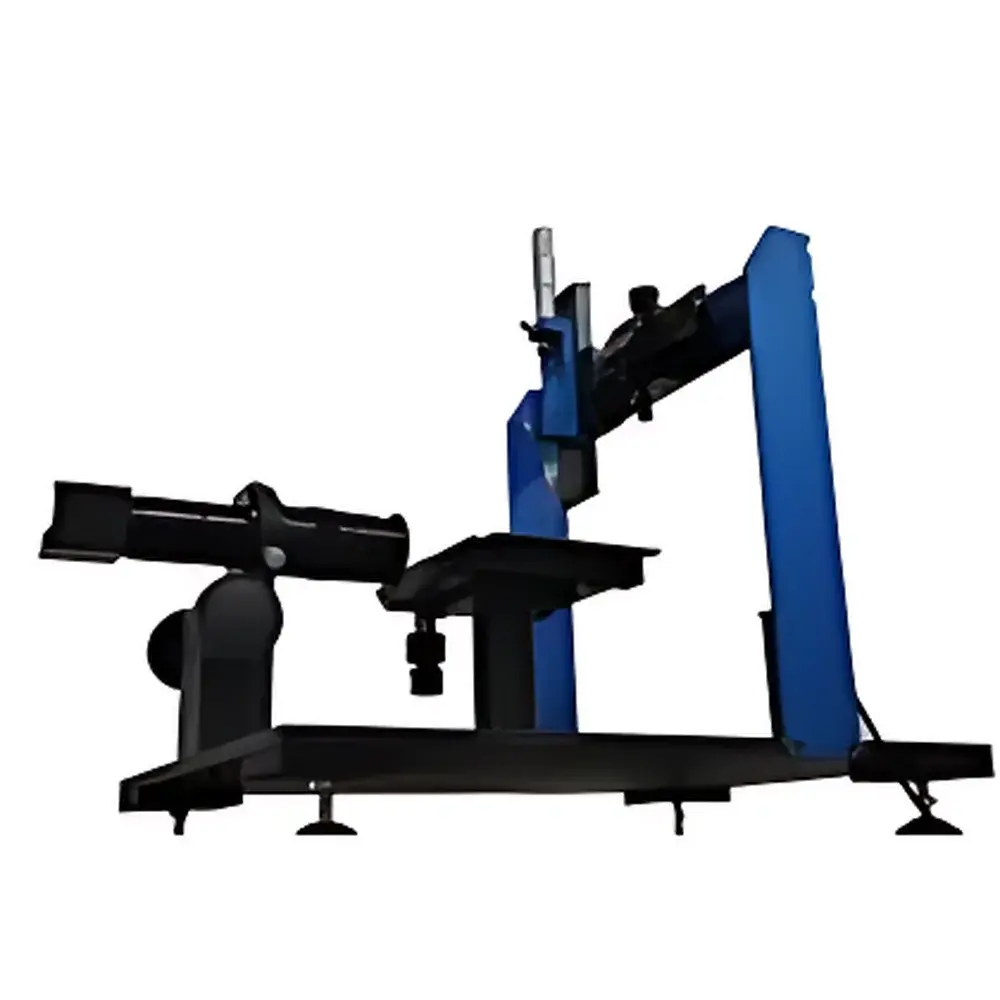
Yuelian YL-9980 Contact Angle Goniometer
| Brand | Yuelian |
|---|---|
| Origin | Guangdong, China |
| Manufacturer Type | Authorized Distributor |
| Country of Origin | China |
| Model | YL-9980 |
| Pricing | Available Upon Request |
| Contact Angle Range | 0–180° |
| Measurement Accuracy | ±0.1° |
| Analysis Methods | Automatic Circle/Fitting Method, Manual Horizontal/Slope Tangent Method, Height-Width Method, User-Defined Tangent Method |
| Optical System | 2× Fixed-Magnification High-Definition Microscope with Adjustable LED Backlight |
| Imaging | High-Resolution CMOS Digital Camera |
| Motion Control | 3-Axis Motorized Sample Stage (X/Y/Z: ±50 mm / ±50 mm / ±30 mm), Extendable Base Plate (±30 mm vertical extension), Independent Syringe Stage (X/Y: ±100 mm), Microscope Translation (Z: ±80 mm, Fine Adjustment ±3 mm) |
| Sample Stage Dimensions | 240 mm × 120 mm |
| Max Sample Thickness | ≤80 mm |
| Overall Dimensions | 360 mm (W) × 480 mm (D) × 460 mm (H) |
| Software Features | Real-Time Video Capture & Playback, Frame-by-Frame Export, Multi-Image Batch Analysis, Surface Energy Calculation (Owens-Wendt, Wu, van Oss-Chaudhury-Good models), Audit-Trail-Ready Data Logging, Report Consolidation Across Sequential Measurements |
Overview
The Yuelian YL-9980 Contact Angle Goniometer is a precision optical instrument engineered for quantitative interfacial characterization of solid–liquid systems. It operates on the principle of sessile drop analysis using high-resolution silhouette imaging: a precisely dispensed liquid droplet is deposited onto a solid substrate, and its profile is captured under controlled illumination using a fixed-magnification microscope and a high-sensitivity CMOS camera. The contact angle—the angle formed between the tangent to the liquid–air interface and the solid surface at the three-phase boundary—is extracted via geometric fitting algorithms or manual tangent placement. This measurement serves as a primary indicator of surface wettability, hydrophobicity/hydrophilicity, and surface energy heterogeneity—critical parameters in materials science, coating development, biomedical device validation, and microfluidic design.
Key Features
- Optical architecture optimized for low-distortion silhouette imaging: 2× fixed-magnification microscope paired with uniform, adjustable-intensity LED backlighting ensures consistent edge contrast across diverse sample reflectivities and topographies.
- Motorized 3-axis sample stage with independent Z-axis extension (±30 mm) accommodates substrates up to 80 mm thick, enabling compatibility with textured, multi-layered, or irregularly shaped specimens without reconfiguration.
- Dual-stage motion control: separate motorized translation for both syringe dispenser (X/Y: ±100 mm) and microscope objective (Z: ±80 mm, fine-adjustment range ±3 mm) permits sub-micron positioning accuracy during dynamic measurements such as advancing/receding angle analysis or time-resolved wetting kinetics.
- Real-time video acquisition at configurable frame rates supports transient phenomena analysis—including droplet spreading, absorption, or evaporation—with frame-accurate export capability for post-hoc quantification.
- Integrated surface energy module implements multiple thermodynamic models (Owens–Wendt, Wu, van Oss–Chaudhury–Good) using user-input contact angle data from at least two probe liquids, delivering quantitative estimates of dispersive and polar surface energy components.
Sample Compatibility & Compliance
The YL-9980 accepts flat, curved, porous, or rough substrates within dimensional limits of 100 mm width × 80 mm thickness. Its modular stage design supports ASTM D7334 (“Standard Practice for Surface Wettability of Coatings by Contact Angle Measurement”) and ISO 19403-2 (“Paints and Varnishes — Contact Angle Measurements — Part 2: Static Contact Angle”). While not pre-certified for GLP/GMP environments, the system’s audit-trail-capable software logs operator ID, timestamp, parameter settings, raw images, and analysis history per measurement session—aligning with FDA 21 CFR Part 11 requirements when deployed with validated IT infrastructure and procedural controls.
Software & Data Management
The proprietary acquisition and analysis suite provides dual-mode operation: automated contour detection with iterative ellipse/circle fitting for rapid screening, and manual intervention tools—including dynamic tangent placement, slope correction, and height-width ratio calculation—for method validation or non-ideal droplet shapes. All results—including contact angle values, standard deviation across replicates, surface energy outputs, and annotated images—are stored in a structured SQLite database. Reports can be exported in PDF or Excel format, with batch consolidation enabling longitudinal comparison across multiple samples or treatment conditions. Data integrity is reinforced through immutable timestamps, user authentication, and version-controlled calibration records.
Applications
- Quality assurance of hydrophobic coatings on medical catheters, filtration membranes, and anti-fog lenses.
- R&D of functional surfaces including self-cleaning glass, superhydrophobic textiles, and plasma-treated polymers.
- Characterization of inkjet printability on flexible electronics substrates and paper-based microfluidics.
- Surface modification verification following corona, flame, or UV-ozone treatment in packaging and automotive component manufacturing.
- Academic research in colloid and interface science, including surfactant adsorption kinetics and nanomaterial dispersion stability assessment.
FAQ
What contact angle analysis methods does the YL-9980 support?
It supports automatic circle/ellipse fitting, manual horizontal and inclined tangent placement, height-width method, and user-defined tangential line drawing—all accessible within a single software interface.
Can the instrument measure advancing and receding contact angles?
Yes—via programmable syringe dispensing and retraction cycles synchronized with video capture, enabling dynamic hysteresis analysis.
Is surface energy calculation included in the base software package?
Yes—Owens–Wendt, Wu, and van Oss–Chaudhury–Good models are embedded and require no additional licensing.
Does the system comply with regulatory documentation standards for pharmaceutical or medical device labs?
The software supports audit trails and electronic signatures when integrated into a validated laboratory information management system (LIMS) and operated under documented SOPs aligned with ISO/IEC 17025 or ICH guidelines.
What is the maximum sample weight the stage can accommodate?
The stage is mechanically rated for loads up to 5 kg; stability under load is maintained via reinforced aluminum alloy framing and linear guide rail construction.






