
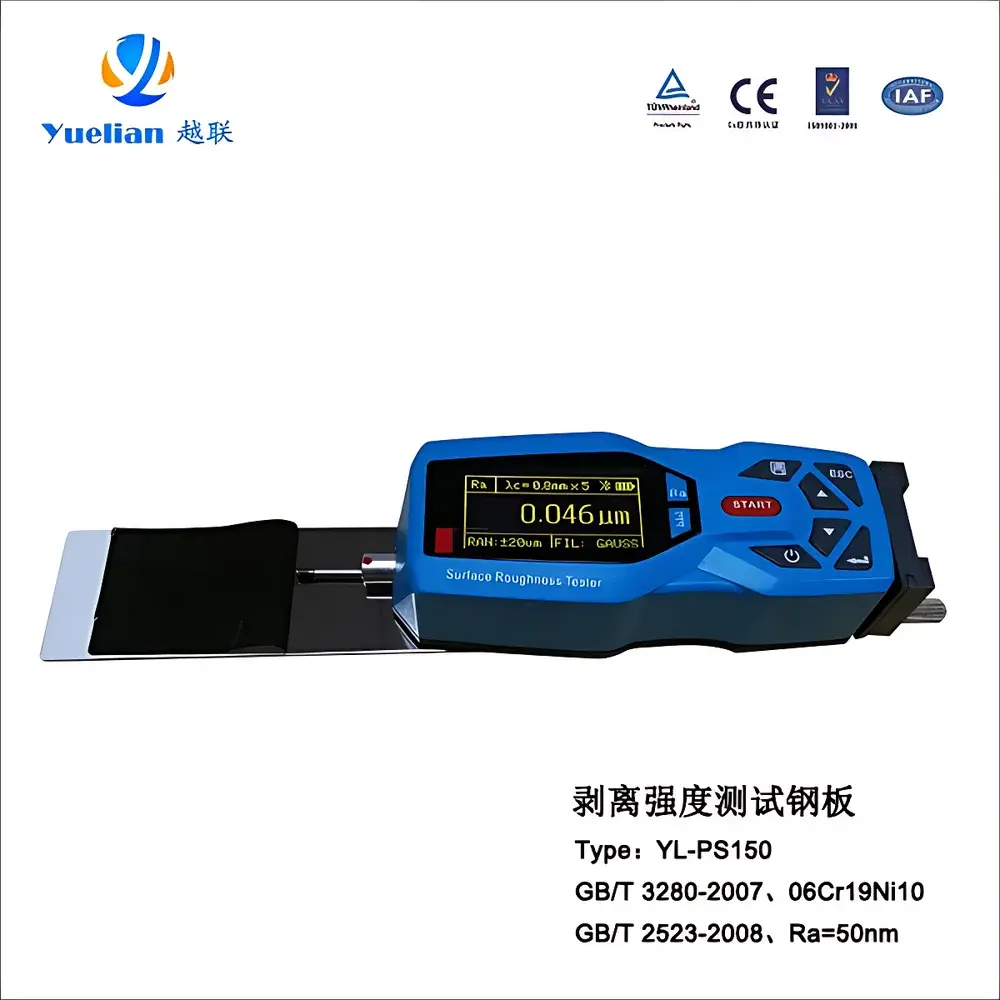
Yuelian YL-PS150 Standard Stainless Steel Test Plate for Adhesion Peel Strength Testing
| Brand | Yuelian |
|---|---|
| Origin | Guangdong, China |
| Manufacturer Type | Authorized Distributor |
| Country of Origin | China |
| Model | YL-PS150 |
| Material | 06Cr19Ni10 (AISI 304 equivalent) |
| Dimensions | 125 mm × 50 mm × 1.1 mm |
| Surface Finish | Annealed & Mirror-Polished |
| Surface Roughness (Ra) | 50 ± 25 nm per GB/T 2523–2008 |
| Compliance | GB/T 3280–2007 |
Overview
The Yuelian YL-PS150 Standard Stainless Steel Test Plate is a precision-engineered substrate designed exclusively for quantitative peel adhesion testing in accordance with international and national standards—including ASTM D3330, ISO 8510-2, and GB/T 7124–2008 for adhesive strength evaluation. Constructed from 06Cr19Ni10 austenitic stainless steel (chemically and mechanically equivalent to AISI 304), the plate undergoes full solution annealing followed by mechanical polishing and electropolishing to achieve a reproducible, mirror-bright surface. Its defined geometry—125 mm in length, 50 mm in width, and 1.1 mm in thickness—ensures dimensional compatibility with standard peel test fixtures used in universal testing machines (UTMs) and dedicated peel testers. The surface roughness is tightly controlled at 50 ± 25 nm (Ra), as verified per GB/T 2523–2008, enabling consistent interfacial contact area and minimizing variability introduced by topographical heterogeneity. Unlike generic or uncharacterized metal substrates, the YL-PS150 is not a consumable support but a metrologically traceable reference surface—its performance directly influences the validity of peel force normalization, interfacial energy calculation, and comparative pass/fail determinations in QC and R&D environments.
Key Features
- Material certified to GB/T 3280–2007 specification for 06Cr19Ni10 cold-rolled stainless steel, with full mill test reports available upon request
- Controlled surface topography: Ra = 50 ± 25 nm, measured via calibrated contact profilometry per GB/T 2523–2008
- Dimensional tolerances held to ±0.05 mm on length/width and ±0.02 mm on thickness for fixture repeatability
- Non-magnetic, corrosion-resistant, and thermally stable up to 400 °C—suitable for elevated-temperature peel protocols
- Supplied with individual serial number and certificate of conformance indicating batch-specific surface characterization data
- Pre-cleaned using solvent-based ultrasonic treatment (IPA + acetone) and sealed under inert atmosphere to prevent oxidation prior to first use
Sample Compatibility & Compliance
The YL-PS150 plate is validated for use with pressure-sensitive adhesives (PSAs), laminated films, medical tapes, automotive bonding foams, and coated packaging materials. Its passive oxide layer and low free-iron content minimize catalytic degradation of sensitive acrylic or rubber-based adhesives during conditioning and testing. The plate complies with requirements outlined in ISO 2409 (cross-cut adhesion), ASTM D1000 (electrical tape peel), and GB/T 2792–2014 (peel resistance of pressure-sensitive tapes). For regulated industries—including medical device manufacturing and pharmaceutical packaging—the plate supports GLP-compliant documentation workflows when paired with audit-trail-enabled peel testers. While the substrate itself does not require FDA clearance, its material composition conforms to USP Class VI biocompatibility guidelines for indirect food and medical contact applications.
Software & Data Management
Though the YL-PS150 is a passive physical standard (not an electronic instrument), its integration into digital QA systems is enabled through standardized metadata tagging. Each plate is assigned a unique identifier linked to a digital certificate containing surface roughness histograms, optical interferometry scans, and material certification documents. When used with compliant peel test systems (e.g., Instron 3340 series, Zwick Roell Z005), the plate’s serial number can be embedded into test method files and exported raw data headers, ensuring full traceability from measurement to report. This supports 21 CFR Part 11 compliance when combined with electronic lab notebooks (ELNs) that enforce user authentication, version control, and immutable audit logs for all peel test records.
Applications
- Quality control of PSA release liners and backing films in converting operations
- Development and validation of structural adhesives for EV battery module bonding
- Stability assessment of transdermal patch adhesion across humidity and temperature cycling
- Comparative peel performance evaluation of bioresorbable polymer coatings on metallic implants
- Calibration verification of peel test fixtures prior to ISO/IEC 17025 accredited testing
- Interlaboratory round-robin studies requiring cross-site substrate harmonization
FAQ
How often should the YL-PS150 plate be replaced?
Plate replacement frequency depends on usage intensity and cleaning protocol adherence. Under typical QC conditions (≤10 peel tests/day), replace every 30–50 tests—or immediately if visual inspection reveals scratches >0.5 µm depth, discoloration, or localized contamination resistant to IPA/acetone cleaning.
Can the plate be re-polished in-house?
No. Re-polishing alters the original Ra profile and compromises metrological integrity. Only factory-refurbished plates with full recertification are acceptable for standards-compliant testing.
Is surface roughness re-verified after cleaning?
Yes—each cleaned plate must undergo non-contact white-light interferometry before reuse. A deviation >±15 nm from baseline Ra invalidates subsequent peel data.
Does the plate meet ISO 15184 requirements for paint adhesion testing?
While dimensionally compatible, ISO 15184 specifies aluminum alloy substrates; the YL-PS150 is intended for adhesive peel—not coating adhesion—per ISO 2409 or ASTM D3359.
What documentation accompanies each shipment?
Each box includes a Certificate of Conformance listing batch number, surface roughness verification date, GB/T 3280–2007 compliance statement, and traceable calibration data for the profilometer used in Ra measurement.
Related Products



