
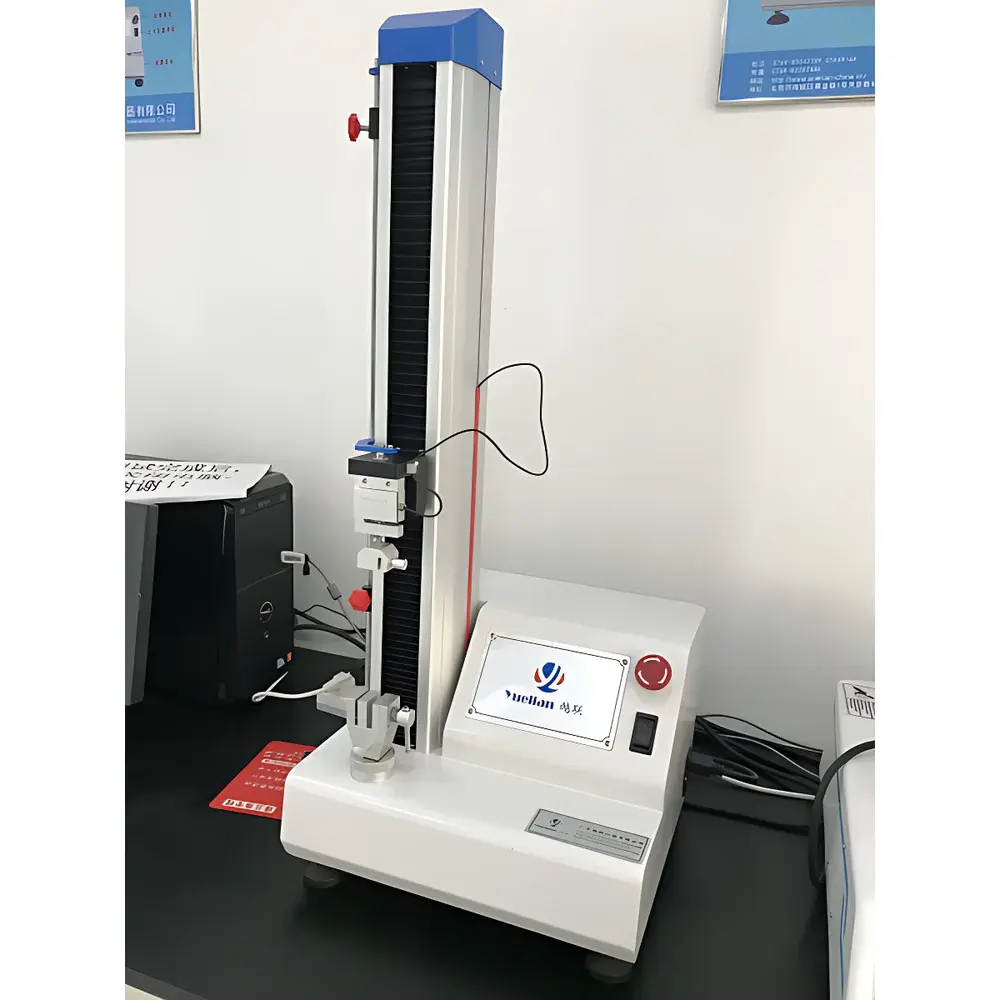
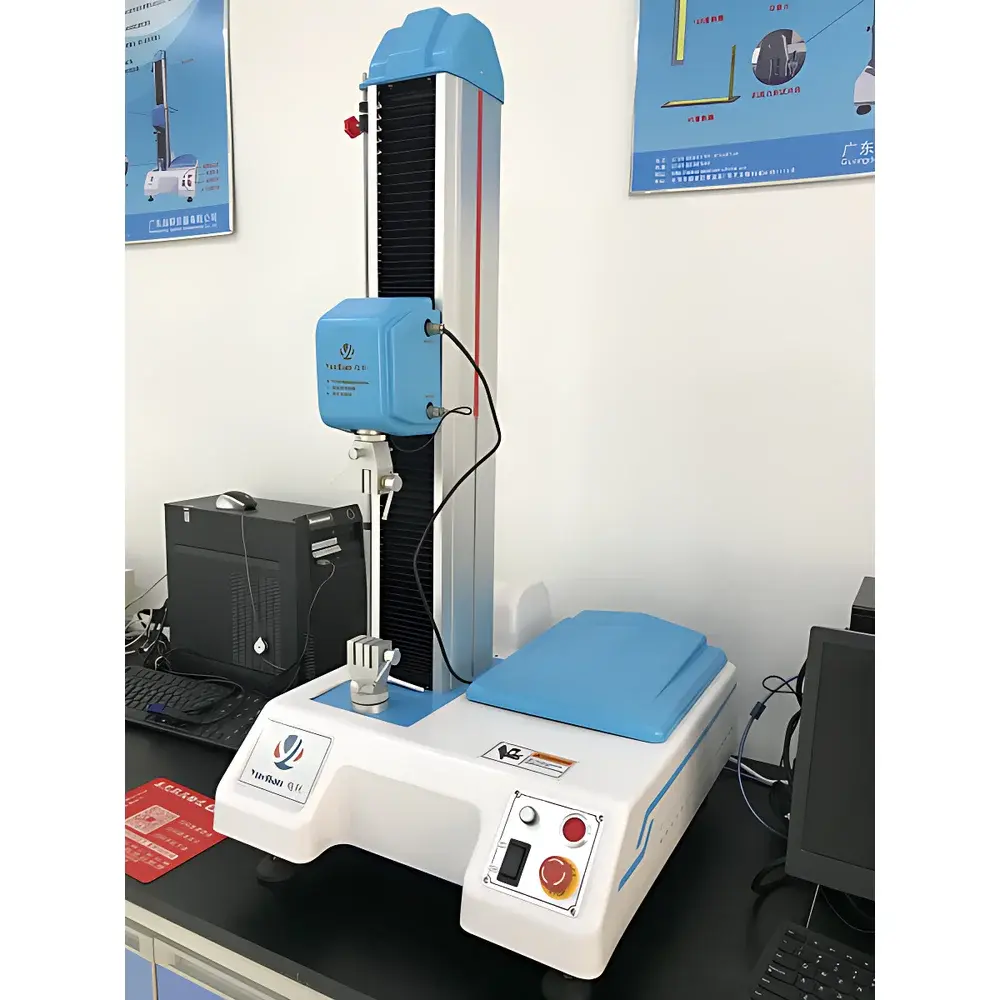
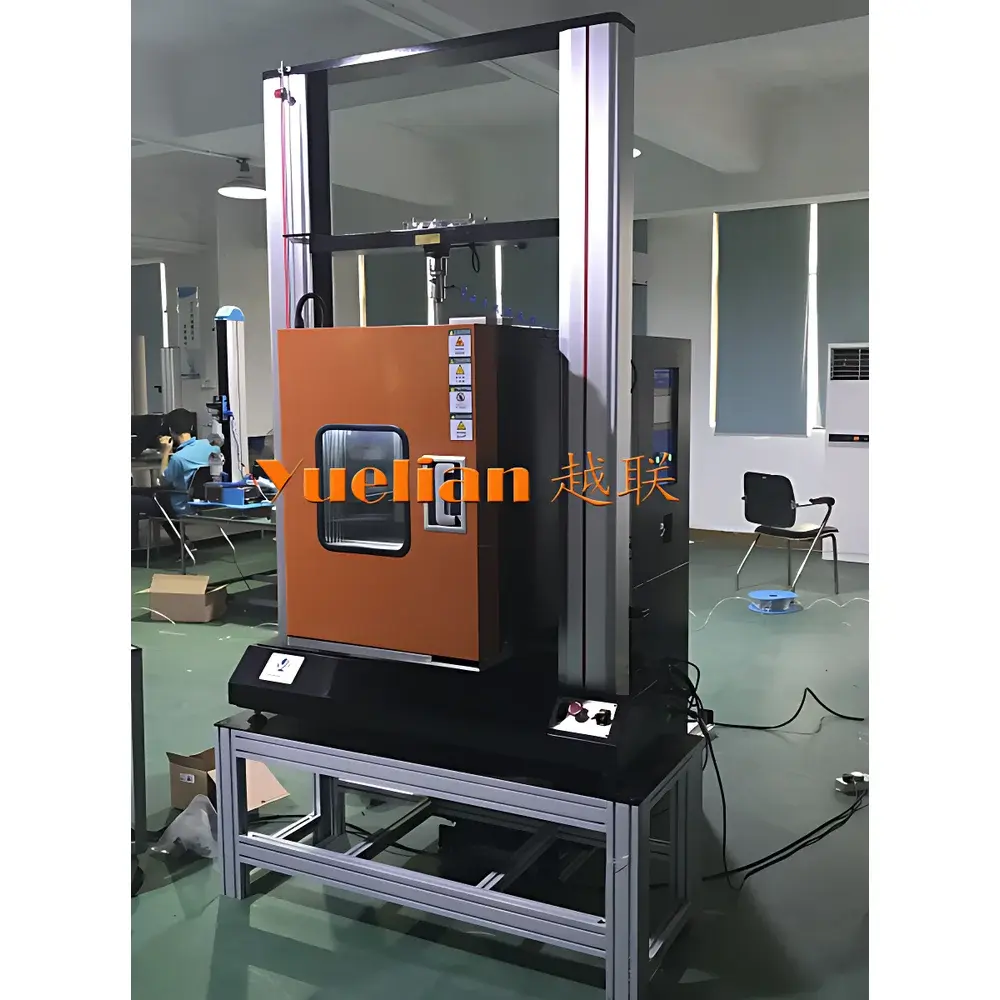
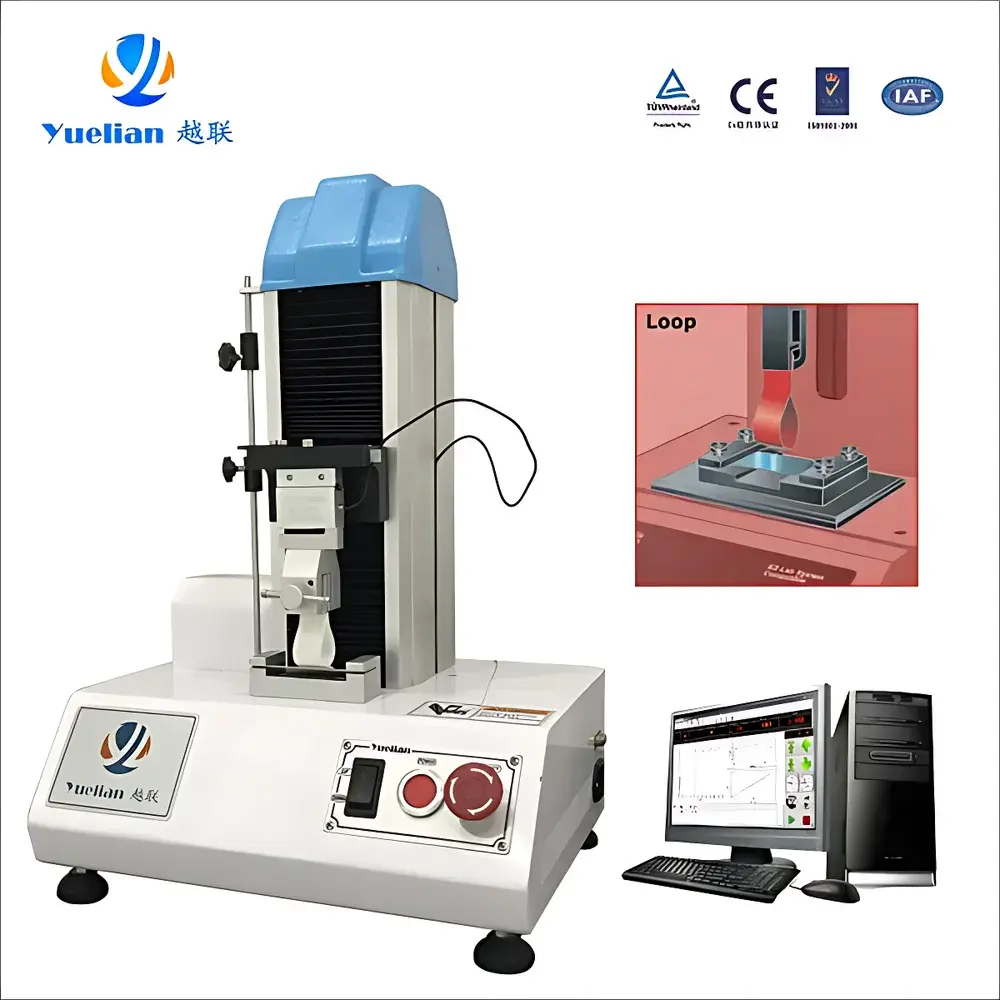
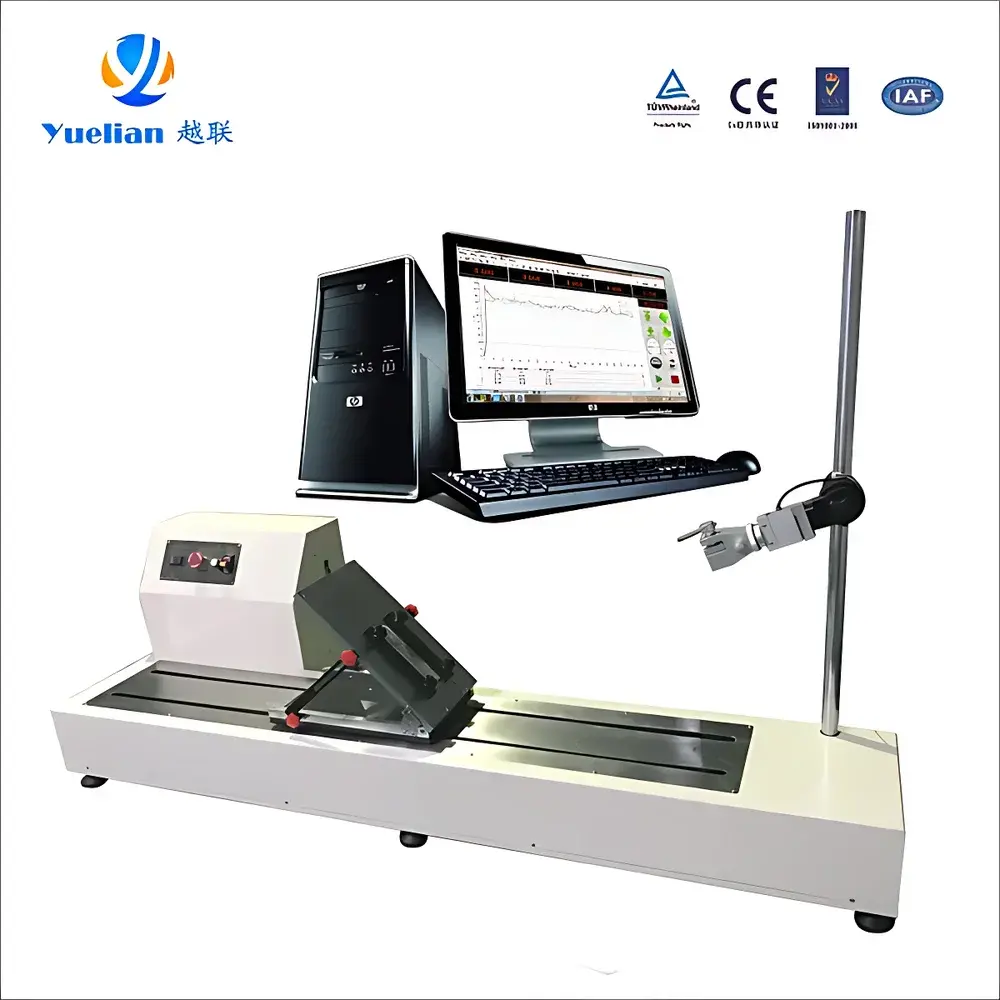
Yuelian YL-S95 Electronic Tensile Testing Machine for Thin Films
| Brand | Yuelian |
|---|---|
| Origin | Guangdong, China |
| Model | YL-S95 |
| Maximum Test Load | 1 kN |
| Load Measurement Range | 100% FS |
| Load Accuracy | ±0.5% |
| Test Stroke | 600 mm |
| Displacement Resolution | 0.01 mm |
| Force Resolution | 1/120,000 |
| Crosshead Speed Range | 0.5–600 mm/min |
| Power Supply | 220 V, 50/60 Hz, 10 A |
| Dimensions (W×D×H) | 400 × 300 × 920 mm or 400 × 300 × 1200 mm |
| Weight | ~28 kg |
| Motor Type | Stepper Motor |
| Transmission | Precision Ball Screw with Synchronous Belt Drive |
| Standard Interfaces | USB, RS-232 |
| Compliance | ASTM D882, ISO 527-3, GB/T 1040.3, GB/T 2792, GB/T 2790, GB/T 2791 |
Overview
The Yuelian YL-S95 Electronic Tensile Testing Machine is a precision-engineered universal testing system specifically optimized for mechanical characterization of thin films, foils, and flexible sheet materials. It operates on the principle of uniaxial tensile loading under controlled displacement or load rate, conforming to standardized test methodologies including ASTM D882 (Standard Test Method for Tensile Properties of Thin Plastic Sheeting) and ISO 527-3 (Plastics — Determination of Tensile Properties — Part 3: Test Conditions for Films and Sheets). The instrument employs a high-efficiency stepper motor coupled with a preloaded precision ball screw drive system, delivering consistent crosshead motion with minimal backlash and energy loss (<15% mechanical inefficiency). Its rigid frame architecture ensures high axial alignment stability—critical for eliminating bending moments during low-thickness specimen testing—and supports repeatable measurement of modulus, yield strength, ultimate tensile strength, elongation at break, and Poisson’s ratio across diverse polymeric, metallic, and composite substrates.
Key Features
- Modular dual-capacity load cell configuration supporting selectable ranges from 10 N to 1 kN, enabling high-resolution force measurement across ultra-thin films (e.g., PET, PE, BOPP) and thicker laminates without sensor recalibration.
- Real-time dual-channel display of load (N, kgf, lbf, MPa) and displacement (mm), with automatic unit conversion and programmable threshold-based stop conditions (overload, specimen rupture, upper/lower limit).
- Stepless speed control from 0.5 to 600 mm/min via PC interface or front-panel keypad; integrated quick-adjustment knobs for rapid vertical positioning of upper and lower grips.
- Quick-release grip interface compatible with pneumatic, wedge-action, roller, and custom-designed film clamps—including non-slip serrated jaws and low-clamp-pressure rubber-faced fixtures to prevent edge slippage or premature failure.
- Auto-return function upon test completion; emergency stop button compliant with IEC 60204-1; overload protection circuitry integrated into the servo driver module.
- USB and RS-232 ports for direct connection to Windows-based host systems; firmware supports plug-and-play enumeration without proprietary drivers.
Sample Compatibility & Compliance
The YL-S95 accommodates specimens up to 55 mm wide and 600 mm in effective travel length, making it suitable for standard ASTM D882 strips (15 mm × 150 mm), ISO 527-3 Type 1A dog-bone geometries, and custom-cut coupons. It meets essential regulatory requirements for quality control laboratories operating under GLP and GMP frameworks: data integrity is preserved through timestamped audit trails, user-access-level permissions, and electronic signature support in optional software packages. All force and displacement outputs are traceable to national metrological standards via factory calibration certificates (NIST-traceable load cells and encoder-based position feedback). The system complies with electromagnetic compatibility (EMC) directives per EN 61326-1 and safety standards per EN 61000-6-2.
Software & Data Management
The included Windows-compatible software provides full test sequence programming, real-time curve visualization (stress–strain, load–displacement), and post-test analysis tools including tangent/ secant modulus calculation, yield point detection (0.2% offset method), and statistical reporting (mean, SD, CV%, min/max) across batched specimens. Raw data exports to CSV, Excel, and PDF formats; XML schema support enables integration with LIMS platforms. Optional modules include 21 CFR Part 11-compliant electronic records with role-based access control, biometric login, and immutable audit logs for FDA-regulated environments. Calibration history, maintenance logs, and test method templates are stored locally with version-controlled backups.
Applications
- Quantitative evaluation of tensile strength and elongation in packaging films (e.g., food-grade LDPE, metallized PET, barrier-coated aluminum foil).
- Adhesion strength assessment of pressure-sensitive adhesives using 180° peel (ASTM D903) and T-peel (ASTM D1876) configurations.
- Mechanical screening of biomedical thin films (hydrogel membranes, drug-eluting polymer coatings) under hydrated or dry conditions.
- Quality assurance of battery separator films (e.g., PP/PE microporous membranes) for puncture resistance and dimensional stability under thermal stress.
- Validation of UV-cured acrylic coatings on flexible substrates via controlled delamination and shear testing modes.
FAQ
What is the minimum specimen thickness this machine can reliably test?
The YL-S95 is validated for specimens ≥12 µm thick when used with appropriate low-force load cells (e.g., 10–100 N range) and anti-slip film grips; thinner samples require environmental humidity control and vacuum-assisted gripping to minimize slippage artifacts.
Does the system support cyclic or creep testing protocols?
Yes—via optional software add-ons, users can define multi-step load-hold-displacement sequences, including constant-load creep tests (per ASTM D2990) and strain-controlled fatigue cycles with programmable dwell times and reversal limits.
Can test methods be saved and recalled as reusable templates?
Yes—up to 100 method profiles can be stored onboard or within the host PC, each containing predefined parameters such as speed, gauge length, pre-load, break sensitivity, and output formatting rules.
Is third-party calibration certification available?
Factory calibration includes NIST-traceable documentation; accredited third-party calibration (ISO/IEC 17025) is available upon request with turnaround time of 5 business days.
What maintenance intervals are recommended for long-term accuracy?
Ball screw lubrication every 6 months; annual verification of encoder linearity and load cell zero drift; biannual inspection of grip jaw wear and alignment using included alignment gauge kit.



