
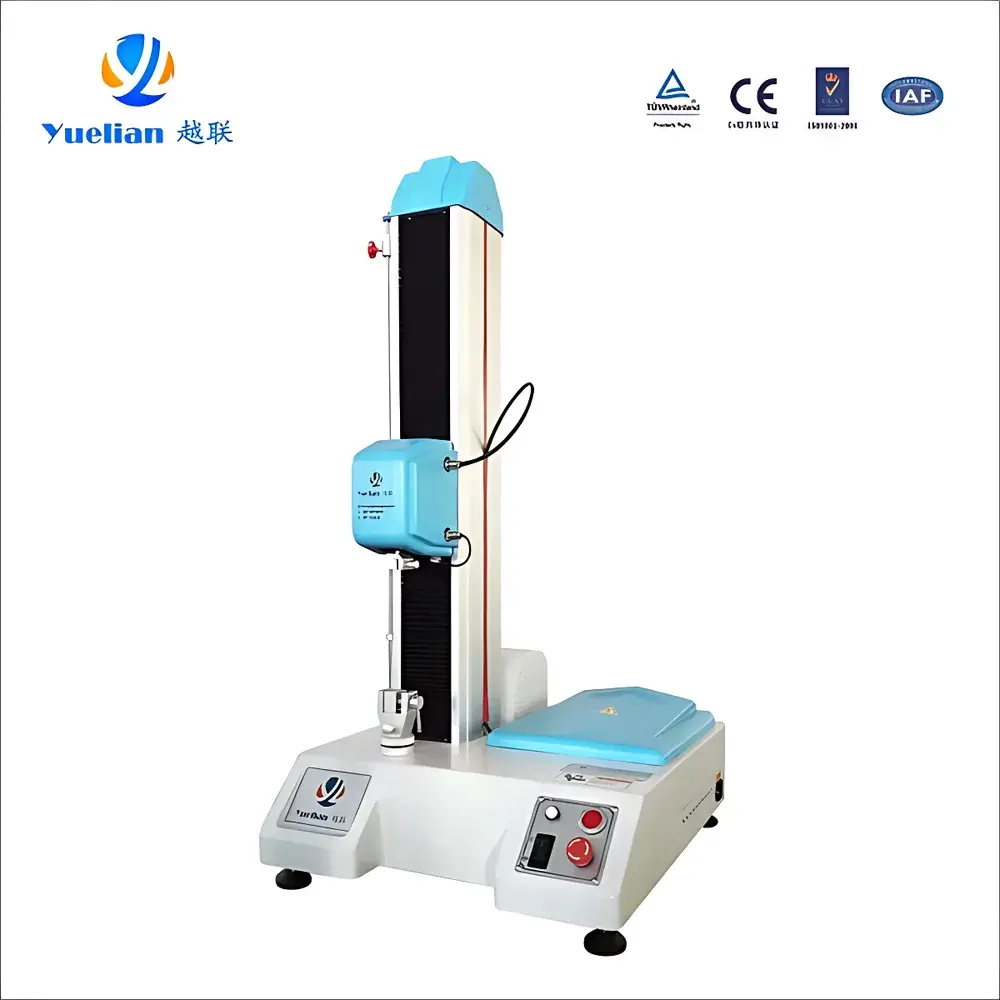
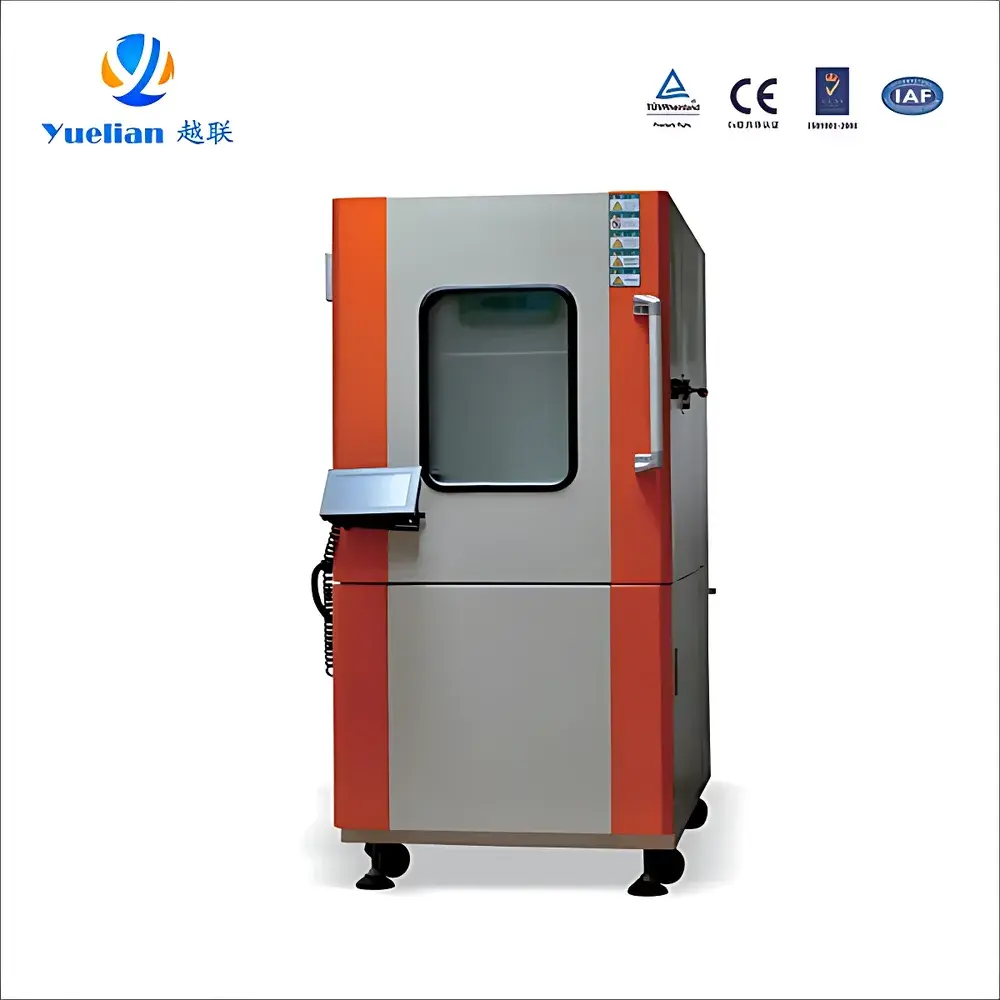
Yuelian YL-S95 Puncture Tester for Thin Films
| Brand | Yuelian |
|---|---|
| Model | YL-S95 |
| Type | Electronic Universal Testing Machine |
| Load Capacity Options | 10 N, 20 N, 50 N, 100 N, 200 N, 500 N, 1 kN (dual-capacity configuration optional) |
| Force Resolution | 1/500,000 full scale |
| Force Accuracy | ±0.3% of reading |
| Displacement Resolution | 1/500,000 full stroke |
| Test Speed Range | 0.1–500 mm/min (computer-controlled) |
| Maximum Travel | 500 mm / 800 mm |
| Test Width | 110 mm |
| Drive System | Stepper motor + precision ball screw |
| Transmission Efficiency | >85% |
| Power Supply | 220 V, 50/60 Hz, 10 A |
| Power Consumption | 180 W |
| Dimensions (W×D×H) | 40×37×92 cm or 40×37×120 cm |
| Weight | ~28 kg / ~35 kg |
| Compliance Standards | GB/T 2792, ASTM D3330, GB/T 12914–1991, GB 13022–91, GB/T 1040–92, GB 2792–81, GB/T 14344–9, GB/T 2191–95, QB/T 2171–95, GB/T 10003–2008 |
| Interface | USB & RS-232 |
| Data Output | Real-time force/displacement display, printer-compatible report generation, PC-based analysis and archival |
Overview
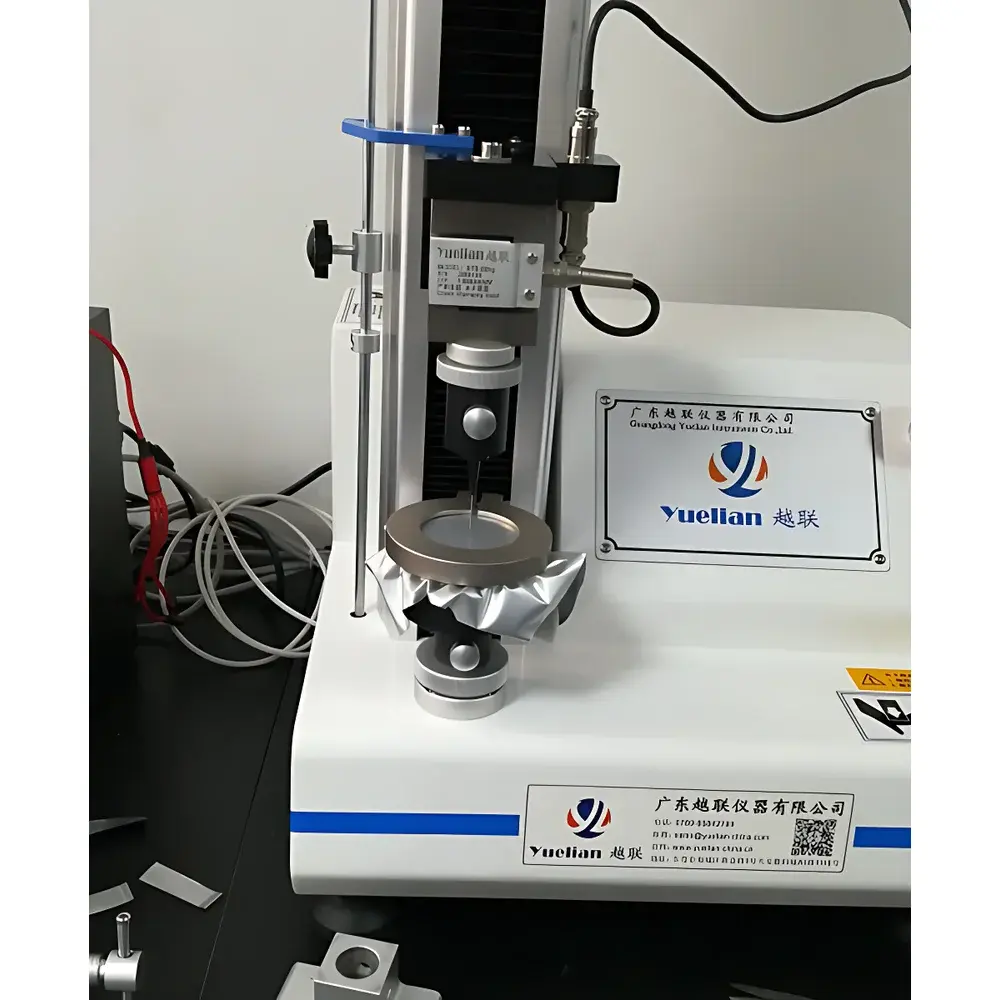
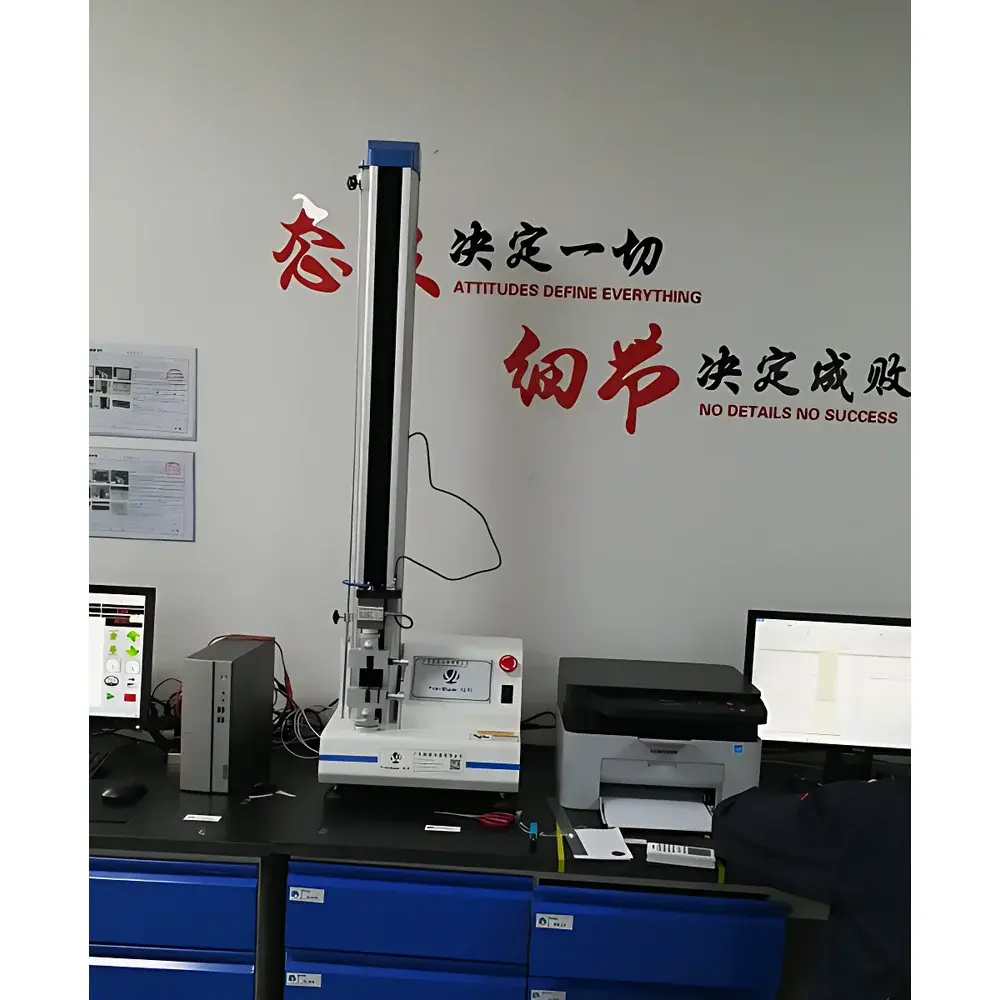
The Yuelian YL-S95 Puncture Tester for Thin Films is an electronically actuated universal testing machine engineered for high-reproducibility mechanical characterization of thin, flexible materials under controlled quasi-static loading conditions. Designed specifically to evaluate puncture resistance — a critical parameter for packaging films, medical barrier layers, protective laminates, and functional polymer coatings — the system operates on the principle of axial force application through a standardized probe (e.g., hemispherical or flat-ended stylus) at precisely regulated displacement rates. Its modular architecture supports both standalone operation via intuitive firmware controls and synchronized data acquisition in compliance with regulatory-grade test protocols. The instrument meets the fundamental mechanical measurement requirements defined in ISO 8513, ASTM F1306 (for slow-rate puncture), and EN 13732 (plastic film puncture resistance), making it suitable for QC laboratories operating under GLP or pre-GMP frameworks.
Key Features
- High-precision stepper motor drive coupled with a ground-accuracy ball screw transmission system ensures minimal hysteresis and thermal drift across extended test cycles.
- Dual-mode operation: fully autonomous single-button testing with onboard digital display, or real-time PC integration via USB/RS-232 for synchronized force–displacement curve capture.
- Adjustable crosshead travel (500 mm or 800 mm variants) accommodates diverse specimen geometries and fixture configurations without mechanical recalibration.
- Quick-release modular fixture interface enables rapid interchange of puncture probes, clamping jaws, peel fixtures, and tensile grips — supporting multi-test methodology within one platform.
- Real-time dual-channel display of load (N, kgf, lbf, MPa) and displacement (mm, µm) with automatic unit conversion and programmable upper/lower limit triggers.
- Comprehensive safety logic includes overload cutoff, emergency stop activation, specimen rupture detection, and auto-return functionality post-test.
- Configurable hold tests (constant-load or constant-displacement modes) for creep or stress-relaxation evaluation of viscoelastic thin films.
Sample Compatibility & Compliance
The YL-S95 accepts specimens ranging from 10 µm-thick polyethylene foils to 500 µm composite laminates, including but not limited to BOPP, PET, aluminum-laminated structures, hydrogel sheets, pharmaceutical blister packs, and textile-reinforced elastomers. Fixture adaptability extends its utility to ASTM D5748 (puncture resistance of geotextiles), ISO 6383-2 (plastic film tear propagation), and GB/T 10004 (packaging composite film performance). All software-generated reports include audit-ready metadata: operator ID, timestamp, environmental ambient log (optional external sensor input), calibration certificate reference, and raw data traceability — satisfying documentation prerequisites under FDA 21 CFR Part 11 when paired with validated software modules.
Software & Data Management
The included Windows-compatible software provides ISO/IEC 17025-aligned data handling: automated curve fitting (linear, polynomial, exponential), peak force identification, puncture energy integration (area under force–displacement curve), and statistical batch reporting (mean, SD, CV%, pass/fail flagging against user-defined thresholds). Export formats include CSV, PDF, and XLSX; all datasets retain embedded calibration coefficients and firmware version stamps. Optional GxP-compliant add-ons support electronic signatures, role-based access control, and 21 CFR Part 11 audit trails — enabling deployment in regulated pharmaceutical packaging validation labs.
Applications
- Quantification of seal integrity failure thresholds in thermoformed medical trays.
- Evaluation of puncture resistance degradation after accelerated aging (e.g., UV exposure, humidity cycling).
- Comparative assessment of adhesive layer cohesion versus substrate adhesion in multilayer pouches.
- Validation of sterilization-induced embrittlement in Tyvek®-based barrier materials.
- Quality gate testing for lithium-ion battery separator films (mechanical robustness prior to cell assembly).
- Supporting R&D workflows for bioresorbable polymer films used in wound dressings and drug-eluting membranes.
FAQ
What probe geometries are supported for puncture testing?
Standard configurations include 1.0 mm radius hemispherical tips per ASTM F1306 and flat-ended 1.6 mm diameter plungers per ISO 8513; custom probes can be integrated via M6 threaded mounting.
Is the system compatible with third-party LIMS or ELN platforms?
Yes — raw ASCII data streams and structured XML exports enable direct ingestion into LabVantage, Thermo Fisher SampleManager, and Benchling via configurable API endpoints.
Does the YL-S95 meet ISO/IEC 17025 calibration traceability requirements?
When calibrated using NIST-traceable deadweight standards and documented per ISO/IEC 17025 Annex A.2, the system satisfies metrological validity for accredited testing laboratories.
Can the instrument perform simultaneous multi-point puncture mapping?
Not natively — the YL-S95 performs single-axis, single-location puncture events; automated XY-stage integration requires external motion controller coordination and is available as a custom OEM solution.
What is the recommended maintenance interval for the ball screw and drive train?
Lubrication and backlash verification every 500 operational hours or annually, whichever occurs first; full metrological recalibration advised biannually or after any mechanical impact event.



