
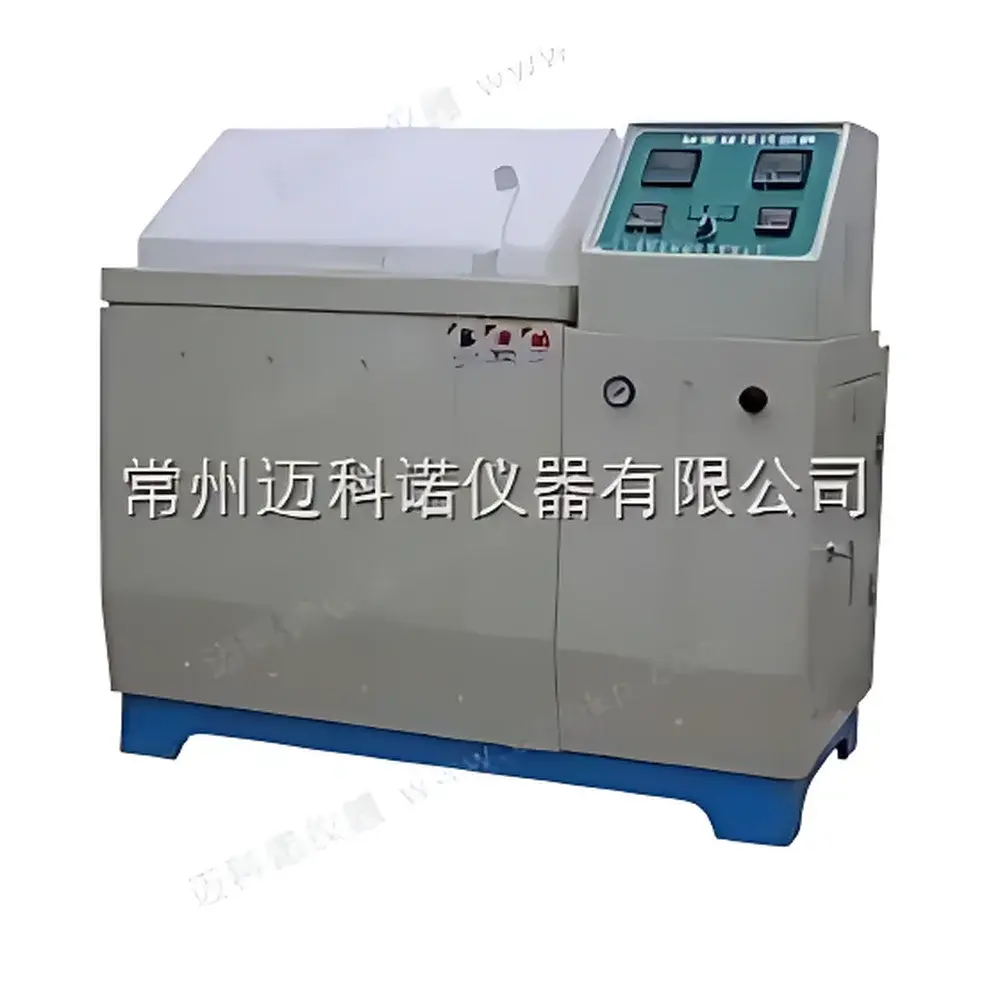
YWX Q Series Salt Spray Test Chamber
| Origin | Zhejiang, China |
|---|---|
| Manufacturer Type | Distributor |
| Origin Category | Domestic |
| Model | Q |
| Pricing | Upon Request |
Overview
The YWX Q Series Salt Spray Test Chamber is an engineered environmental test system designed to replicate aggressive marine atmospheric conditions for accelerated corrosion assessment of metallic components, coated surfaces, and protective finishes. It operates on the principle of continuous or cyclic nebulization of a standardized sodium chloride (NaCl) solution—atomized via compressed air through precision quartz nozzles—into a thermally controlled test chamber. This process generates a stable, uniform salt fog environment in accordance with internationally recognized corrosion testing protocols. The chamber maintains precise thermal equilibrium between the test chamber and saturated air jacket, ensuring strict adherence to temperature tolerances required by ASTM B117, ISO 9227, IEC 60068-2-11, and GB/T 2423.17. As one of the core equipment units within the “Three-Defense” (humidity-heat, salt fog, mold) environmental simulation suite, it supports reliability validation across aerospace, defense electronics, automotive OEM supply chains, and industrial coating R&D laboratories.
Key Features
- Corrosion-resistant construction: Inner and outer chamber walls fabricated from imported high-purity PVC rigid sheet—exhibiting exceptional resistance to HCl, NaCl, and acidic aerosols, with long-term dimensional stability and UV resistance.
- Hermetic water-sealed design: Leak-tight chamber lid made of transparent, optical-grade PVC for real-time visual monitoring of specimen condition and spray distribution without compromising test integrity.
- Crystal-free quartz nozzle assembly: Precision-machined fused silica nozzles eliminate salt crystallization-induced clogging, ensuring consistent droplet size distribution (typically <10 µm Sauter mean diameter) and uniform fog deposition across the test area.
- Tower-type spray system: Optimized multi-point atomization architecture enables adjustable spray angle, controllable settling rate (1–2 mL/80 cm²·h), and programmable intermittent or continuous operation modes.
- Dual-zone PID temperature control: Independent regulation of chamber temperature (±0.1 °C accuracy) and saturated air jacket temperature, supporting both standard salt spray (35 ±1 °C) and elevated-accelerated testing (50 ±1 °C).
- Integrated safety architecture: Triple-redundant protection including low-water cutoff, overtemperature shutoff, phase-loss detection, and pneumatic gas-strut-assisted lid actuation for ergonomic access and operator safety.
Sample Compatibility & Compliance
The YWX Q Series accommodates specimens up to 2000 L total chamber volume (model-dependent), with flat or three-dimensional geometries mounted on non-corrosive PVC or polypropylene racks. Compatible substrates include ferrous and non-ferrous metals (e.g., steel, aluminum, zinc alloys), electroplated layers (Cr, Ni, Zn-Ni), organic coatings (epoxy, polyurethane), conversion coatings (chromate, phosphate), and temporary rust inhibitors. All models comply with structural and performance requirements defined in GB/T 10587 (Technical Specifications for Salt Spray Test Chambers), and are validated against the operational criteria of ISO 9227:2017 Annex A (fog collection uniformity), ASTM B117 Section 7 (chamber calibration), and IEC 60068-2-11 Clause 4 (test severity classification). Optional configuration supports acetic acid salt spray (AASS) and copper-accelerated acetic acid salt spray (CASS) per ISO 9227 Annexes B and C.
Software & Data Management
While the base model utilizes analog/digital panel instrumentation with manual parameter setting, optional digital controllers support RS-485 Modbus RTU communication for integration into centralized lab management systems. Data logging includes time-stamped records of chamber temperature, saturation jacket temperature, spray duration cycles, and fault event history. When configured with compliant firmware (optional), the system meets audit trail and electronic signature requirements under FDA 21 CFR Part 11 for regulated environments—supporting GLP/GMP-aligned test documentation, user access levels, and change control logs. Calibration certificates traceable to NIM (National Institute of Metrology, China) are available upon request.
Applications
- Accelerated corrosion screening of automotive body panels, fasteners, and under-hood components per ISO 11997 and VW PV1210.
- Qualification testing of marine-grade stainless steels and aluminum alloys used in offshore platforms and shipboard systems.
- Evaluation of adhesion durability and blistering resistance in aerospace primer/topcoat systems (MIL-PRF-23377, AMS-C-83286).
- Verification of passivation efficacy on medical device stainless steel parts (ASTM A967, ISO 10993-15).
- Comparative lifetime modeling of galvanized and aluminized steel substrates in coastal infrastructure applications.
- Process validation of electrochemical surface treatments—including anodizing, electrophoretic deposition (EDP), and silane-based pretreatments.
FAQ
What standards does the YWX Q Series fully comply with?
It conforms to ISO 9227:2017, ASTM B117–23, IEC 60068-2-11, GB/T 2423.17–2022, and GB/T 10587–2006 for design, calibration, and operational performance.
Can this chamber perform CASS or AASS testing?
Yes—when equipped with optional acid-resistant internal components and calibrated pH monitoring, it supports acetic acid salt spray (AASS) and copper-accelerated acetic acid salt spray (CASS) per ISO 9227 Annexes B and C.
Is remote monitoring or data export supported?
Standard models feature local display only; however, optional digital controllers enable RS-485 output for SCADA integration and CSV-formatted data export via USB or serial interface.
What maintenance intervals are recommended for optimal performance?
Quartz nozzles should be inspected weekly and cleaned ultrasonically every 100 hours of operation; PVC chamber surfaces require monthly neutral-pH wipe-down; compressed air filters must be replaced quarterly per ISO 8573-1 Class 4 requirements.
Does the system include calibration documentation?
Factory calibration reports covering temperature uniformity, fog deposition rate, and chamber seal integrity are provided; NIM-traceable certification is available as an add-on service.
Related Products



