
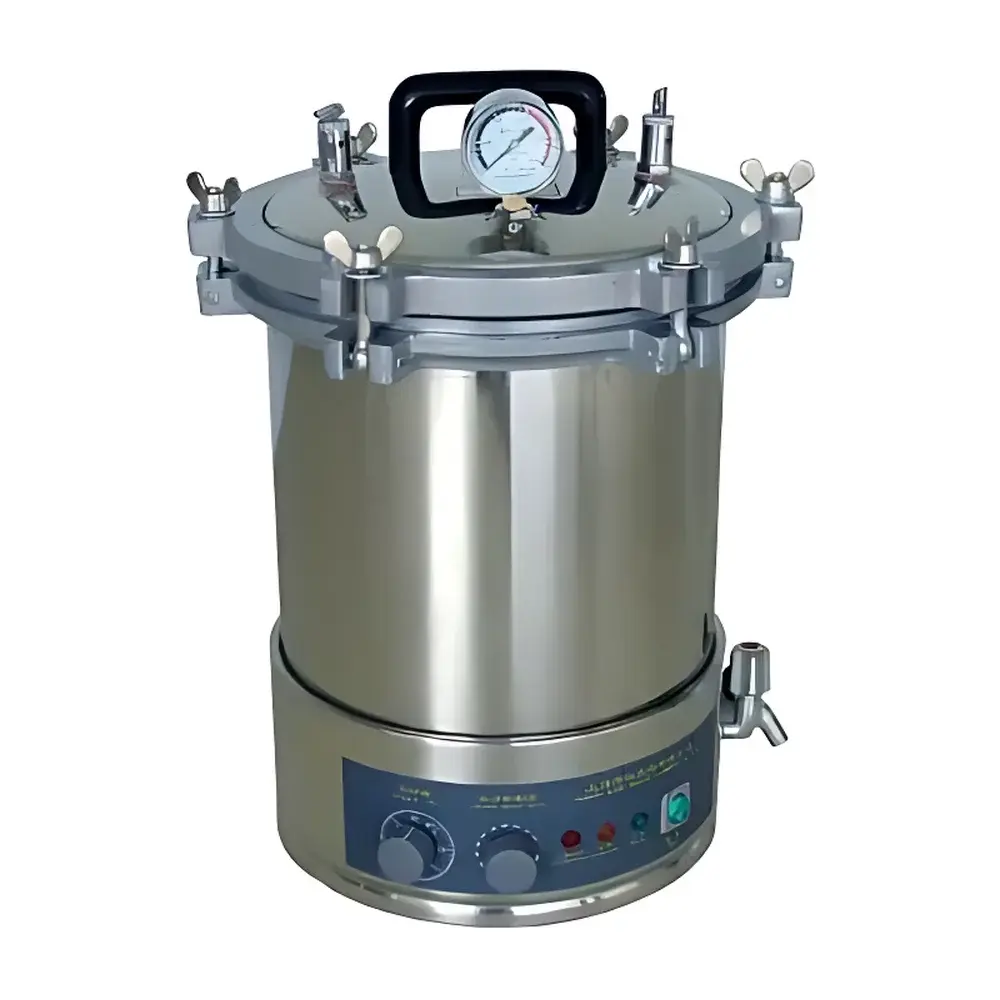
YXQ-LS-18SI Automatic Portable High-Pressure Steam Sterilizer
| Origin | Shanghai, China |
|---|---|
| Manufacturer Type | Authorized Distributor |
| Origin Category | Domestic (PRC) |
| Model | YXQ-LS-18SI |
| Quotation | Available Upon Request |
| Capacity | 18 L |
| Rated Operating Temperature | 126 °C |
| Rated Working Pressure | 0.145 MPa |
| Power Rating | 2 kW |
| Voltage/Frequency | 220 V ±10% / 50 Hz ±2% |
| Dimensions (Ø × H) | 390 mm × 530 mm |
| Sterilization Timer Range | 0–60 min |
| Heating Method | Electric Resistance |
| Chamber & Housing Material | SUS304 Stainless Steel |
| Safety Pressure Relief Range | 0.145–0.165 MPa |
| Adjustable Temperature Control | 110–127 °C |
| Sealing System | Self-Inflating Silicone Gasket |
| Pressure Gauge | Dual-Scale Class II Bourdon Tube Gauge |
| Low-Water Protection | Integrated Level Sensor with Heater Cut-Off |
Overview
The YXQ-LS-18SI Automatic Portable High-Pressure Steam Sterilizer is a compact, benchtop-class autoclave engineered for reliable saturated steam sterilization under controlled pressure and temperature conditions. Based on the fundamental principle of moist heat sterilization—where microbial inactivation is achieved through protein denaturation and nucleic acid hydrolysis under pressurized saturated steam—the unit operates at a validated nominal setpoint of 126 °C at 0.145 MPa (equivalent to ~21 psi gauge pressure), conforming to internationally recognized thermal sterilization kinetics for routine laboratory decontamination. Its 18-liter chamber volume supports batch processing of standard laboratory loads including wrapped surgical instruments, cotton gauze, glassware, reusable plasticware, liquid media (in vented containers), and microbiological culture substrates. Designed for low-infrastructure environments, it requires only a standard single-phase 220 V AC supply and does not rely on external steam generators or compressed air sources.
Key Features
- Automated cycle control with integrated microprocessor logic for repeatable start-to-finish operation—including pre-vacuum phase (if applicable), heating, sterilization hold, exhaust, and drying stages.
- SUS304 stainless steel construction for both inner chamber and outer casing ensures long-term resistance to chloride-induced pitting, acidic condensate corrosion, and alkaline cleaning agents commonly used in lab maintenance protocols.
- Self-inflating silicone sealing gasket maintains consistent radial compression across the lid interface, eliminating manual torque adjustment and reducing seal fatigue over repeated thermal cycling.
- Dual-scale Class II pressure gauge provides simultaneous readout in MPa and psi, calibrated per ISO 5171:2019 for mechanical pressure instrumentation used in sterilization equipment.
- Adjustable temperature regulation (110–127 °C) and timer (0–60 min) enable protocol customization for heat-labile materials, spore validation studies, or extended dwell times required by specific institutional SOPs.
- Overpressure safety release valve activates within 0.145–0.165 MPa range, compliant with GB 8599–2008 (Chinese national standard for sterilizers) and aligned with ASME BPVC Section VIII Div. 1 requirements for pressure vessel relief devices.
- Low-water level detection circuit automatically de-energizes the heating elements when water volume falls below minimum operational threshold—preventing dry-heating damage and enhancing user safety.
Sample Compatibility & Compliance
The YXQ-LS-18SI accommodates a broad spectrum of sterilizable load types: porous loads (e.g., wrapped instrument packs, textile drapes), non-porous items (e.g., glass Petri dishes, metal forceps), and liquids (e.g., nutrient broths, saline solutions) when processed using gravity-displacement cycles with appropriate container venting. It supports validation according to ISO 17665-1:2019 (sterilization of health care products — Moist heat) and is routinely employed in GLP-compliant laboratories for preparation of sterile reagents and consumables. While not certified to EN 285 or FDA 510(k) out-of-the-box, its design basis aligns with core functional safety principles referenced in IEC 61010-1 (safety requirements for electrical equipment for measurement, control, and laboratory use). Documentation packages—including calibration records, material certifications, and factory test reports—are available upon request to support internal audit readiness.
Software & Data Management
This model operates via embedded hardware-based logic without proprietary software dependencies. All operational parameters—including set temperature, exposure duration, and real-time pressure/temperature status—are displayed on an analog-digital hybrid interface. Cycle logs are not stored internally; however, external data acquisition is supported via optional analog output (0–5 V or 4–20 mA) for connection to laboratory building management systems (BMS) or standalone chart recorders. For facilities requiring electronic record retention under 21 CFR Part 11, integration with third-party validated data loggers (e.g., Omega OM-CP-HITEMP140) is recommended and technically feasible using the unit’s auxiliary sensor terminals.
Applications
- Routine sterilization of reusable labware in teaching laboratories, field clinics, and small-scale research facilities lacking centralized autoclave infrastructure.
- Preparation of sterile culture media and buffers in microbiology, molecular biology, and tissue culture workflows.
- Decontamination of biohazardous waste prior to disposal in BSL-1 and BSL-2 settings.
- Validation testing of sterilization parameters during method transfer or equipment qualification (IQ/OQ).
- Agricultural extension services for seed treatment, soil extract sterilization, and plant tissue culture media preparation.
FAQ
What is the maximum recommended load weight for this sterilizer?
The unit is rated for volumetric capacity (18 L), not mass. Users should ensure load configuration allows unimpeded steam penetration—typically limiting dense instrument packs to ≤70% chamber volume.
Can liquid media be sterilized without boil-over?
Yes, provided containers are loosely capped or fitted with vented closures, and the sterilization cycle includes a slow exhaust phase to minimize thermal shock and pressure differentials.
Is third-party calibration support available?
Yes—certified thermocouple probes and pressure transducers meeting ISO/IEC 17025 traceability standards can be deployed during routine performance qualification.
Does the unit meet international export compliance requirements?
It complies with CE-marking essential requirements (EMC Directive 2014/30/EU and Low Voltage Directive 2014/35/EU) when supplied with appropriate documentation and labeling per destination market regulations.
How often should the sealing gasket be replaced?
Under typical usage (2–4 cycles/day), replacement is advised every 12–18 months or immediately upon visible cracking, flattening, or loss of rebound elasticity.



