
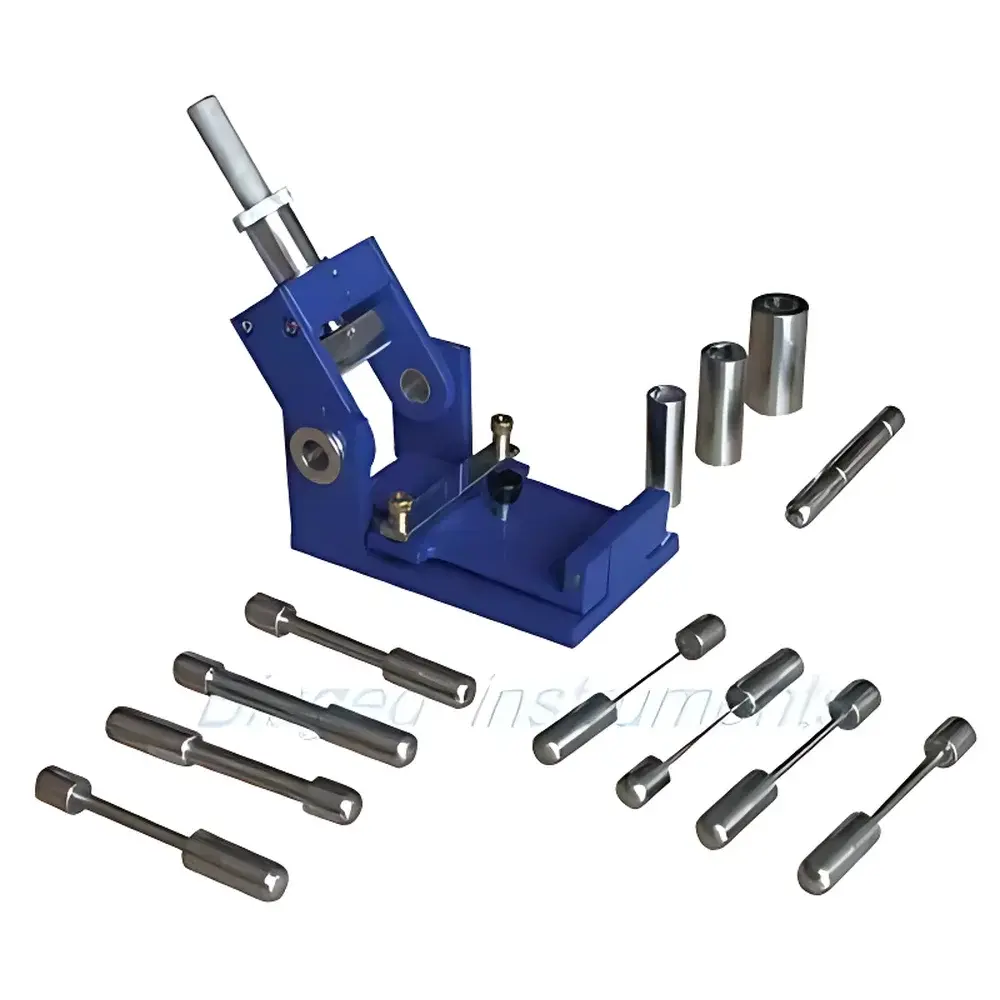
YZQ-II Cylindrical Bend Tester
| Origin | Shanghai, China |
|---|---|
| Manufacturer Type | Authorized Distributor |
| Product Origin | Domestic (China) |
| Model | YZQ-II |
| Pricing | Available Upon Request |
| Dimensions | 200 × 100 × 130 mm |
| Mandrel Diameters | 2, 3, 4, 5, 6, 8, 10, 12, 16, 18, 20, 25, 32 mm |
| Substrate Thickness Limit | ≤ 1.0 mm (polished steel or tinplate) |
Overview
The YZQ-II Cylindrical Bend Tester is a precision mechanical testing instrument engineered for the standardized evaluation of coating flexibility and adhesion integrity under controlled bending deformation. It operates on the principle of cylindrical mandrel bending—where a coated test panel is clamped and forcibly bent 180° around a fixed-diameter cylindrical mandrel. The resulting stress induces micro-cracking, delamination, or cohesive failure in the coating layer; visual assessment of these defects determines the minimum mandrel diameter at which the coating remains intact without cracking or flaking. This method is universally recognized for its simplicity, repeatability, and direct correlation to real-world performance of protective and decorative coatings on metallic substrates. Designed in alignment with international coating qualification protocols, the YZQ-II supports routine quality control in paint, ink, lacquer, and surface treatment laboratories where compliance with ASTM D522 (Standard Test Methods for Mandrel Bend Test of Attached Organic Coatings), ISO 1519:2002 (Paints and varnishes — Bend test (cylindrical mandrel)), GB/T 6742–1986 (Chinese national standard for coating bend resistance), and DIN 53152 (Bend test for organic coatings on metal substrates) is mandatory.
Key Features
- Modular mandrel set included: 13 precision-ground hardened steel mandrels (2–32 mm diameters, in 1 mm and 2 mm increments), each laser-etched with nominal size and traceable calibration markings.
- Robust cast-aluminum base with integrated T-slot mounting system for secure panel fixation and repeatable positioning.
- Ergonomic lever-actuated bending mechanism delivering consistent 180° angular displacement without slippage or over-bending.
- Compact footprint (200 × 100 × 130 mm) optimized for benchtop integration in QC labs with space constraints.
- Compliance-ready design: All mechanical tolerances and operational procedures adhere to the dimensional and procedural requirements specified in ASTM D522 Method A (direct bend) and ISO 1519 Annex A.
Sample Compatibility & Compliance
The YZQ-II accommodates rigid flat substrates up to 1.0 mm thickness—including polished cold-rolled steel panels and electrolytic tin-coated steel (ETP) plates—per ISO 1519 and ASTM D522 specifications. Substrate dimensions must be sufficient to span the mandrel support arms (minimum 70 mm width × 120 mm length recommended). The instrument does not support flexible films, plastics, or non-metallic substrates unless explicitly validated per internal method transfer protocols. All test reports generated using this device may be referenced in GLP-compliant documentation when paired with defined SOPs, operator training records, and mandrel calibration logs. While the YZQ-II itself is not electronically certified, its mechanical conformity enables full traceability to ISO/IEC 17025-accredited testing environments when used within documented analytical workflows.
Software & Data Management
The YZQ-II is a manually operated mechanical tester and does not incorporate embedded electronics, firmware, or digital interfaces. Consequently, it requires no software installation, driver configuration, or data export functionality. Test outcomes are recorded manually in laboratory notebooks or LIMS-integrated spreadsheets following predefined pass/fail criteria (e.g., “no visible cracks under 10× magnification after bending over 4 mm mandrel”). For laboratories subject to FDA 21 CFR Part 11 or EU Annex 11 requirements, manual entry must be supported by dual-signature verification, dated annotations, and retention of original test panels for audit review. Optional accessories—including calibrated mandrel certification certificates (NIST-traceable upon request) and standardized evaluation charts aligned with ISO 1519 grading scales—are available to strengthen method validation packages.
Applications
- Quality assurance of coil-coated steel and aluminum used in architectural cladding and appliance manufacturing.
- R&D screening of novel resin systems (e.g., acrylic, epoxy, polyester hybrids) for improved low-temperature flexibility.
- Batch release testing for automotive OEM primer-surfacer systems prior to electrocoat application.
- Supplier qualification audits requiring third-party verification of coating ductility claims.
- Educational use in polymer science and materials engineering curricula to demonstrate stress–strain behavior at coating–substrate interfaces.
FAQ
Does the YZQ-II comply with current ASTM D522–2023?
Yes—the mechanical geometry, mandrel tolerances, and bending procedure fully satisfy ASTM D522–2023 Method A for attached organic coatings on metallic substrates.
Can I use non-standard mandrel diameters?
No—only the supplied 13 mandrels (2–32 mm) are dimensionally certified and aligned with ISO 1519 grading intervals. Custom mandrels invalidate compliance with cited standards.
Is calibration required before each test?
Mandrel diameter verification is recommended quarterly or after impact exposure; calibration certificates are provided with initial shipment and may be renewed through authorized service centers.
What substrate preparation is required?
Panels must be cleaned per ASTM D2651, dried thoroughly, and free of oil, dust, or handling marks; substrate thickness must be measured and documented prior to coating application.
How is pass/fail determined?
Per ISO 1519:2002 Section 6.2, evaluation is performed visually (unaided or at 2×–10× magnification) immediately after bending; failure is defined as any crack crossing >50% of the bent area or complete flaking along the bend line.



