
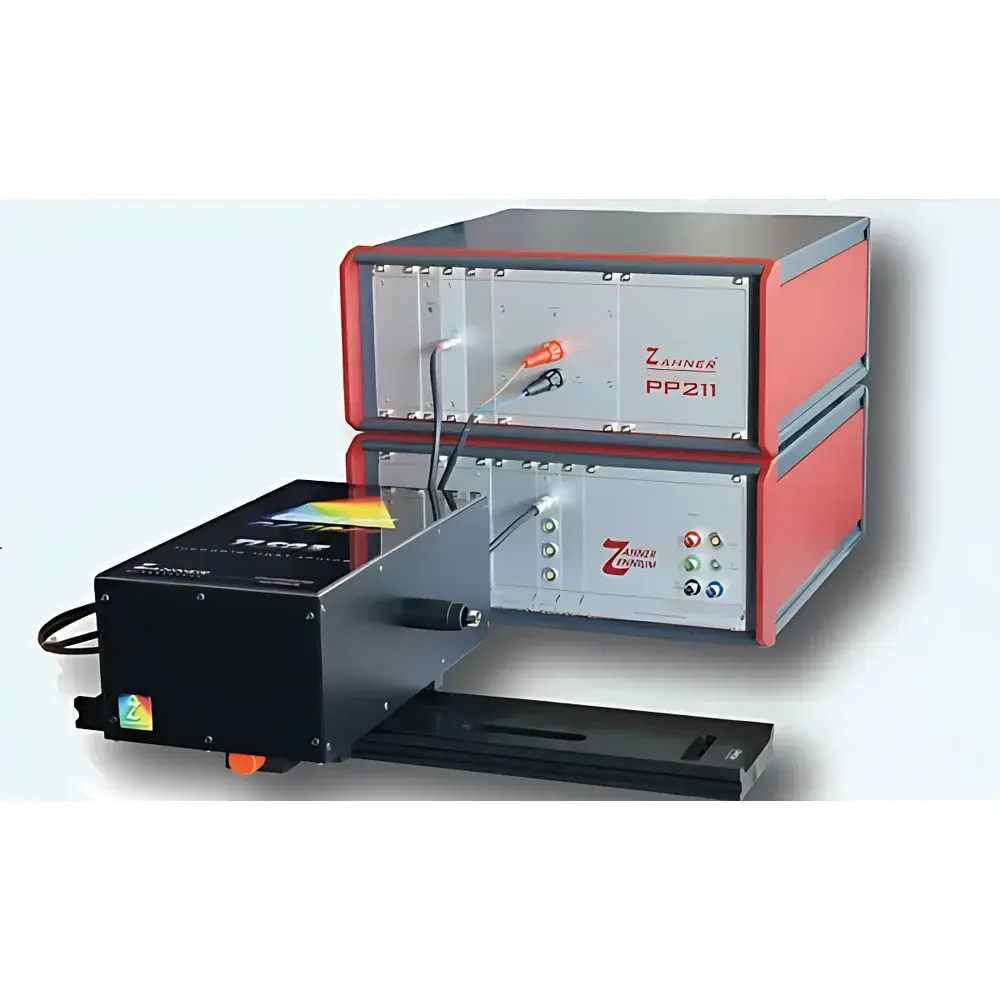
Zahner CIMPS-QE/IPCE Quantum Efficiency and Incident Photon-to-Current Efficiency Measurement System
| Origin | Germany |
|---|---|
| Manufacturer Type | Authorized Distributor |
| Origin Category | Imported Instrument |
| Model | CIMPS-QE/IPCE |
| Pricing | Available Upon Request |
Overview
The Zahner CIMPS-QE/IPCE Quantum Efficiency and Incident Photon-to-Current Efficiency Measurement System is a high-precision, research-grade instrument engineered for absolute spectral responsivity characterization of photovoltaic devices. It operates on the fundamental principle of monochromatic photocurrent spectroscopy, utilizing a digitally addressable, multi-channel LED array light source with real-time closed-loop intensity stabilization. Unlike conventional filter-based or grating-monochromator systems, the CIMPS-QE/IPCE employs wavelength-specific LEDs (365–1020 nm standard; extendable to 295–1020 nm with optional UV module) to deliver discrete, narrow-band illumination with minimal thermal load and exceptional temporal stability. Each LED channel is calibrated traceably to NIST-traceable reference photodiodes, enabling direct calculation of external quantum efficiency (EQE), incident photon-to-current efficiency (IPCE), and wavelength-resolved photocurrent spectra (PCS) without reliance on secondary standards or interpolation. The system is designed for integration into controlled-environment test stations—compatible with gloveboxes, solar simulators (Class AAA), and electrochemical workstations—and supports bias-light and voltage-bias synchronization for advanced device characterization under operational conditions.
Key Features
- Wavelength-tunable LED array source covering 365–1020 nm (standard); UV extension option extends range to 295 nm with certified spectral output and reduced ozone generation
- Real-time closed-loop optical power control using integrated, factory-calibrated silicon photodiode sensors with ±0.5% intensity stability over 8-hour continuous operation
- Simultaneous acquisition of photocurrent, bias voltage, and illumination wavelength with sub-millisecond timing resolution for transient analysis
- Native support for intensity-modulated photocurrent spectroscopy (IMPS) and intensity-modulated photovoltage spectroscopy (IMVS) via synchronized LED modulation (0.01–100 Hz)
- Modular architecture enabling seamless coupling with Zahner’s CIMPS electrochemical impedance spectroscopy platform for correlative optoelectronic–electrochemical analysis
- Patented optical design minimizing stray light, spectral crosstalk, and thermal drift—validated per IEC 60904-8 Ed. 2 and ASTM E1021 standards
Sample Compatibility & Compliance
The CIMPS-QE/IPCE accommodates planar and textured photovoltaic samples up to 100 mm × 100 mm, including silicon heterojunction (SHJ), perovskite, organic photovoltaics (OPV), dye-sensitized solar cells (DSSC), and tandem architectures. Sample holders feature spring-loaded gold-plated contacts, adjustable probe pressure (0.1–2.5 N), and optional temperature control (−40 °C to +85 °C). All optical and electrical calibrations are performed in accordance with ISO/IEC 17025-accredited procedures. Measurement protocols align with key international standards: IEC 60904-8 (spectral response measurement), IEC 60904-9 (solar simulator classification), and ASTM E1021 (quantum efficiency testing). Full audit trails—including sensor calibration certificates, LED spectral irradiance maps, and raw time-stamped data files—are retained for GLP/GMP-compliant laboratories.
Software & Data Management
Control and analysis are executed via Zahner’s Thales software suite (v2.5+), a Windows-based application compliant with FDA 21 CFR Part 11 requirements (electronic signatures, role-based access, immutable audit logs). The software provides automated wavelength sweeps, multi-point bias-voltage mapping, and batch processing for comparative QE/IPCE analysis across sample sets. Raw current–wavelength datasets are exported in HDF5 and ASCII formats, preserving metadata (LED drive current, sensor gain, ambient temperature, sample ID). Integrated scripting (Python API) enables custom sequence automation, machine learning–assisted defect detection, and export to PV-Lighthouse, SCAPS, or Synopsys Sentaurus TCAD workflows. All calibration data—including absolute irradiance values per LED channel and spectral mismatch correction factors—is embedded directly into measurement files.
Applications
- Determination of external quantum efficiency (EQE) and IPCE for single-junction and multi-junction solar cells
- Identification of spectral loss mechanisms (e.g., parasitic absorption, carrier recombination zones, interface defects)
- Quantification of spectral mismatch errors in outdoor performance modeling and STC validation
- Time-resolved IMPS/IMVS analysis to extract charge transport times, recombination lifetimes, and surface state density distributions
- Correlative study of light-bias-dependent EQE shifts to assess ion migration (in perovskites) or Fermi-level pinning (in OPVs)
- Validation of anti-reflective coatings, transparent conductive oxides, and selective contact layers via wavelength-resolved photocurrent gain analysis
FAQ
What calibration standards are used for the LED irradiance output?
Each LED channel is calibrated against a NIST-traceable reference photodiode (Hamamatsu S1337 series) under collimated beam conditions; full spectral irradiance maps (W·m⁻²·nm⁻¹) are provided with instrument delivery.
Can the system measure under simultaneous white-light bias?
Yes—the CIMPS-QE/IPCE supports superimposed broadband bias illumination (e.g., from a Class AAA solar simulator) while performing monochromatic QE scans, with precise synchronization of bias onset and LED pulse timing.
Is remote operation and data monitoring supported?
Thales software includes OPC UA server functionality for integration into LabView, MATLAB, or enterprise LIMS platforms; encrypted TLS 1.3 web interface enables secure off-site monitoring and diagnostic access.
How is spectral crosstalk minimized between adjacent LED channels?
Through proprietary bandpass filtering, physical LED spacing optimization, and firmware-enforced sequential activation with >60 dB inter-channel isolation verified by FTIR spectroradiometry.
Does the system comply with ISO/IEC 17025 for accredited testing labs?
Yes—Zahner provides ISO/IEC 17025-compliant calibration documentation, uncertainty budgets per IEC 60904-8 Annex B, and on-site verification services by DAkkS-accredited engineers.



