
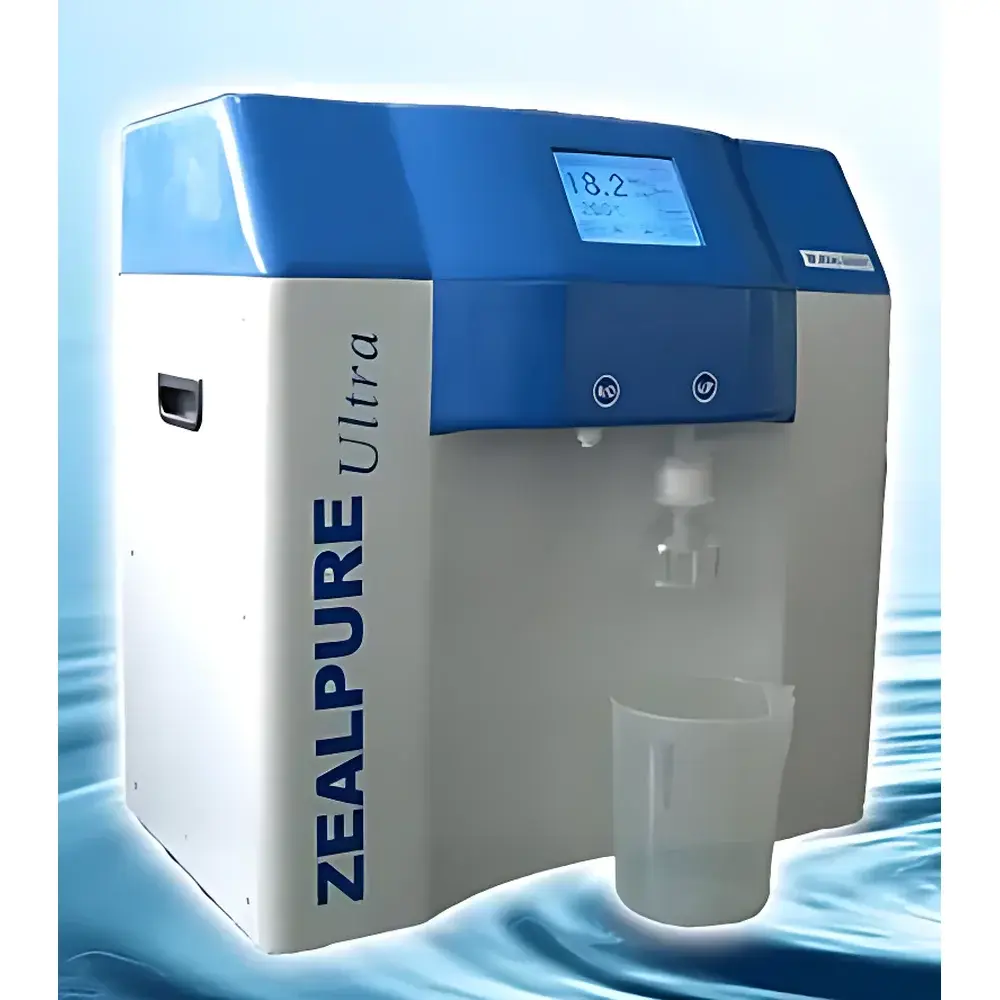
Zealpure Ultra ZP15UV Ultra-Pure Water System (Low-TOC Configuration)
| Origin | Shanghai, China |
|---|---|
| Manufacturer Type | Authorized Distributor |
| Origin Category | Domestic (China) |
| Model | ZP15UV |
| Price Range | USD 700–1,400 |
| Pure Water Grade | ASTM Type I |
| Resistivity | 18.2 MΩ·cm @ 25°C |
| Heavy Metals & Soluble Silica | <0.1 ppb |
| Total Organic Carbon (TOC) | <3 ppb |
| Microbial Count / Endotoxin | <0.001 EU/mL |
| Particles (>0.1 µm) | <1 particle/mL |
| Flow Rate | 15 L/h (25°C) |
| UV Wavelengths | 185 nm + 254 nm |
| Integrated Final Filtration | 0.22 µm hydrophilic membrane |
| System Architecture | Dual-Outlet (RO Water + Ultrapure Water) |
| Control Interface | Backlit LCD touchscreen with real-time monitoring and alarm logic |
| In-line Recirculation | Yes, with programmable frequency |
| Sanitization | Manual or automated chemical disinfection protocol |
| Compliance | Meets ASTM D1193-20, ISO 3696:1987, CLSI EP22-A, and supports GLP/GMP audit trails when paired with optional data logging module |
Overview
The Zealpure Ultra ZP15UV Ultra-Pure Water System is an engineered solution for laboratories requiring ultrapure water with exceptionally low organic contamination—specifically optimized for trace-level organic analysis, high-sensitivity instrumental applications, and regulatory-compliant workflows. It employs a multi-stage purification architecture grounded in established physical and chemical separation principles: reverse osmosis (RO) for bulk ion and particulate removal; dual-wavelength ultraviolet photooxidation (185 nm + 254 nm) to mineralize low-molecular-weight organics and suppress microbial regrowth; high-capacity mixed-bed deionization for residual ion elimination; and terminal 0.22 µm filtration to ensure particle-free delivery. Unlike generic purification systems, the ZP15UV integrates a dedicated low-TOC pathway—where UV irradiation occurs downstream of deionization to prevent recontamination—and maintains continuous recirculation within the ultrapure loop to minimize stagnation-induced TOC rebound. Its design targets compliance with ASTM Type I water specifications (D1193-20), with verified performance across resistivity (>18.2 MΩ·cm), TOC (<3 ppb), endotoxin (<0.001 EU/mL), and sub-0.1 µm particle counts (<1/mL).
Key Features
- Integrated dual-wavelength UV oxidation module (185 nm for TOC photolysis; 254 nm for microbial inactivation), rated for >8,000 hours of stable output
- Real-time, temperature-compensated resistivity and TOC monitoring via backlit LCD touchscreen interface
- Automated RO membrane flush cycle to mitigate scaling and extend service life under variable feedwater conditions (TDS <250 ppm recommended)
- Self-diagnostic system with visual/audible alerts for consumables exhaustion, pressure anomalies, and temperature deviations
- Modular, tool-free consumable housing enabling rapid replacement of PP prefilter (2–3 months), activated carbon cartridges (4–6 months), RO membrane (3 years), and mixed-bed DI column (~1,000 L per cartridge)
- Sealed ultrapure water loop with programmable internal recirculation to inhibit biofilm formation and maintain consistent TOC stability
- Optional data export via RS232/USB interface for integration with LIMS or electronic lab notebooks (ELN)
Sample Compatibility & Compliance
The ZP15UV delivers water suitable for direct use in analytical instrumentation where organic interference compromises detection limits—including HPLC mobile phase preparation, GC/MS solvent blanks, ICP-MS calibration standards, and TOC system validation. Its <3 ppb TOC output meets the stringent requirements of USP , EP 2.2.44, and ISO 14644-1 Class 5 cleanroom environments when deployed with appropriate point-of-use filtration. The system’s construction adheres to FDA 21 CFR Part 11–compatible operational logic (when configured with audit-trail-enabled software), and its materials of construction—FDA-compliant polypropylene, PTFE-sealed diaphragms, and 316L stainless steel wetted components—ensure leachate-free operation. All consumables are certified non-pyrogenic and tested per USP endotoxin limits.
Software & Data Management
The embedded control firmware provides granular operational transparency: real-time display of feed pressure, RO rejection rate, DI column exhaustion status, UV lamp intensity decay, and cumulative ultrapure water volume dispensed. Alarms are configurable—e.g., TOC threshold warnings at 2.5 ppb, resistivity deviation alerts at 18.15 MΩ·cm—to support proactive maintenance. Optional data-logging modules record timestamped parameters at user-defined intervals (1 min to 24 h), generating CSV-compatible reports compliant with GLP documentation standards. The system supports external printer connectivity for hard-copy audit trails and includes password-protected administrator mode for calibration adjustments and protocol updates.
Applications
- HPLC & LC-MS: Mobile phase preparation, column equilibration, and blank injection to eliminate organic ghost peaks
- ICP-MS & Trace Metal Analysis: Diluent and standard matrix preparation where carbon-mediated polyatomic interferences (e.g., 12C16O+) must be suppressed
- TOC Instrument Calibration: Certified low-TOC source water for instrument verification per USP and ASTM D5905
- GC/MS Solvent Blanks: Elimination of background hydrocarbon signals during method development
- Pharmaceutical Stability Studies: Formulation diluents meeting ICH Q5C bioburden and extractables criteria
- Reference Material Preparation: Matrix-matched standards for environmental and clinical reference labs
FAQ
What distinguishes the ZP15UV from standard ultrapure water systems?
The ZP15UV features a dedicated low-TOC architecture—positioning dual-wavelength UV irradiation after deionization and before final filtration—to prevent post-purification organic reintroduction and maximize photolytic TOC reduction.
Can the system be validated per IQ/OQ protocols?
Yes. Documentation packages—including factory test reports, material certifications, and installation checklists—are provided. Optional third-party IQ/OQ services are available through authorized partners.
Is the 185 nm UV lamp replaceable in the field?
Yes. The UV chamber is modular and accessible without tools; lamp replacement requires only disconnecting the power harness and sliding in the calibrated OEM component.
Does the system support remote monitoring?
Via optional Ethernet or Wi-Fi add-on modules, real-time status and historical logs can be accessed through secure HTTPS web interface or integrated into building management systems.
How does the recirculation loop affect TOC stability?
Programmable low-flow recirculation (0.3–0.5 L/min) maintains laminar flow and prevents boundary-layer organic accumulation, reducing TOC drift to <0.5 ppb over 24-hour static hold periods.



