
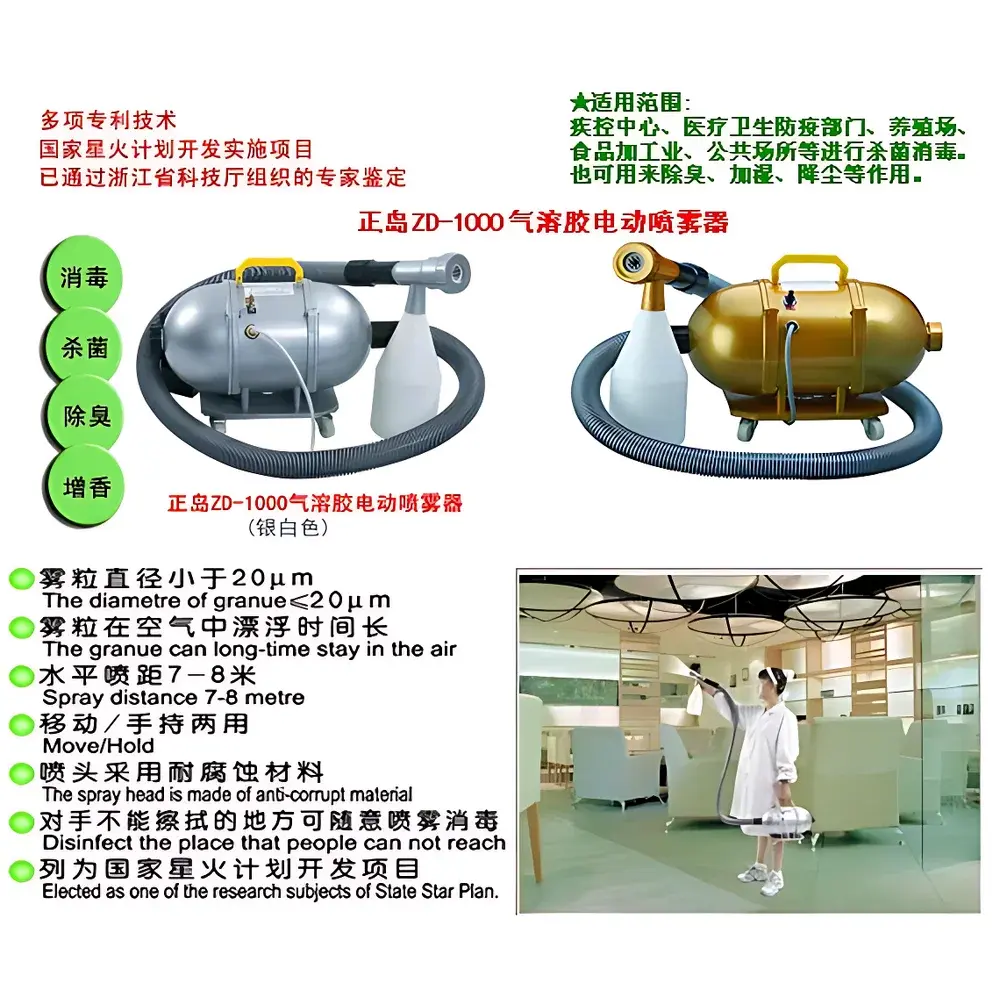
ZEDO ZD-1000 Portable Aerosol Disinfection Sprayer
| Brand | ZEDO |
|---|---|
| Origin | Zhejiang, China |
| Manufacturer Type | OEM/ODM Manufacturer |
| Country of Origin | China |
| Model | ZD-1000 |
| Power | 1000 W |
| Voltage/Frequency | 220 V / 50 Hz |
| Current | 5 A |
| Spray Distance | 6–8 m |
| Spray Flow Rate | 250 mL/min |
| Tank Capacity | 1400 mL |
| 雾粒直径 (雾滴粒径) | ≤20 µm |
| Net Weight | 4.4 kg |
| Dimensions (L×W×H) | 45 × 24 × 42 cm |
| Material | Corrosion-resistant engineering plastics (nozzles, tank, handle) |
| Hose Length | 1.5 m |
Overview
The ZEDO ZD-1000 Portable Aerosol Disinfection Sprayer is an engineered electro-mechanical device designed for ULV (Ultra-Low Volume) cold fogging applications in controlled indoor environments. It operates on the principle of high-pressure air-assisted atomization—where compressed air shears liquid disinfectant into a polydisperse aerosol cloud with a mass median aerodynamic diameter (MMAD) ≤20 µm. This particle size range ensures prolonged airborne suspension (typically >15–30 minutes under standard indoor conditions), enabling effective contact with airborne microorganisms and deposition onto vertical/horizontal surfaces—including hard-to-reach zones such as ceiling corners, ventilation grilles, and equipment undersides. Unlike manual pump sprayers or low-efficiency thermal foggers, the ZD-1000 delivers consistent droplet size distribution without thermal degradation of heat-labile biocides (e.g., hydrogen peroxide, peracetic acid), making it suitable for routine environmental decontamination in biosafety-sensitive settings.
Key Features
- ULV aerosol generation with verified ≤20 µm median droplet diameter—optimized for airborne pathogen inactivation and surface coverage uniformity.
- 1000 W high-efficiency brush motor driving a precision-engineered air compressor and dual-fluid nozzle assembly, ensuring stable output at 250 mL/min flow rate.
- Corrosion-resistant construction: all wetted components—including tank, suction tube, and spray nozzle—are fabricated from chemically inert engineering plastics compatible with oxidizing agents (e.g., ≥15% peracetic acid, 3–6% H₂O₂, sodium hypochlorite solutions).
- Ergonomic portable design: net weight of 4.4 kg, compact footprint (45 × 24 × 42 cm), integrated carrying handle, and 1.5 m flexible reinforced hose for operator mobility and reach extension.
- Adjustable spray pattern and directional control via handheld trigger valve—enabling targeted application without overspray or pooling.
- No thermal input: cold fogging preserves active ingredient stability and eliminates fire hazard associated with thermal fogging units.
Sample Compatibility & Compliance
The ZD-1000 is validated for use with WHO- and CDC-recommended disinfectants, including aqueous solutions of peracetic acid (0.5–0.8%), hydrogen peroxide (1–3%), and sodium hypochlorite (0.05–0.5%). It meets functional requirements outlined in ISO 14644-1 (cleanroom aerosol dispersion testing methodology) and aligns with EPA Pesticide Registration Notice 2003-1 guidance for ULV device performance characterization. While not certified to EN 14470 or UL 2900 (as it is a non-electronic-controlled mechanical appliance), its material compatibility conforms to ASTM D4295-20 (Standard Guide for Selection of Materials Resistant to Disinfectants). The unit supports GLP-aligned documentation when paired with calibrated volumetric dispensing and time-stamped operational logs.
Software & Data Management
The ZD-1000 is a standalone electromechanical instrument with no embedded firmware, touchscreen interface, or digital connectivity. Operation is fully manual via on/off switch and trigger-actuated flow control. For auditability in regulated environments (e.g., pharmaceutical QC labs, hospital infection control departments), users are advised to integrate external logging—such as calibrated timers, pre-weighed solution batches, and post-application surface ATP swabbing—to establish traceable disinfection cycles. No data export, remote monitoring, or 21 CFR Part 11 compliance features are included; however, its mechanical simplicity enhances long-term reliability and reduces validation burden in GMP-adjacent workflows.
Applications
- Hospital environmental hygiene: terminal disinfection of isolation rooms, ambulances, and waiting areas following suspected or confirmed pathogen exposure (e.g., SARS-CoV-2, influenza A, MRSA).
- Public transportation infrastructure: fogging of bus interiors, subway carriages, and airport gate lounges during off-peak hours.
- Education and office facilities: periodic decontamination of classrooms, laboratories, and shared workspaces during outbreak response protocols.
- Agricultural biosecurity: poultry house sanitation between flocks using approved veterinary biocides.
- Pharmaceutical manufacturing support: non-product-contact area disinfection in Grade C/D cleanrooms where vapor-phase alternatives are contraindicated.
FAQ
What disinfectants are compatible with the ZD-1000?
Peracetic acid (0.5–0.8%), hydrogen peroxide (1–6%), and sodium hypochlorite (0.05–0.5%) solutions have been operationally validated. Always verify chemical compatibility with tank and hose materials prior to first use.
Does the ZD-1000 require calibration or routine maintenance?
No formal calibration is required; however, monthly inspection of nozzle orifice integrity, hose flexibility, and motor cooling vents is recommended. Replace the air filter every 50 operating hours in dusty environments.
Can the ZD-1000 be used for surface-only disinfection without air dispersion?
Yes—by reducing operator distance to <1 m and directing the spray stream perpendicular to target surfaces, the device functions effectively as a high-coverage surface sanitizer while minimizing aerosol drift.
Is personal protective equipment (PPE) required during operation?
Yes. Operators must wear N95 respirators, nitrile gloves, and eye protection per OSHA 1910.1200 and local biocide handling regulations—especially when fogging oxidizing agents in confined spaces.
What is the expected service life under typical lab or facility use?
With proper cleaning after each use and storage in a dry, ventilated location, the unit demonstrates >5 years of reliable service at ≤2 hours/day average runtime.



