
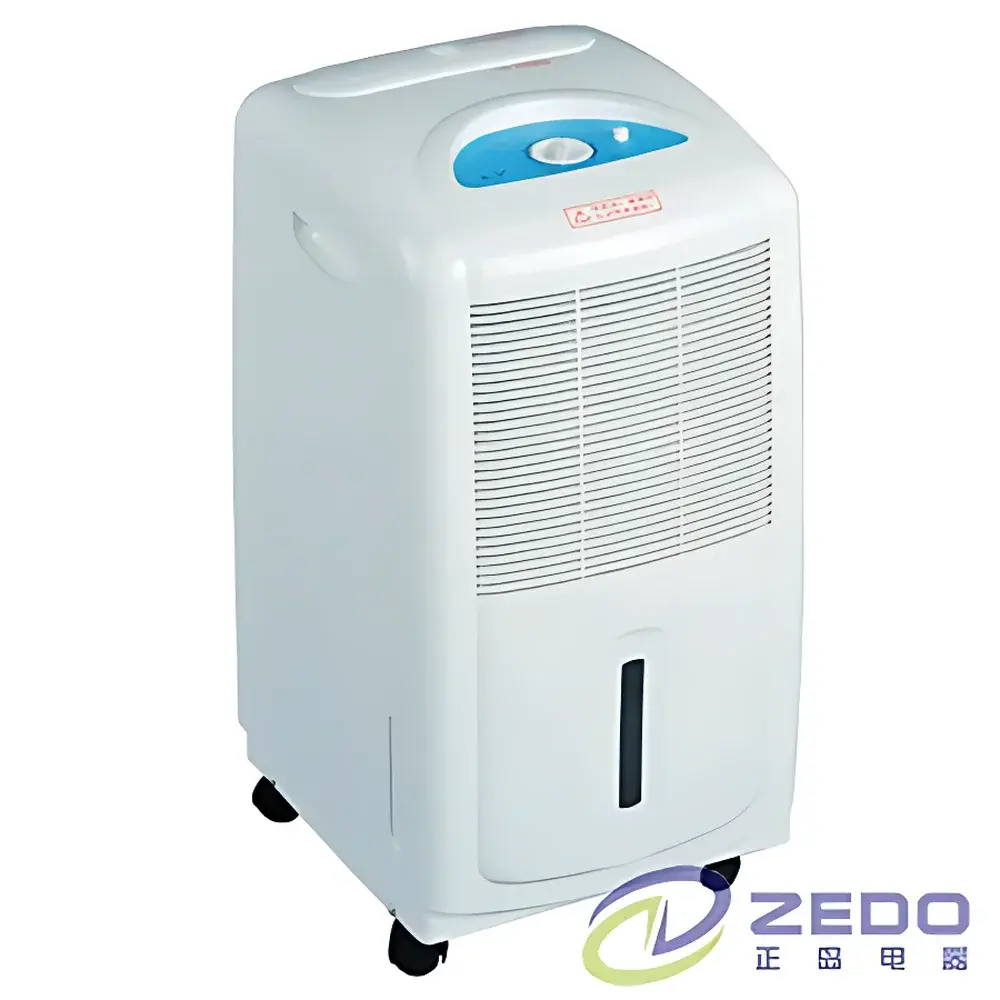
ZEDO ZD-558LB Laboratory Desiccant-Style Dehumidifier
| Brand | ZEDO |
|---|---|
| Origin | Zhejiang, China |
| Manufacturer Type | OEM/ODM Manufacturer |
| Country of Origin | China |
| Model | ZD-558LB |
| Instrument Type | Compressor-Based Refrigerant Dehumidifier |
| Dehumidification Capacity | 58 L/day |
| Applicable Area | 40–60 m² (at 2.8 m ceiling height) |
| Power Input | 670 W |
| Voltage/Frequency | 220 V~50 Hz |
| Airflow Rate | 850 m³/h |
| Noise Level | ≤48 dB(A) |
| Operating Temperature Range | 0–38 °C |
| Water Tank Capacity | 6 L |
| Drainage Options | Continuous via hose or manual tank removal |
| Dimensions (W×D×H) | 350 × 455 × 603 mm |
| Net Weight | 25 kg |
| Control System | Microprocessor-Based Humidity Setpoint Control with LCD Display |
| Sensor | High-Accuracy Japanese Shinko Hygrothermograph |
| Safety Protections | High/Low Pressure Cut-off, Anti-Freeze Protection, Overcurrent & Undervoltage Protection, 3-Minute Compressor Delay Start |
| Filtration | Activated Carbon + Washable Pre-Filter |
| Compressor Type | Rotary Scroll Compressor (International Brand) |
| Refrigerant | Eco-Friendly R-134a or Equivalent |
| Certifications | CE-marked per EN 60335-1 & EN 60335-2-40 (IEC 60335 Series), RoHS Compliant |
Overview
The ZEDO ZD-558LB is a precision-engineered, compressor-based refrigerant dehumidifier specifically designed for controlled laboratory environments where stable relative humidity (RH) is critical to equipment integrity, measurement repeatability, and sample stability. Unlike desiccant-based units, the ZD-558LB employs a closed-cycle vapor-compression cycle—cooling ambient air below its dew point via an evaporator coil, condensing moisture into liquid water, and reheating the dried air before discharge. This thermodynamic process delivers consistent dehumidification performance across a wide operating temperature range (0–38 °C), making it suitable for general-purpose labs, metrology rooms, QC/QA laboratories, electronics testing bays, and analytical instrument enclosures. Its design prioritizes operational reliability, low acoustic signature (<48 dB[A]), and long-term stability—key requirements for environments where continuous unattended operation and minimal environmental interference are mandated.
Key Features
- Microprocessor-controlled humidity regulation with user-selectable RH setpoints (typically 40–65 %RH range) and real-time digital display of current ambient RH and temperature.
- High-efficiency rotary scroll compressor from an internationally recognized manufacturer, delivering optimized energy conversion, reduced mechanical wear, and extended service life.
- Dual centrifugal impeller air circulation system with industrial-grade external rotor fan—engineered for high volumetric flow (850 m³/h) and low turbulence, ensuring uniform humidity distribution without localized drafts.
- Optimized heat exchanger assembly featuring internally grooved copper tubing and hydrophilic aluminum fin stock—maximizing latent heat transfer efficiency while minimizing frost accumulation under marginal conditions.
- Multi-layer filtration system comprising a washable pre-filter and activated carbon media—capturing airborne particulates, organic volatiles, and odorous compounds that could otherwise contaminate sensitive instrumentation or calibration standards.
- Comprehensive electrical and thermal safety architecture including high/low refrigerant pressure cut-offs, anti-freeze thermostat monitoring, overcurrent protection, undervoltage lockout, and mandatory 3-minute compressor restart delay to prevent short-cycling.
Sample Compatibility & Compliance
The ZD-558LB is not a sample-processing device but an environmental conditioning unit intended to maintain ambient RH within defined operational envelopes. It does not contact samples directly and introduces no chemical agents or ionizing radiation into the space. As such, it complies with foundational safety and electromagnetic compatibility standards applicable to Class II household and laboratory appliances: EN 60335-1 (General Safety) and EN 60335-2-40 (Particular Requirements for Refrigerant-Type Dehumidifiers), verified through third-party testing. While not inherently GLP/GMP-certified, its microprocessor logging capability (via optional external data logger interface), stable control algorithm, and fault-code diagnostics support integration into regulated environments requiring documented environmental controls per ISO/IEC 17025 Clause 6.3 or ASTM E145 Annex A1. Units deployed in pharmaceutical QC labs or metrology facilities may be included in facility qualification protocols (IQ/OQ/PQ) when paired with traceable hygrometers.
Software & Data Management
The ZD-558LB operates via embedded firmware with no proprietary software dependency. All operational parameters—including setpoint, current RH reading, runtime hours, and active fault codes—are displayed on a backlit LCD panel. The unit supports passive data capture via analog 4–20 mA or 0–10 V output (optional accessory module) compatible with building management systems (BMS) or SCADA platforms. For audit-trail compliance, external USB or RS-485 dataloggers can record time-stamped RH/temperature values at configurable intervals. No cloud connectivity or remote access functionality is provided, aligning with institutional IT security policies restricting internet-facing lab peripherals. Firmware updates—when released—are performed manually via physical service port by authorized technicians; no over-the-air (OTA) capability exists.
Applications
- Protection of optical instruments (e.g., interferometers, spectrophotometers) from lens fogging and coating degradation.
- Maintenance of calibration standards (mass, length, electrical) in metrology labs where dimensional drift correlates with RH-induced expansion/contraction.
- Stabilization of electronic test benches housing high-impedance circuitry susceptible to surface leakage currents at elevated RH.
- Prevention of oxidation and corrosion in metallography preparation areas and materials characterization labs.
- Support of stable weighing conditions for analytical balances (especially ultra-micro and micro balances), where buoyancy corrections depend on precise air density calculation.
- Conditioning of storage zones for hygroscopic reference materials, certified standards, and desiccated reagents per USP and ICH Q5C guidelines.
FAQ
What is the recommended maintenance schedule for the ZD-558LB?
Filter cleaning every 2 weeks under normal lab conditions; full internal inspection and coil cleaning every 6 months by qualified service personnel.
Can this unit operate continuously in unattended mode?
Yes—designed for 24/7 operation with automatic defrost cycling, overflow protection, and self-diagnostic fault reporting.
Does the unit meet FDA 21 CFR Part 11 requirements for electronic records?
No—the device lacks electronic signature capability or audit-trail generation; however, external validated dataloggers may fulfill Part 11 requirements when integrated per site-specific SOPs.
Is refrigerant charging accessible for field service?
Refrigerant circuit is sealed and non-serviceable; any refrigerant loss indicates component failure requiring factory-replacement assembly.
How is condensate disposal managed during extended operation?
Continuous drainage via 10 mm ID PVC hose is strongly recommended for uninterrupted operation; the 6 L tank serves only as backup or intermittent-use contingency.



