
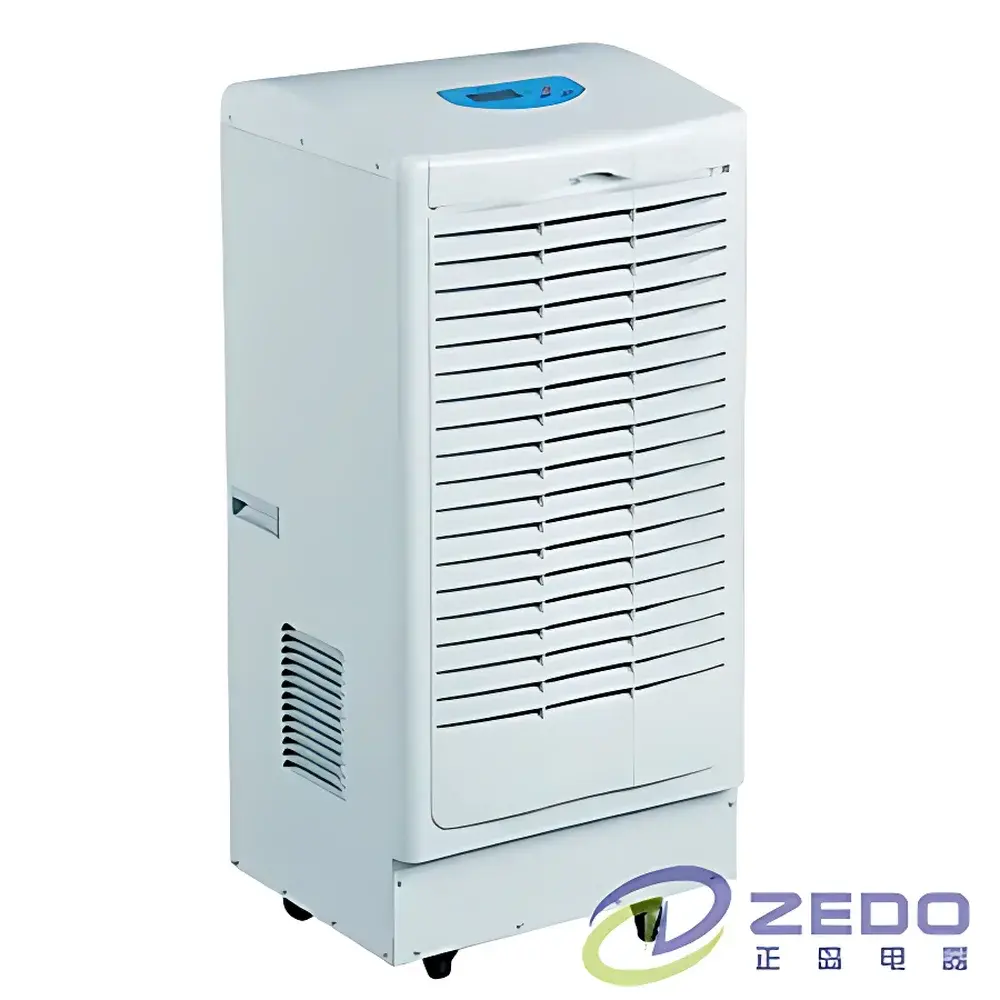
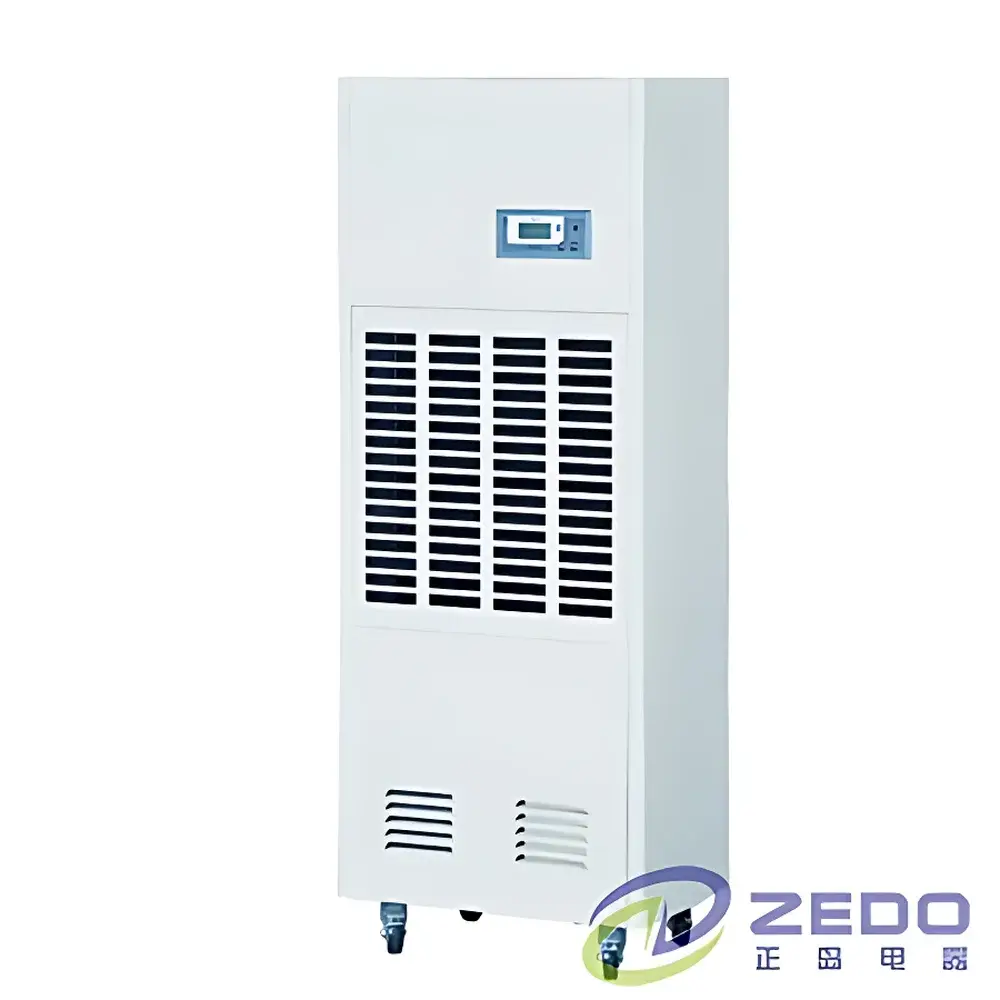
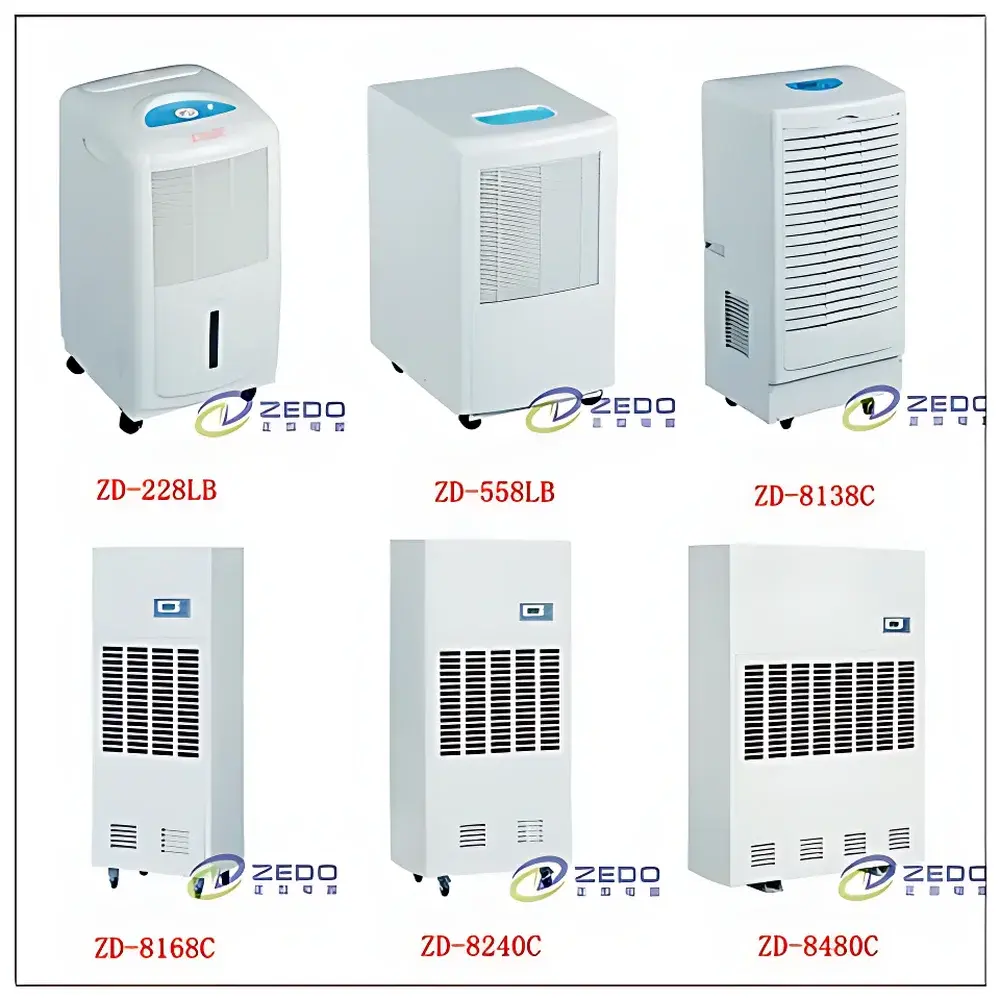
ZEDO ZD-8138C Industrial Dehumidifier for Electrical Switchgear Rooms
| Brand | ZEDO |
|---|---|
| Origin | Zhejiang, China |
| Manufacturer Type | Direct Manufacturer |
| Regional Category | Domestic (China) |
| Model | ZD-8138C |
| Dehumidification Capacity | 138 L/day |
| Control Method | Intelligent Humidity Setpoint Control |
| Drainage | Continuous via PVC Drain Hose |
| Power Supply | 220 V~50 Hz |
| Input Power | 2000 W |
| Operating Temperature Range | 5–38 °C |
| Noise Level | 50 dB(A) |
| Dimensions (W×D×H) | 480 × 430 × 1100 mm |
| Net Weight | 58 kg |
| Compressor Start Delay | 3-minute Anti-short-cycle Protection |
| Safety Protections | High/Low Pressure, Overload, Undervoltage, Reverse Phase |
| Air Filtration | Standard Activated Carbon Filter |
| Smart Diagnostics | Real-time Fault Detection & Display |
| Fan System | Dual-centrifugal, External Rotor Industrial Blower |
| Heat Exchanger | Enhanced Finned Copper Tube with Internal Grooved Tubing |
| Refrigerant | Environmentally Compliant (R-410A or Equivalent) |
| Compliance | Designed to meet IEC 60529 (IP20), GB/T 19411–2003 (Chinese National Standard for Dehumidifiers), and general industrial electrical safety requirements (GB 4706.1) |
Overview
The ZEDO ZD-8138C Industrial Dehumidifier is an engineered environmental control solution specifically designed for critical infrastructure environments—particularly electrical switchgear rooms, low-voltage distribution chambers, and utility substations—where precise humidity management is essential to equipment reliability and operational continuity. Unlike general-purpose dehumidifiers, the ZD-8138C employs a robust refrigerant-based condensation cycle optimized for stable, continuous operation under variable ambient conditions (5–38 °C). Moisture-laden air is drawn into the unit by a high-efficiency dual-centrifugal blower system, passed across a finned-tube evaporator coil cooled below the dew point, and condensed into liquid water. The resulting dry air is reheated via the condenser coil before discharge—ensuring minimal temperature fluctuation in the conditioned space while maximizing moisture removal efficiency. This thermodynamic process aligns with ISO 8502-6 and IEC 60068-2-30 standards for humidity-controlled testing and storage environments, making the unit suitable not only for power infrastructure but also for GLP-compliant laboratories, archival vaults, and precision instrument enclosures where hygroscopic degradation must be mitigated.
Key Features
- Industrial-grade refrigeration system featuring a scroll-type compressor from a globally recognized OEM supplier, delivering high volumetric efficiency and extended service life under 24/7 duty cycles.
- Optimized heat exchanger assembly using internally grooved copper tubing with hydrophilic aluminum fins—enhancing thermal transfer coefficient and reducing frost accumulation during prolonged low-temperature operation.
- Microprocessor-based controller integrated with a Japanned Shinko high-accuracy capacitive humidity sensor (±3% RH typical accuracy), enabling programmable setpoint control (30–80% RH range), hysteresis adjustment, and real-time status feedback.
- Dual centrifugal fan configuration ensures uniform airflow distribution, reduced pressure drop across the filter and coil, and consistent dehumidification performance even at partial load or elevated static resistance (e.g., ducted installations).
- Comprehensive electrical protection suite including motor overcurrent relays, phase failure detection, high/low refrigerant pressure switches, and automatic compressor restart delay—fully compliant with IEC 60204-1 safety requirements for industrial machinery.
- Standard activated carbon pre-filter mitigates airborne particulates and volatile organic compounds (VOCs) commonly present in aging concrete or cable insulation environments—reducing corrosion risk on copper busbars and relay contacts.
Sample Compatibility & Compliance
The ZD-8138C is intended for use in enclosed, mechanically ventilated spaces housing medium- and low-voltage electrical assets—including metal-clad switchgear, metering panels, capacitor banks, and SCADA interface cabinets. It is not rated for explosive atmospheres (ATEX/IECEx) or Class I Div 1 hazardous locations. Units are constructed per GB/T 19411–2003 (Chinese national standard for dehumidifiers), with enclosure ingress protection rated IP20 per IEC 60529. While not certified to UL 1995 or CSA C22.2 No. 236, its electrical architecture adheres to fundamental principles outlined in NFPA 70 (NEC) Article 440 for HVAC-related equipment. For facilities operating under FDA 21 CFR Part 11 or EU Annex 11 requirements, optional data logging modules (not included standard) may be integrated to support audit-ready humidity trend records.
Software & Data Management
The ZD-8138C operates autonomously via its embedded microcontroller without external software dependency. All operational parameters—including current RH%, target setpoint, compressor runtime, fault codes, and filter maintenance interval—are displayed on a backlit LCD interface with tactile membrane keypad navigation. The unit supports RS-485 Modbus RTU communication (optional module) for integration into building management systems (BMS) or SCADA platforms, enabling remote monitoring of humidity trends, energy consumption, and predictive maintenance alerts. Audit trails are maintained locally for ≥30 days; export functionality requires third-party gateway hardware. No cloud connectivity or proprietary SaaS platform is implemented—ensuring full data sovereignty and compatibility with air-gapped utility networks.
Applications
- Electrical switchgear rooms in municipal substations, data center utility corridors, and industrial plant distribution centers—where relative humidity must be maintained ≤60% RH to prevent insulator tracking, contact oxidation, and relay coil corrosion.
- Archival storage vaults and library preservation chambers requiring long-term stabilization of cellulose-based media and magnetic tape integrity.
- Pharmaceutical cleanroom support areas, particularly cold rooms and stability chambers, where condensation on HVAC ductwork or instrumentation enclosures poses contamination risks.
- Military and transportation infrastructure (e.g., rail signaling cabinets, naval auxiliary power rooms) exposed to coastal or monsoonal humidity profiles.
- Research laboratories housing hygroscopic reference standards, optical metrology benches, or vacuum pump foreline conditioning systems.
FAQ
What is the recommended installation orientation for optimal airflow?
The unit must be installed on a level, vibration-isolated surface with ≥500 mm clearance on all sides—especially rear and top—for unrestricted condenser airflow and service access.
Can the ZD-8138C operate continuously in unattended mode?
Yes. Its three-minute compressor restart delay, thermal overload protection, and self-diagnostic display ensure safe unattended operation for indefinite periods.
Is ducted exhaust compatible with this model?
While not supplied with ducting, the unit’s static pressure capability (≥120 Pa) permits integration with short-run rigid ductwork (≤3 m total length, no sharp bends) when paired with an external static pressure sensor loop.
Does the unit comply with electromagnetic compatibility (EMC) directives?
It meets GB/T 17626 series immunity requirements (surge, ESD, fast transients) for industrial environments, though formal CE marking is not applied.
How often should the activated carbon filter be replaced?
Under typical switchgear room conditions (moderate dust, low VOC loading), replacement is recommended every 12 months—or sooner if pressure drop exceeds 15 Pa across the filter assembly.
Related Products



