
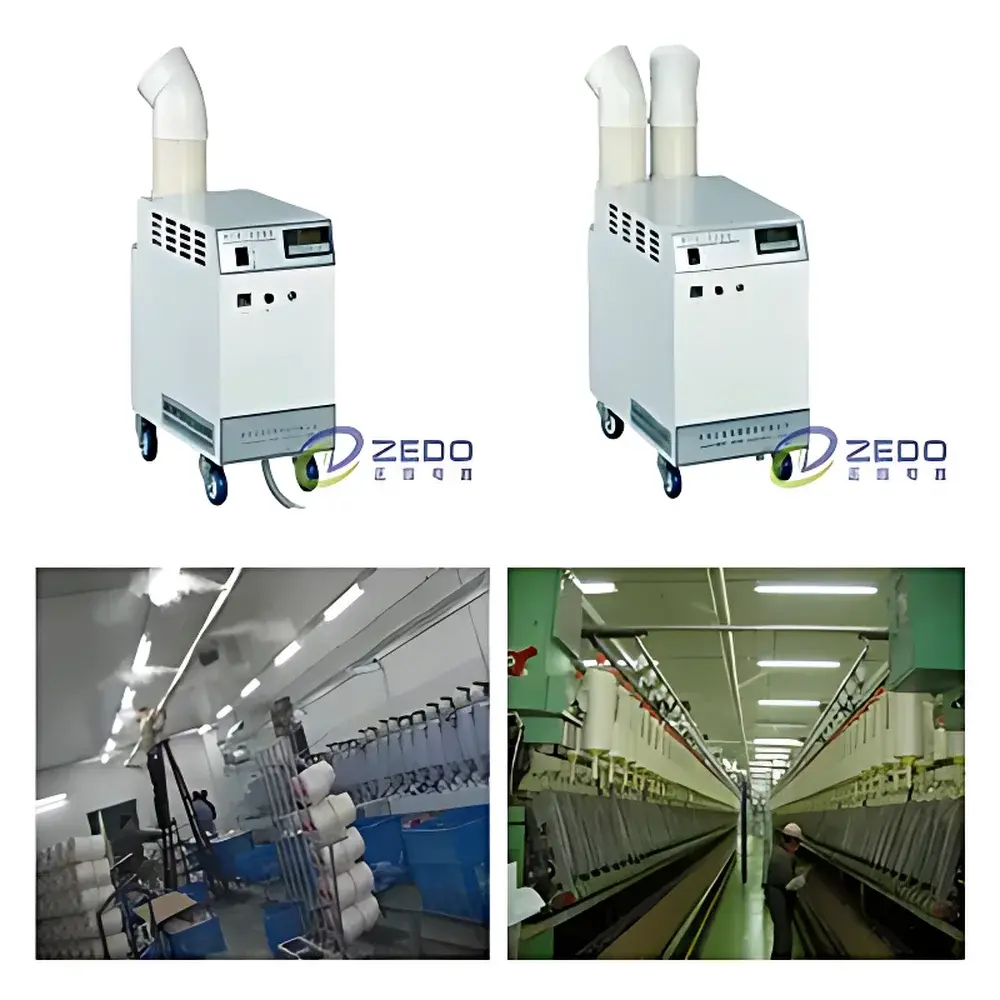
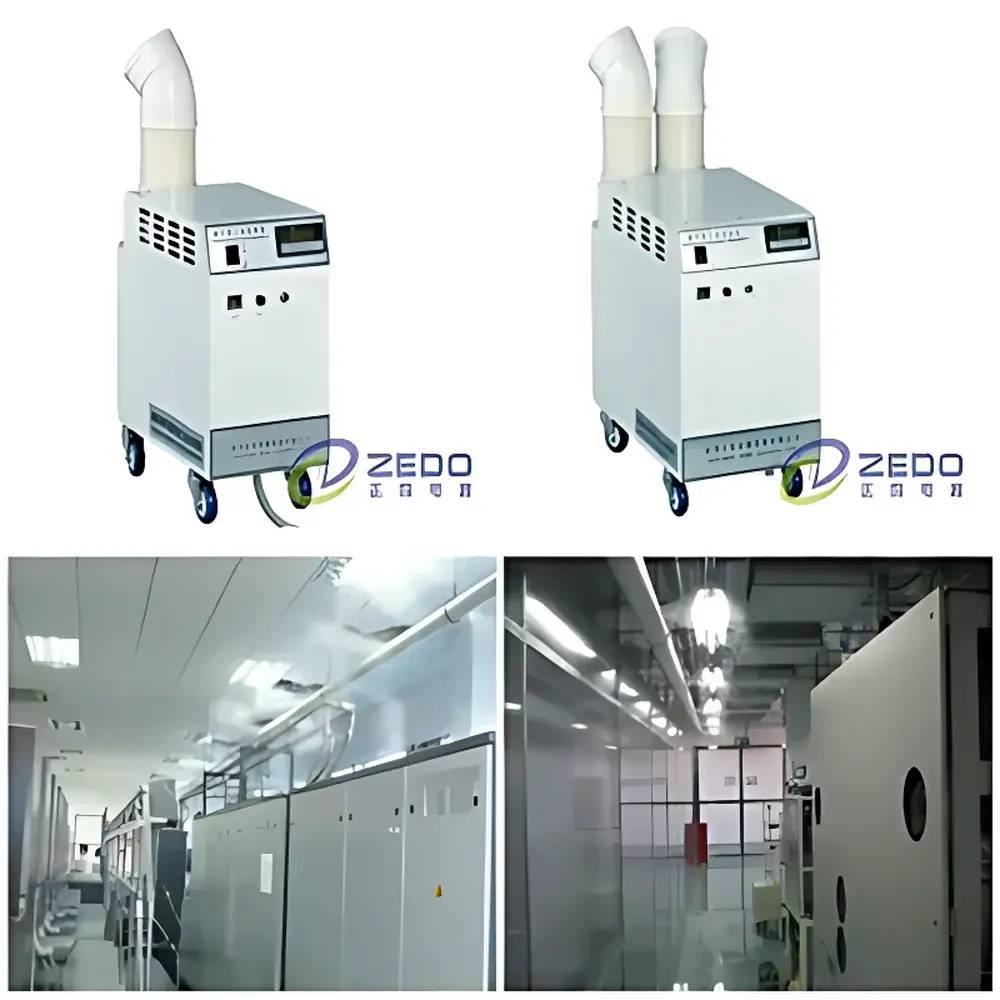
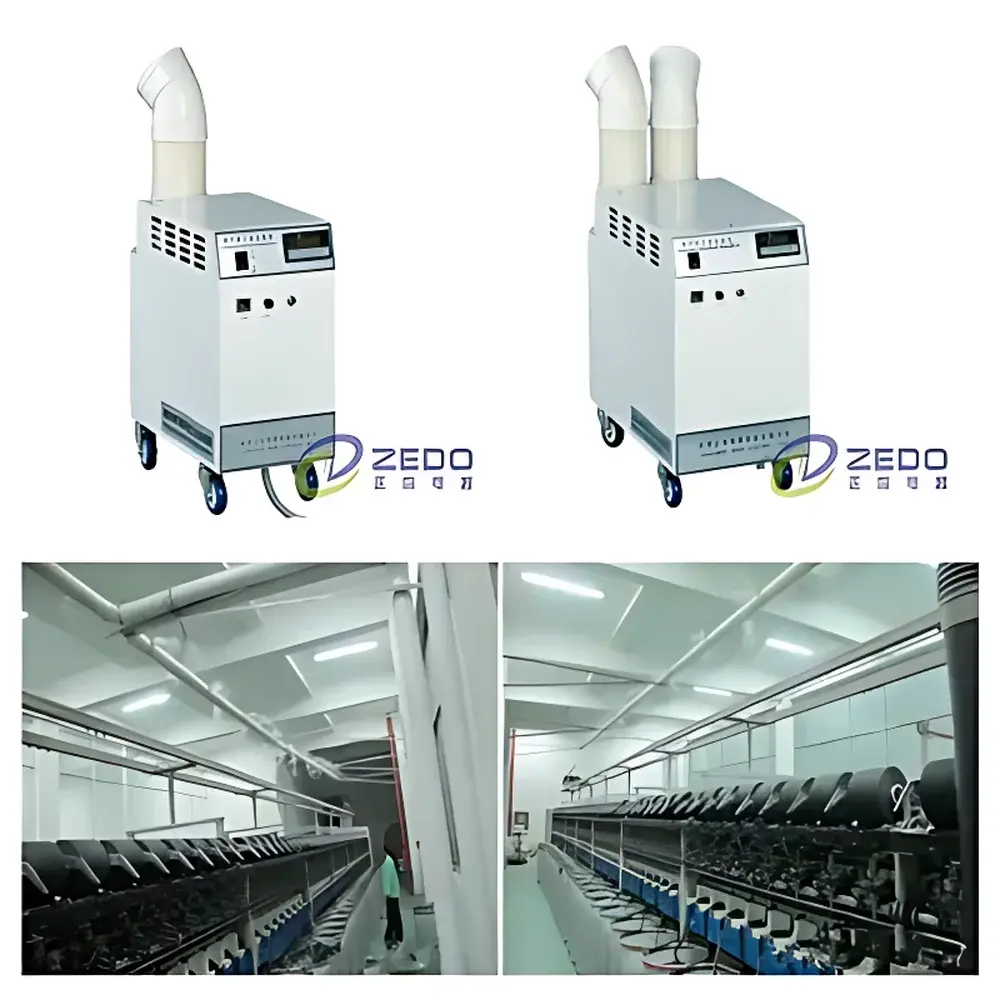
ZEDO ZS-40Z Series Ultrasonic Industrial Humidifier for Weaving Mill Environmental Control
| Brand | ZEDO |
|---|---|
| Origin | Zhejiang, China |
| Manufacturer Type | OEM/ODM Manufacturer |
| Country of Origin | China |
| Model | ZS-40Z Series |
| Humidification Capacity | 12 kg/h |
| Power Consumption | 1200 W |
| Net Weight | 38 kg |
| 雾化方� | �: Single-tube ultrasonic atomization |
| Protection Rating | IP68 (power supply & fan) |
| Humidity Control Accuracy | ±3% RH (with SUGINO high-precision capacitive sensor) |
| Control Modes | On/Off, Timer, and Closed-loop RH Feedback |
Overview
The ZEDO ZS-40Z Series Ultrasonic Industrial Humidifier is engineered for precise, stable, and contamination-free relative humidity (RH) control in textile weaving environments—particularly for air-jet loom operations. Unlike evaporative or steam-based systems, this unit employs high-frequency ultrasonic transduction (1.7 MHz) to atomize deionized or softened water into sub-10 µm droplets, enabling rapid, uniform dispersion without thermal input or mineral carryover. Its design addresses the core physicochemical challenge in weaving: electrostatic charge accumulation due to low ambient RH (<55% RH), which directly correlates with yarn breakage, shuttle misalignment, and fabric defect rates (e.g., skipped picks, selvage distortion). By maintaining RH within the ISO 9001–recommended range of 70–78% for cotton yarns and up to 80% RH for synthetic blends, the ZS-40Z mitigates fiber brittleness, reduces inter-yarn friction coefficients, and stabilizes warp tension dynamics—critical parameters validated per ASTM D1776 (Standard Practice for Conditioning and Testing Textiles) and GB/T 6529 (Chinese national standard for textile conditioning).
Key Features
- IP68-rated sealed variable-frequency power supply: Fully encapsulated circuitry rated for submersion at 1 m depth; eliminates moisture ingress failure modes common in industrial HVAC zones.
- Integrated ceramic ultrasonic transducer array: Alumina-based piezoelectric elements resistant to alkaline scaling and hard-water corrosion; rated for 3,000–5,000 operational hours with field-replaceable modular design.
- 36V brushless waterproof blower: Ball-bearing impeller with IP68 ingress protection; delivers consistent airflow (>220 m³/h) at <45 dB(A), minimizing vibration-induced mechanical resonance in precision loom installations.
- Full stainless-steel chassis (AISI 304): Electropolished interior surfaces prevent biofilm formation; includes auto-fill solenoid valve, float-level cutoff, and overflow drainage per IEC 60335-1 safety requirements.
- Microprocessor-based RH feedback control: Paired with SUGINO HS-100 series capacitive humidity sensor (NIST-traceable calibration); supports setpoint programming, ramp-and-soak profiles, and real-time deviation logging.
- Modular single-tube mist distribution: Optimized for ceiling-mounted ducted integration or free-standing localized deployment; compatible with BMS interfaces via 0–10 VDC or Modbus RTU output.
Sample Compatibility & Compliance
The ZS-40Z is validated for continuous operation in Class 3 industrial environments (per ISO 14644-1 cleanroom classification equivalents) with ambient temperatures from 10–40°C and non-condensing RH ≤90%. It complies with CE marking directives (2014/30/EU EMC, 2014/35/EU LVD), RoHS 2011/65/EU, and meets UL 61010-1 third-party certification requirements for laboratory and light-industrial equipment. For GMP-aligned textile quality systems, its closed-loop humidity control architecture supports audit-ready data integrity when integrated with FDA 21 CFR Part 11–compliant SCADA platforms. No consumables or replaceable filters are required—only periodic descaling (recommended every 500 operating hours using citric acid solution per ASTM D7145).
Software & Data Management
The embedded controller features a 4.3-inch TFT-LCD HMI with touch-sensitive interface supporting multilingual prompts (English, Spanish, Chinese). All operational parameters—including runtime, RH setpoint history, alarm logs (e.g., low-water, overtemperature), and sensor drift compensation values—are stored in non-volatile memory for ≥12 months. Optional Ethernet/WiFi module enables remote monitoring via SNMPv3 or MQTT protocol; historical datasets export in CSV format for statistical process control (SPC) analysis using Minitab or JMP. Audit trails include timestamped operator ID, parameter modifications, and firmware revision metadata—fully compliant with GLP documentation standards for textile QC laboratories.
Applications
- Stabilizing warp beam tension during high-speed air-jet weaving of cotton, polyester, viscose, and blended yarns
- Preventing static discharge on carbon-fiber or aramid reinforcement fabrics in technical textile production
- Maintaining RH setpoints in pre-weaving processes: warping, sizing (slashing), and beaming rooms
- Supplemental humidification in HVAC zones where central systems lack fine-grained RH resolution
- Controlled-environment testing of yarn hygroscopic expansion coefficients per ISO 6941
FAQ
What water quality is required for optimal transducer lifespan?
Deionized water (conductivity <10 µS/cm) or softened water (hardness <1°dH) is mandatory. Untreated municipal water will accelerate ceramic transducer erosion and require quarterly descaling.
Can the ZS-40Z integrate with existing BMS or PLC systems?
Yes—via 0–10 VDC analog output (RH feedback), digital dry-contact alarms, or optional Modbus RTU RS-485 interface (addressable slave mode, baud rate 9600–115200 bps).
Is condensate management required in installation?
No—ultrasonic atomization produces adiabatic cooling only at the droplet surface; no bulk condensation occurs when installed per ASHRAE Guideline 18 minimum clearance (≥1.2 m from ceilings or obstructions).
How does the unit handle seasonal ambient RH fluctuations?
The closed-loop control continuously adjusts duty cycle (0–100% PWM) based on real-time sensor input; response time to ±5% RH setpoint deviation is <90 seconds under nominal load conditions.
What maintenance intervals apply under continuous 24/7 operation?
Visual inspection weekly; descaling every 500 hours; ceramic transducer replacement every 3,000–5,000 hours; annual calibration verification of humidity sensor traceable to NIST standards.



