
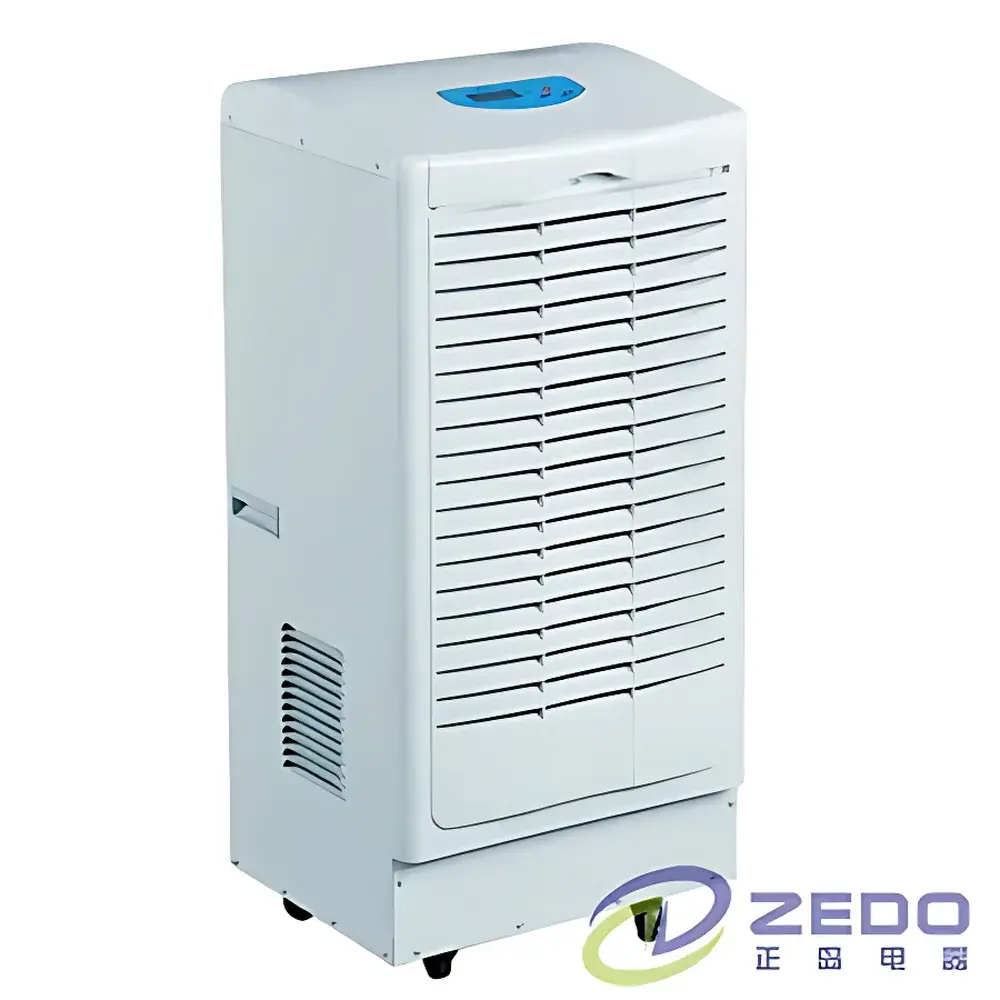
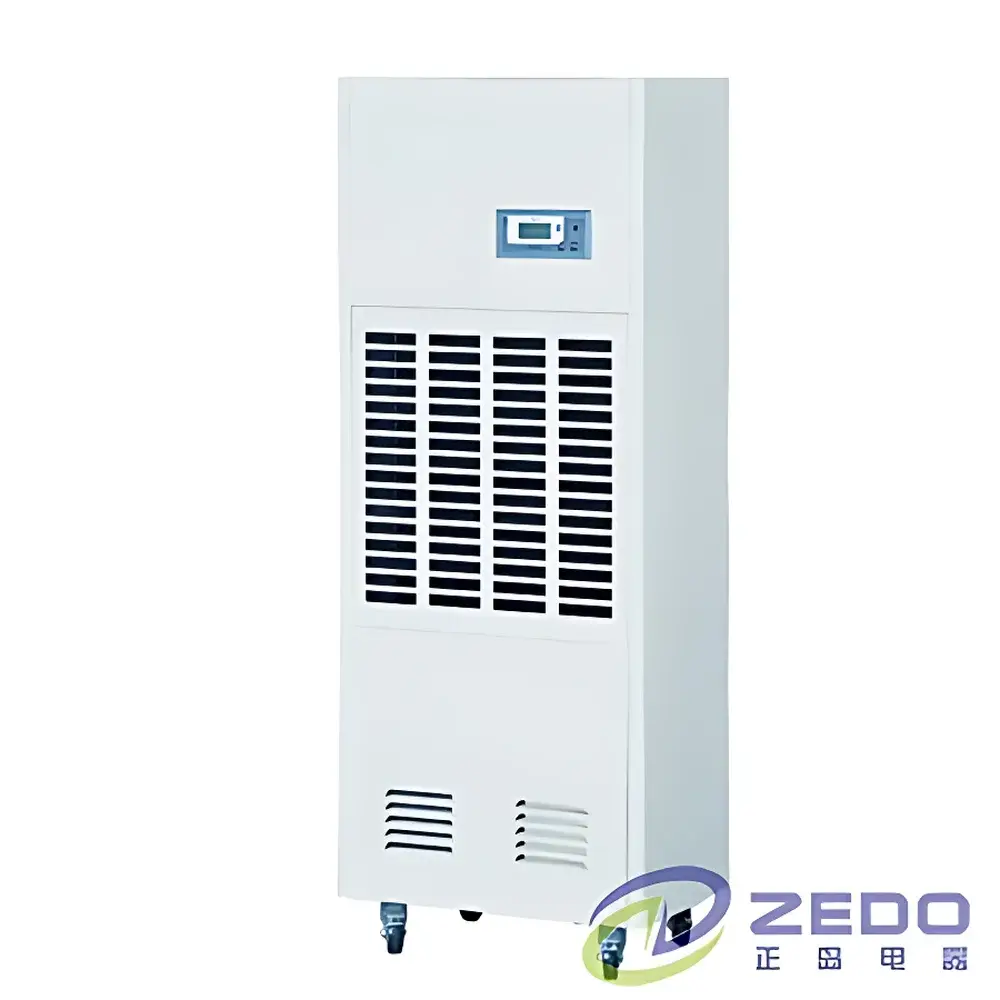
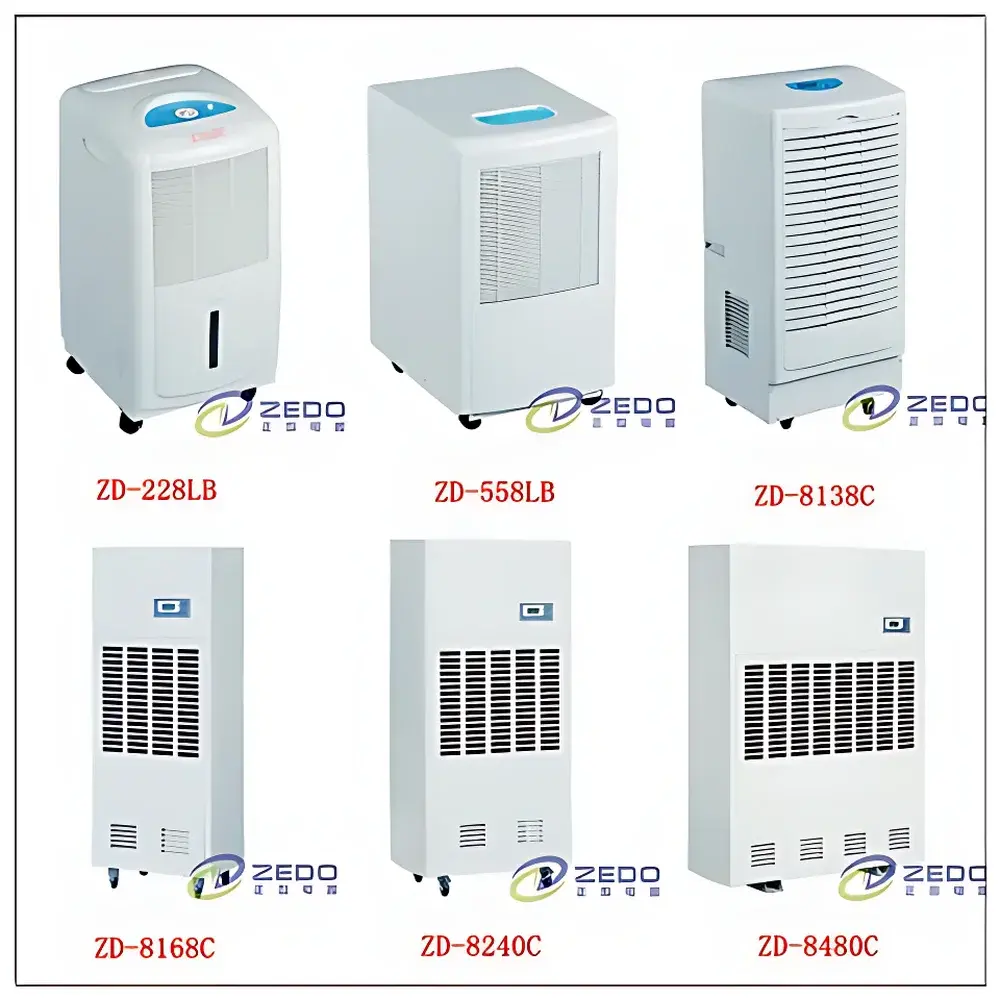
ZEDO ZD-8138C Industrial Refrigerant Dehumidifier for Electrical Switchrooms
| Brand | ZEDO |
|---|---|
| Origin | Zhejiang, China |
| Manufacturer Type | OEM/ODM Manufacturer |
| Country of Origin | China |
| Model | ZD-8138C |
| Instrument Type | Compressor-Based Dehumidifier |
| Dehumidification Capacity | 138 L/day |
| Control Method | Intelligent Humidity Setpoint Control |
| Drainage | Continuous via PVC Drain Hose |
| Power Supply | 220 V AC, 50 Hz |
| Input Power | 2000 W |
| Operating Temperature Range | 5–38 °C |
| Noise Level | 50 dB(A) |
| Dimensions (W×D×H) | 480 × 430 × 1100 mm |
| Net Weight | 58 kg |
| Safety Protections | 3-min Compressor Delay Start, High/Low Pressure Protection, Overload & Undervoltage Protection |
| Air Filtration | Standard Activated Carbon Filter |
| Sensor | Japanese Shinko High-Accuracy Hygrothermograph |
| Fan System | Dual-Centrifugal Industrial External-Rotor Blower |
| Heat Exchanger | Enhanced Aluminum Finned Copper Tube with Internal Grooved Design |
| Compressor | International Brand Scroll-Type Refrigeration Compressor |
| Refrigerant | Eco-Friendly R-410A |
| Compliance | CE-marked per EN 60335-1 & EN 60335-2-40 (Household and Similar Electrical Appliances – Safety) |
Overview
The ZEDO ZD-8138C Industrial Refrigerant Dehumidifier is an engineered solution for precision humidity control in mission-critical electrical infrastructure environments—specifically designed for indoor switchrooms, distribution cabinets, and control panels where ambient relative humidity must be maintained below 60% RH to prevent condensation-induced failure. Unlike consumer-grade units, the ZD-8138C operates on the principle of refrigerant-based condensation dehumidification: moist air is drawn across a sub-zero evaporator coil, cooled below its dew point, and condensed into liquid water; the dried air is then reheated via the condenser coil before discharge—ensuring stable sensible temperature output and minimizing thermal shock to sensitive equipment enclosures. Its robust architecture supports continuous 24/7 operation under industrial load cycles, making it suitable for Class I, Division 2 hazardous location-adjacent applications when installed per NEC Article 500 guidelines.
Key Features
- Industrial-grade scroll compressor with R-410A refrigerant—optimized for high coefficient of performance (COP) and low GWP compliance
- Dual-centrifugal external-rotor blower system delivering uniform airflow distribution across large-volume switchroom zones (100–150 m² coverage)
- Microprocessor-based controller with Shinko hygrothermographic sensor (±2% RH accuracy, 0.1% RH resolution) enabling programmable setpoint control from 30–80% RH
- Structural separation of refrigeration and air-handling circuits—facilitating modular maintenance without system shutdown
- Integrated activated carbon pre-filter mitigating airborne particulates and trace volatile organic compounds (VOCs) common in aging electrical insulation materials
- Comprehensive electrical protection suite including high/low pressure cutouts, thermal overload relays, undervoltage lockout, and 3-minute compressor restart delay to prevent short-cycling
Sample Compatibility & Compliance
The ZD-8138C is validated for use in non-explosive, indoor environments housing low- and medium-voltage distribution assets—including metal-enclosed switchgear (IEC 62271-200), motor control centers (NEMA ICS 2), and uninterruptible power supply (UPS) bays. It complies with EN 60335-1 (General Safety Requirements) and EN 60335-2-40 (Particular Requirements for Refrigerant Dehumidifiers), and meets electromagnetic compatibility (EMC) requirements per EN 61000-6-3 and EN 61000-6-4. While not intrinsically safe, its design aligns with IEEE Std 1100 (Recommended Practice for Powering and Grounding Sensitive Electronic Equipment) regarding mitigation of moisture-related insulation resistance degradation and electrochemical migration risks in printed circuit board assemblies.
Software & Data Management
The unit features a local HMI interface with tactile membrane keypad and LCD display showing real-time RH%, temperature, operating status, and fault codes. Although no cloud connectivity or remote SCADA integration is embedded, the controller supports analog 4–20 mA output for external building management systems (BMS) and includes dry-contact alarm relay outputs for integration into facility-wide environmental monitoring networks. Audit-ready event logging captures compressor runtime, sensor calibration history, and safety interlock activations—supporting GLP-aligned record retention protocols when paired with external data loggers compliant with FDA 21 CFR Part 11 requirements.
Applications
- Electrical switchrooms and transformer vaults requiring sustained RH < 55% to inhibit copper sulfide formation on busbar joints
- Substation control houses housing RTUs, protective relays, and digital fault recorders vulnerable to hygroscopic dust accumulation
- Medical imaging equipment rooms (MRI, CT) where humidity-induced dielectric breakdown in high-voltage generators poses operational risk
- Archival storage vaults for legacy SCADA firmware media and calibration certificates requiring ISO 14721 (OAIS) environmental stability
- Pharmaceutical clean utility corridors where HVAC redundancy mandates backup dehumidification capacity during AHU maintenance windows
FAQ
What is the minimum recommended operating temperature for continuous duty?
The unit is rated for uninterrupted operation between 5 °C and 38 °C ambient. Below 5 °C, frost accumulation on the evaporator requires defrost cycling—reducing net dehumidification efficiency.
Can this unit be integrated into a BMS using Modbus RTU or BACnet MS/TP?
No native fieldbus protocol is supported; however, analog 4–20 mA output and dry-contact alarms enable basic integration with third-party controllers supporting hardwired inputs.
Is the unit certified for use in classified electrical rooms per NFPA 70E?
While not arc-flash rated, its non-sparking enclosure design and grounding provisions meet NFPA 70E Table 130.7(C)(15)(a) requirements for “normal operation” tasks within limited approach boundaries.
Does the activated carbon filter require scheduled replacement?
Yes—ZEDO recommends replacement every 6 months under continuous operation or after 4,000 hours of runtime, depending on ambient airborne contaminant loading.
How does the unit handle condensate disposal in unattended locations?
Continuous gravity drainage via supplied 1.5 m PVC hose is standard; optional condensate pump kits (model CP-24V) support lift heights up to 5 m for remote sump discharge.



