
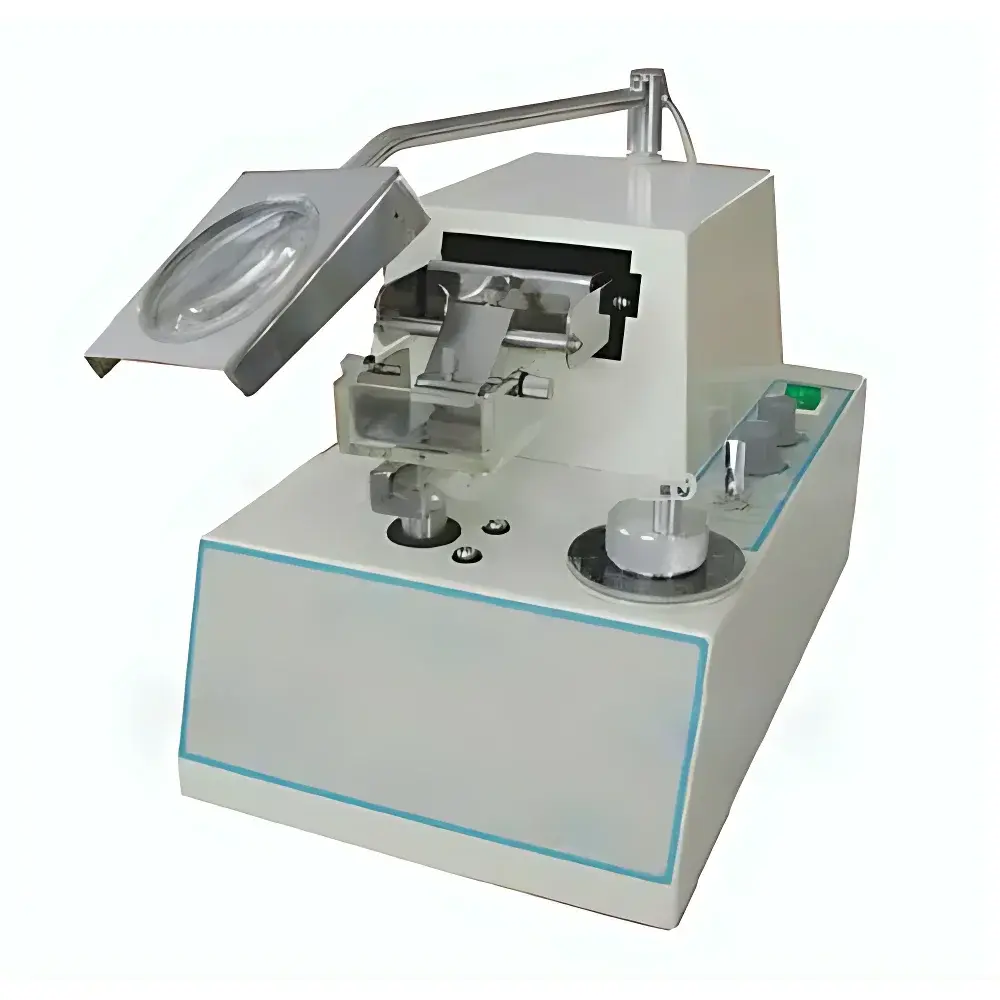
ZEEDO HS-1205 Vibrating Microtome
| Brand | ZEEDO |
|---|---|
| Origin | Zhejiang, China |
| Manufacturer Type | Authorized Distributor |
| Country of Origin | China |
| Model | HS-1205 |
| Cutting Step Resolution | 1 µm |
| Section Thickness Range | ≥10 µm |
| Cutting Speed | 0–1.3 mm/s (adjustable) |
| Vibration Amplitude | 0–1 mm |
| Specimen Vertical Travel | 9 mm |
| Blade Angle | 15° |
| Power Supply | AC 220 V, 50 Hz / AC 110 V, 60 Hz |
| Power Consumption | 200 VA |
| Dimensions (W×D×H) | 400 × 220 × 300 mm |
| Net Weight | 12 kg |
Overview
The ZEEDO HS-1205 Vibrating Microtome is an electromechanical precision sectioning instrument engineered for the preparation of live or chemically fixed biological tissues without cryofixation or embedding. Unlike conventional cryostats or paraffin microtomes, it operates on the principle of high-frequency blade oscillation—typically in the 50–100 Hz range—combined with controlled linear specimen advancement. This vibration-assisted cutting mechanism significantly reduces shear stress and thermal artifacts, preserving native tissue architecture, enzymatic activity, and antigenic epitopes essential for functional assays and immunohistochemical analysis. Designed specifically for neuroscience and physiological research, the HS-1205 enables reproducible slicing of soft, hydrated specimens—including fresh rodent brain, spinal cord, heart, and kidney—with minimal compression or chatter. Its ability to produce intact, undistorted sections as thin as 10 µm (for fixed tissue) and 30 µm (for fresh tissue) supports downstream applications such as patch-clamp electrophysiology, live-cell imaging, and confocal fluorescence reconstruction.
Key Features
- Precision step motor-driven advancement with 1 µm minimum increment resolution, ensuring consistent section thickness across serial cuts.
- Adjustable cutting speed (0–1.3 mm/s) optimized for varying tissue elasticity and viscosity—critical for balancing section integrity and throughput.
- Programmable vibration amplitude (0–1 mm peak-to-peak), allowing fine-tuning of blade kinematics to match tissue mechanical properties.
- 9 mm vertical specimen travel range accommodates standard tissue cassettes and custom embedding molds while maintaining optimal blade–specimen geometry.
- Fixed 15° blade angle calibrated for optimal chip removal and reduced tissue drag during vibrational shearing.
- Dual-voltage compatibility (AC 110 V / 220 V) with universal frequency support (50/60 Hz), enabling stable operation in global laboratory environments.
- Compact footprint (400 × 220 × 300 mm) and low power draw (200 VA) suitable for benchtop integration in electrophysiology rigs or core imaging facilities.
Sample Compatibility & Compliance
The HS-1205 is validated for use with unfixed, lightly fixed (e.g., 4% paraformaldehyde ≤2 h), and resin-infiltrated soft tissues. It demonstrates high reproducibility with murine and porcine neural tissues, cardiac ventricular slices, and renal cortical explants. While not certified to ISO 13485 or FDA 21 CFR Part 11 out-of-the-box, its mechanical design aligns with GLP-compliant documentation practices when paired with external audit trails (e.g., timestamped video capture, manual logbooks). The system complies with IEC 61010-1:2010 for electrical safety in laboratory equipment and meets CE marking requirements for EMC and low-voltage directives. Users performing clinical research should validate protocol-specific performance per CLIA or CAP guidelines prior to diagnostic application.
Software & Data Management
The HS-1205 operates via a front-panel digital interface with tactile rotary encoder and LED display—no proprietary software or PC connection required. All operational parameters (speed, thickness, vibration amplitude) are retained in non-volatile memory after power cycling. For laboratories requiring traceability, optional RS-232 or USB-to-serial adapters enable integration with LabArchives, ELN platforms, or custom Python-based logging scripts. Though the device lacks built-in audit trail functionality, its deterministic mechanical behavior ensures full repeatability under defined environmental conditions (20–25°C, <60% RH), supporting ISO/IEC 17025 method validation workflows.
Applications
- Preparation of acute brain slices for hippocampal or cortical electrophysiology (e.g., field potential recording, whole-cell patch clamp).
- Spinal cord slice generation for locomotor circuit mapping and synaptic pharmacology studies.
- Viable cardiac tissue sectioning to assess contractile dynamics and calcium transients ex vivo.
- Routine histological sectioning of perfusion-fixed tissues where antigen retrieval must be minimized (e.g., phosphorylation-state immunodetection).
- Correlative light-electron microscopy (CLEM) sample prep, where ultrastructural preservation precedes resin embedding.
- Teaching laboratories requiring robust, low-maintenance instrumentation for undergraduate neuroanatomy or physiology labs.
FAQ
What types of blades are compatible with the HS-1205?
The instrument accepts standard vibrating microtome blades (e.g., Feather S35, Ted Pella 11000-00, or Leica 1500 series) mounted on a universal blade holder with 15° angular alignment.
Can the HS-1205 cut frozen tissue?
No—it is not designed for cryosectioning; freezing induces ice crystal damage that compromises vibrational cutting fidelity. For frozen samples, a dedicated cryostat (e.g., Leica CM1950) is recommended.
Is calibration verification required before each experiment?
Yes. Users must verify section thickness accuracy using a calibrated stage micrometer and optical measurement (e.g., via transmitted-light microscope with graticule), especially after blade replacement or mechanical recalibration.
Does the HS-1205 support automated serial sectioning?
It provides manual or semi-automated sequential advancement but lacks integrated auto-collection or tape-transfer modules found in research-grade systems like the Leica VT1200S.
What maintenance schedule is recommended?
Blade sharpening or replacement every 10–20 hours of cumulative operation; lubrication of vertical translation rails every 3 months; annual inspection of motor coupling and encoder alignment by authorized service personnel.
Related Products



