
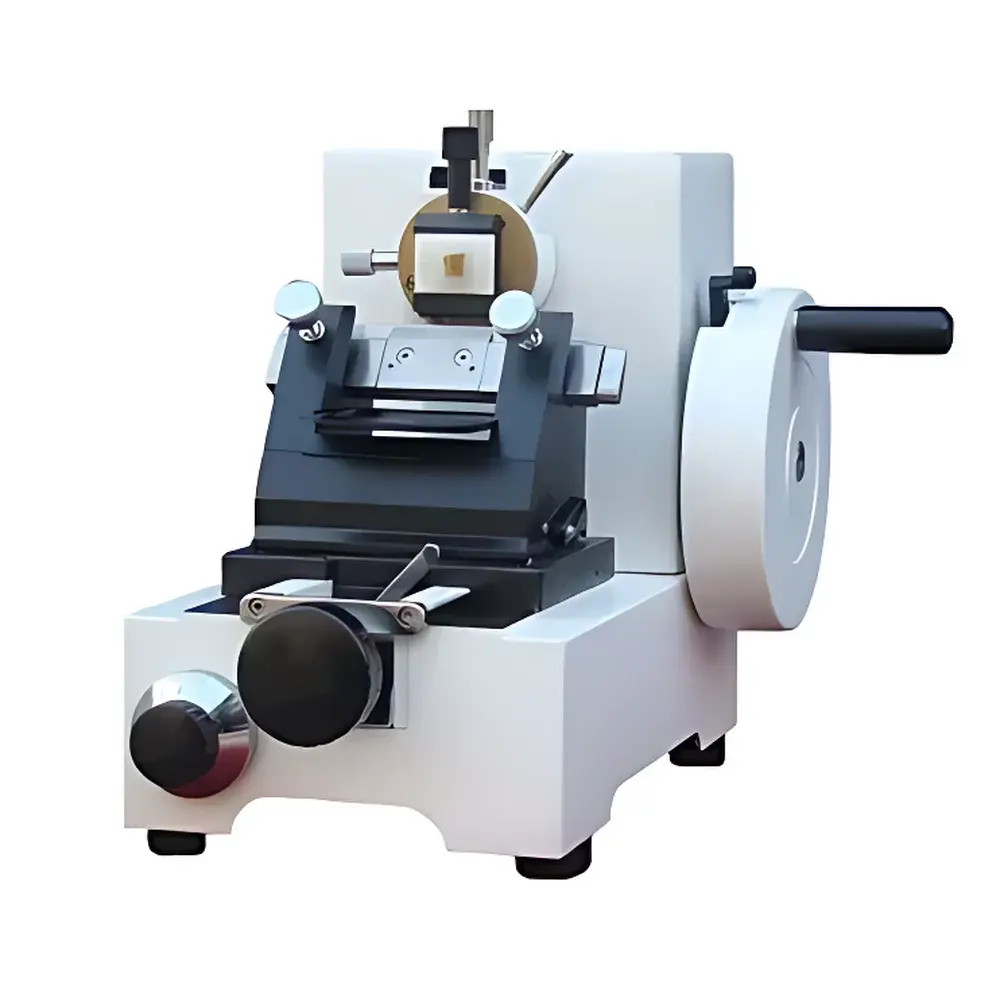
ZEEDO HS-2026 Rotary Microtome for Plant and Biological Tissue Sectioning
| Brand | ZEEDO |
|---|---|
| Origin | Zhejiang, China |
| Model | HS-2026 |
| Maximum Sample Size | 50 × 40 mm |
| Section Thickness Range | 1–35 µm |
| Minimum Increment | 1 µm |
| Accuracy | ±10% |
| Compatible Embedding Medium | Paraffin |
| Dimensions (W×D×H) | 470 × 320 × 320 mm |
| Weight | 22.5 kg |
Overview
The ZEEDO HS-2026 Rotary Microtome is a precision-engineered instrument designed for consistent, high-fidelity sectioning of plant, animal, and human biological tissues embedded in paraffin or compatible low-melting-point media. Operating on the classic rotary microtome principle—where the specimen advances vertically toward a stationary knife with each revolution of the handwheel—the HS-2026 delivers reproducible thin sections essential for light microscopy, histopathological evaluation, and routine laboratory diagnostics. Its mechanical architecture prioritizes stability and tactile control, supporting both manual operation and semi-automated workflows. The device is optimized for routine histology laboratories requiring reliable performance across diverse tissue types—from fibrous plant stems and lignified xylem to soft mammalian organs and fixed embryonic specimens.
Key Features
- Adjustable section thickness from 1 µm to 35 µm in precise 1 µm increments, enabling fine-tuning for delicate plant epidermis or dense sclerenchyma.
- Robust specimen stage with calibrated horizontal and vertical adjustment, ensuring optimal alignment relative to the cutting edge.
- Integrated knife holder accommodating standard steel or disposable blades (e.g., Feather 819/818, Leica-compatible profiles), with adjustable tilt and clearance angle controls.
- Stainless-steel construction and vibration-damped base minimize operational drift and enhance long-term repeatability.
- Ergonomic handwheel with dual-scale vernier readout for real-time thickness verification and intuitive operation during extended sessions.
- Compact footprint (470 × 320 × 320 mm) and 22.5 kg mass ensure stable benchtop placement without requiring anchoring or specialized mounting.
Sample Compatibility & Compliance
The HS-2026 supports tissue blocks up to 50 × 40 mm in cross-section, accommodating standard paraffin-embedded cassettes and custom molds used in botanical and agricultural research. It is validated for use with routinely processed plant material—including leaf lamina, root nodules, woody stem cross-sections, and seed embryos—as well as animal-derived formalin-fixed, paraffin-embedded (FFPE) samples. While not certified under ISO 13485 or FDA 21 CFR Part 11, the instrument’s mechanical design aligns with general laboratory good practice (GLP) requirements for traceable, documented sectioning procedures. Users performing regulated histology (e.g., academic GLP studies or preclinical pathology) are advised to implement internal calibration logs and periodic verification using NIST-traceable thickness standards.
Software & Data Management
The HS-2026 operates as a fully manual/mechanical system with no embedded electronics or digital interface. Consequently, it does not require firmware updates, driver installation, or software licensing. All operational parameters—including section thickness, number of cuts, and orientation—are recorded manually in laboratory notebooks or integrated into LIMS via user-defined entry protocols. This analog architecture ensures immunity to electromagnetic interference, eliminates cybersecurity concerns, and guarantees uninterrupted functionality in environments where power stability or IT infrastructure is limited—such as field stations, teaching labs, or resource-constrained research facilities.
Applications
- Preparation of serial sections for anatomical mapping of vascular bundles in monocot and dicot species.
- Routine histological analysis of transgenic plant lines undergoing phenotypic screening.
- Sectioning of resin-embedded or paraffin-processed root tissue for mycorrhizal colonization assessment.
- Supporting correlative workflows with downstream staining (e.g., PAS, toluidine blue, safranin-O/fast green) and digital slide scanning.
- Training platform in undergraduate and graduate histotechnology curricula due to its transparent mechanical operation and direct operator feedback loop.
- Complementary use alongside cryostats (e.g., HS-3090A, HS-3060 series) when dual-modality sectioning—paraffin vs. frozen—is required for comparative expression studies.
FAQ
Is the HS-2026 suitable for cutting unfixed or frozen tissue?
No—it is engineered exclusively for paraffin-embedded or low-melting-point wax-embedded specimens. For frozen sections, refer to the HS-3090A or HS-3060T cryostat series.
What blade types are compatible with the knife holder?
Standard disposable steel blades (Feather 819, 818), Leica 818/819 equivalents, and reusable tungsten-carbide knives with 22–25 mm width and 0.5–1.0 mm thickness.
Does the instrument include calibration documentation or certification?
No factory-issued calibration certificate is provided; users must perform initial verification using certified micrometer gauges or calibrated test sections per internal SOPs.
Can the HS-2026 be integrated into automated tissue processing lines?
It is a standalone mechanical unit with no digital I/O ports, network connectivity, or robotic interface capability.
What maintenance is recommended for long-term accuracy?
Monthly cleaning of the specimen advance mechanism with isopropyl alcohol, biannual lubrication of gear trains with silicone-free microtome oil, and annual inspection of knife alignment by qualified service personnel.



