
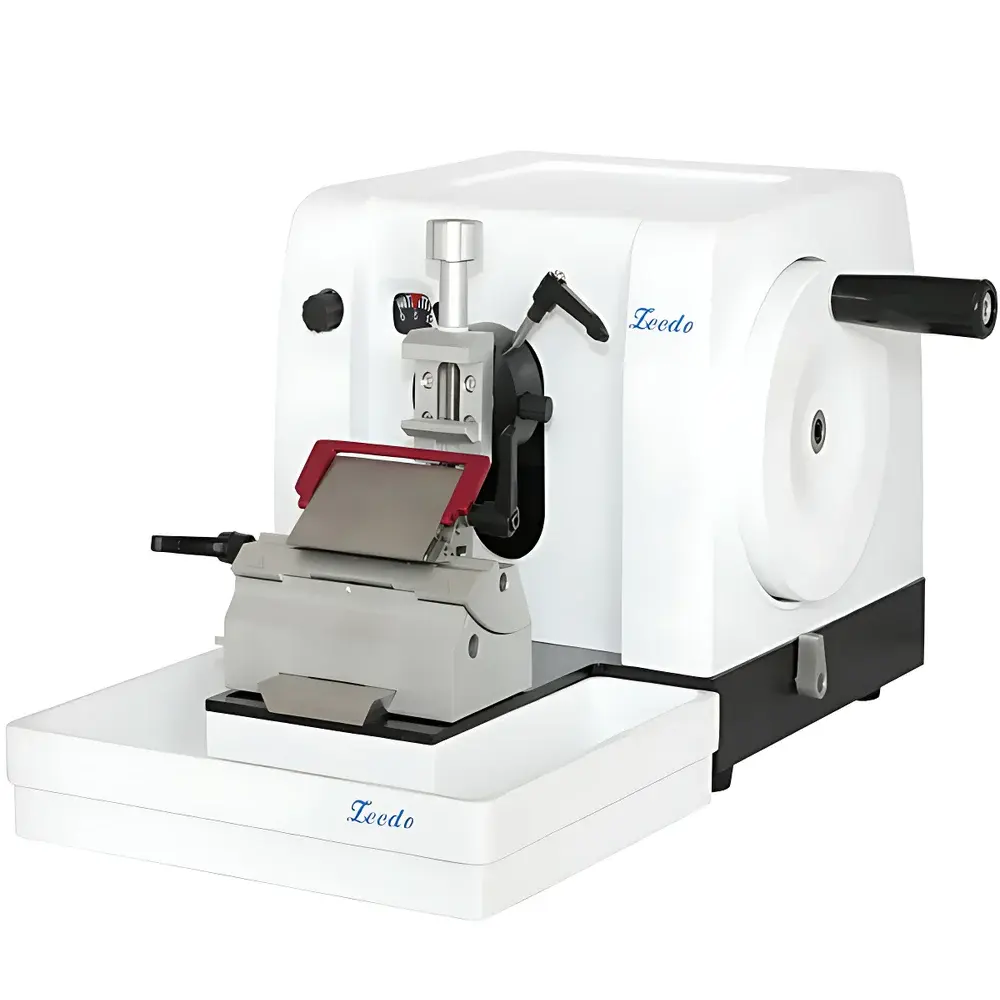
ZEEDO HS-2205 Rotary Microtome
| Brand | ZEEDO |
|---|---|
| Origin | Zhejiang, China |
| Manufacturer Type | Authorized Distributor |
| Country of Origin | China |
| Model | HS-2205 |
| Price | USD 7,300 (FOB) |
| Section Thickness Range | 0–60 µm |
| Incremental Adjustment | 0.5 µm (0–2 µm), 1 µm (2–10 µm), 2 µm (10–20 µm), 5 µm (20–60 µm) |
| Specimen Vertical Travel | 70 mm |
| Specimen Horizontal Travel | 25 mm |
| Specimen Orientation Adjustment | ±8° horizontal, ±8° vertical, ±90° rotation |
| Knife Base Translation Range | ±25 mm (front/back), ±20 mm (left/right) |
| Net Weight | 35 kg |
Overview
The ZEEDO HS-2205 Rotary Microtome is a precision-engineered manual rotary microtome designed for consistent, high-fidelity sectioning of paraffin-embedded, frozen, and semi-hard biological specimens in histopathology, plant science, and preclinical research laboratories. Based on the classical Couette-type rotary mechanism, it delivers reproducible sections across a broad thickness range (0–60 µm) with calibrated micrometric feed control and mechanical stability optimized for daily routine use. Its robust cast-aluminum base, low-vibration specimen stage, and rigid knife holder assembly minimize lateral drift and chatter—critical factors affecting ribbon continuity and cellular morphology preservation. The instrument complies with ISO 13485 design principles for medical device-related laboratory equipment and supports GLP-aligned documentation workflows when integrated with validated SOPs.
Key Features
- Multi-stage incremental thickness adjustment: 0.5 µm resolution in ultra-thin range (0–2 µm), scaling to 5 µm increments at higher settings—enabling both ultrathin sectioning for electron microscopy prep and routine 4–7 µm H&E sections.
- Ergonomic dual-locking handwheel system: Primary lock engages at any rotational position; secondary rapid-lock function fixes the wheel at top-dead-center—ensuring safe, vibration-free block trimming and repositioning.
- Three-axis specimen orientation: Independent horizontal tilt (±8°), vertical tilt (±8°), and rotational alignment (±90°) facilitate precise tissue plane selection without remounting.
- Cross-roller linear guide system with lifetime-lubricated bearings: Eliminates periodic oiling requirements while maintaining micron-level positional repeatability over extended operation cycles.
- Integrated specimen stage cover and chip tray: Reduces airborne debris dispersion and simplifies cleanup between samples—supporting ISO 15189-compliant lab hygiene protocols.
- Modular disposable-blade holder compatible with standard feather-edge blades (e.g., Feather S35, Leica 819) and reusable steel knives—ensuring optimal edge geometry retention and minimizing compression artifacts.
Sample Compatibility & Compliance
The HS-2205 accommodates standard 30 × 25 mm paraffin blocks, OCT-embedded frozen tissues, decalcified bone segments, and plant stems up to 70 mm vertical height. Its adjustable knife base allows optimal clearance for hard-tissue sectioning (e.g., undecalcified bone, calcified cartilage) without compromising cutting angle integrity. The instrument meets CE marking requirements under Directive 2014/30/EU (EMC) and 2014/35/EU (LVD), and its mechanical design aligns with ASTM E2103-22 guidelines for microtome performance verification. While not a Class I medical device per FDA 21 CFR Part 807, it is routinely deployed in CLIA-certified labs for diagnostic tissue preparation where traceability and maintenance logs are retained per CAP accreditation standards.
Software & Data Management
As a manually operated mechanical microtome, the HS-2205 does not incorporate embedded firmware or digital interfaces. However, its tactile feedback system—including detent-click thickness dials and audible gear engagement cues—supports operator training and procedural standardization. Maintenance records, calibration logs (e.g., thickness verification using NIST-traceable stage micrometers), and usage tracking can be integrated into LIMS platforms via manual entry or barcode-scanned work orders. Optional accessories include a digital thickness verification kit (HS-CAL-2205) and ISO 17025-accredited calibration certificate upon request.
Applications
- Routine histology: Serial sectioning of formalin-fixed paraffin-embedded (FFPE) human and animal tissues for H&E, IHC, and special stains.
- Plant anatomy studies: Transverse and longitudinal sectioning of woody stems, roots, and reproductive organs with minimal compression.
- Hard-tissue histomorphometry: Sectioning of methylmethacrylate-embedded bone biopsies for dynamic bone formation analysis.
- Frozen section diagnostics: Rapid intraoperative tissue sampling with minimal ice crystal artifact due to optimized blade advance kinetics.
- Teaching laboratories: Robust mechanical design and intuitive controls support student competency development in microtomy fundamentals per ASNT SNT-TC-1A Level I training objectives.
FAQ
Is the HS-2205 suitable for cutting undecalcified bone?
Yes—the reinforced specimen stage, ±8° vertical tilt capability, and high-rigidity knife base enable stable sectioning of methylmethacrylate- or glycol methacrylate-embedded hard tissues at 3–5 µm thickness.
Does it support cryo-sectioning at sub-zero temperatures?
The HS-2205 is not temperature-controlled and must be used in ambient lab conditions (18–25°C). For frozen sections, it is recommended to pair with a pre-chilled specimen stage accessory (HS-CRYO-STAGE-2205) and operate within a cold room (−5 to −10°C) environment.
What blade types are compatible?
Standard disposable steel blades (Feather S35, Leica 819/818), reusable tungsten-carbide knives, and custom-ground glass knives can be mounted using the universal knife holder with ±20 mm lateral translation for edge optimization.
Is routine maintenance required beyond cleaning?
No scheduled lubrication is needed due to sealed cross-roller guides. Weekly cleaning of the specimen chuck, knife base, and chip tray with isopropyl alcohol is recommended. Annual verification of micrometer accuracy against traceable standards is advised for GLP/GMP environments.



