
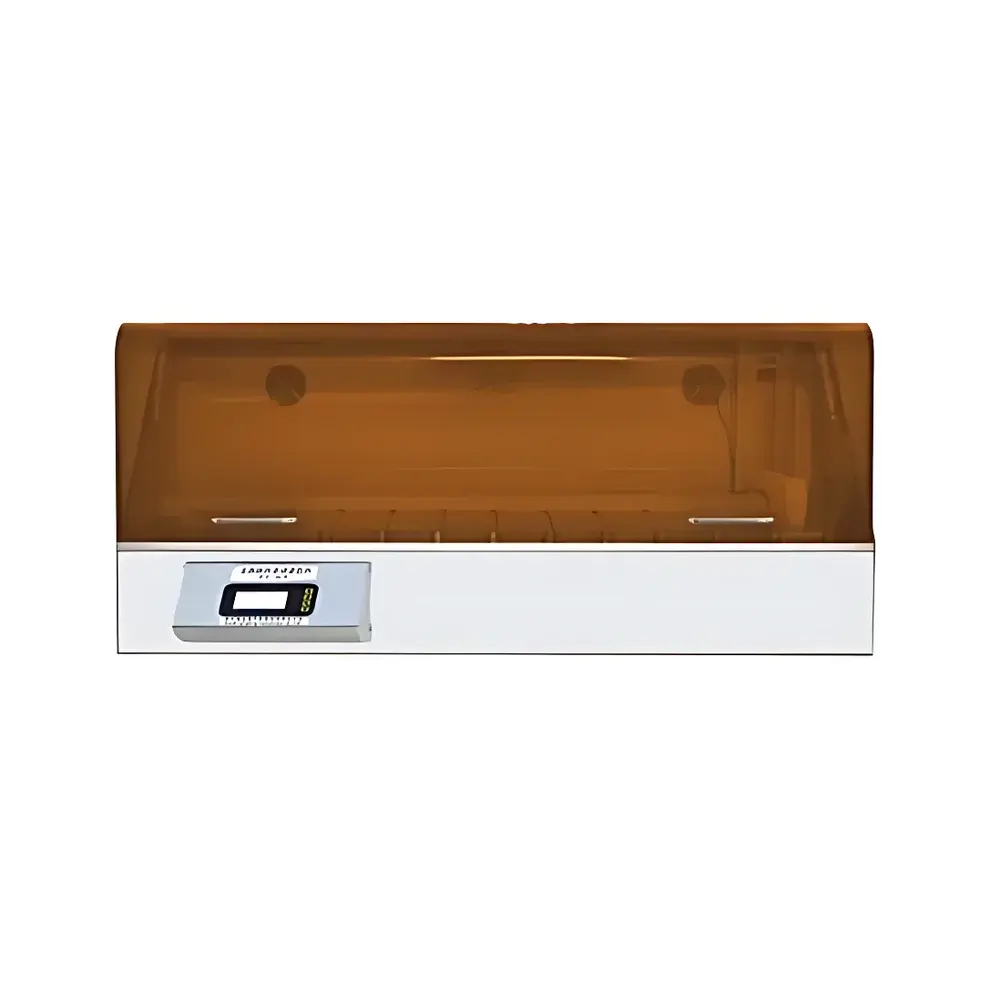
ZEEDO LSD-600 Fully Automatic Rotary Tissue Staining System
| Brand | ZEEDO |
|---|---|
| Origin | Zhejiang, China |
| Manufacturer Type | Authorized Distributor |
| Country of Manufacture | China |
| Model | LSD-600 |
| Price | USD 7,300 (FOB) |
| Automation Level | Fully Automatic |
| Instrument Type | Rotary Staining System |
| Processing Tanks | 14 (12 reagent tanks + 1 rinse tank + 1 drying tank) |
| Tank Capacity | ≥1000 mL per tank |
| Staining Capacity | 72 glass slides per cycle |
| Time per Tank | 0–59 min 59 sec (adjustable) |
| Power Supply | AC 220 V / 50 Hz or AC 110 V / 60 Hz |
| Power Consumption | 500 VA |
| Dimensions (W×D×H) | 1130 × 460 × 400 mm |
| Net Weight | 85 kg |
Overview
The ZEEDO LSD-600 Fully Automatic Rotary Tissue Staining System is an engineered solution for high-throughput histopathological slide preparation in clinical laboratories, academic pathology departments, and contract research organizations (CROs). Based on the rotary immersion principle—where glass slide racks rotate continuously through a sequence of precisely timed reagent baths—the system ensures uniform, reproducible staining across all slides within a batch. Unlike dip-and-dwell or linear transport systems, the LSD-600’s balanced rotary motion minimizes mechanical stress on delicate tissue sections while optimizing reagent contact time and diffusion kinetics. Its architecture supports routine hematoxylin–eosin (H&E), special stains (e.g., Masson’s trichrome, PAS), and immunohistochemistry (IHC) pretreatment protocols under controlled environmental conditions. Designed to meet evolving workflow demands, the LSD-600 integrates fluid management, thermal regulation, and programmable sequencing into a single compact platform compliant with ISO 13485–aligned manufacturing practices.
Key Features
- 14-position rotary carousel with dedicated stations: 12 reagent tanks, 1 dedicated deionized water rinse tank (Tank #9), and 1 heated drying station (Tank #1)
- High-resolution 7-inch TFT LCD touchscreen interface with Chinese/English bilingual firmware and intuitive icon-driven navigation
- Programmable dwell time per tank (0–59 min 59 sec in 1-second increments), enabling protocol customization for H&E, Alcian blue, silver stains, and antigen retrieval steps
- Intelligent water management system featuring automatic inlet valve control, gravity-assisted drainage, and sequential fresh-water rinsing to minimize carryover and cross-contamination
- Low-noise brushless DC motor drive with precision gear reduction, delivering stable rotational speed (<±2 rpm variation) and operational noise <52 dB(A)
- Dual-mode drying: ambient air circulation + optional resistive heating (up to 60 °C) in Tank #1, configurable per protocol
- Corrosion-resistant stainless-steel tank housing and PTFE-coated internal components for long-term chemical compatibility with xylene, ethanol, acid fuchsin, and alkaline reagents
Sample Compatibility & Compliance
The LSD-600 accommodates standard 1″ × 3″ (25 × 75 mm) microscope slides mounted in reusable polypropylene staining racks (capacity: 72 slides per run). It supports both paraffin-embedded and frozen-sectioned tissues without modification. Slide rack geometry ensures consistent immersion depth and prevents edge stacking or slide adhesion during rotation. The system complies with key regulatory expectations for laboratory instrumentation: hardware design follows IEC 61010-1 safety standards; software architecture supports audit trail generation (user login, protocol edits, run logs) in alignment with GLP and CAP checklist requirements. While not FDA 510(k)-cleared as a Class II device, its operational parameters and documentation framework are structured to facilitate integration into ISO 15189-accredited pathology labs and support traceability under CLIA and UKAS assessment criteria.
Software & Data Management
Embedded firmware enables storage of up to 99 user-defined staining protocols, each with independent temperature, timing, agitation, and rinse settings. All runs are timestamped and logged locally with operator ID, protocol name, start/end time, and any manual intervention flags. Optional RS-232 or USB-C export allows transfer of CSV-formatted run reports to LIMS or electronic lab notebooks (ELN). No cloud connectivity or remote access is implemented—data residency remains fully on-device to meet institutional IT security policies. Firmware updates are performed via encrypted USB stick with SHA-256 signature verification, ensuring integrity and version control.
Applications
- Routine diagnostic H&E staining for surgical pathology specimens
- Special stain workflows including reticulin, van Gieson, Giemsa, and Ziehl–Neelsen
- IHC pre-treatment modules (heat-induced epitope retrieval in citrate or EDTA buffer)
- Research-grade staining consistency across multi-center studies requiring inter-laboratory reproducibility
- Training environments where standardized, hands-off operation reduces technician variability
FAQ
What types of tissue sections is the LSD-600 validated for?
The system is validated for formalin-fixed paraffin-embedded (FFPE) sections and cryosections on standard glass slides. Decalcified bone or heavily pigmented tissues may require protocol optimization.
Does the LSD-600 support temperature-controlled staining steps?
Yes—reagent tanks can be maintained at ambient temperature; the integrated drying station (Tank #1) provides adjustable heating up to 60 °C. External water bath integration is supported for temperature-sensitive protocols.
How is carryover between reagents prevented?
Sequential fresh-water rinsing (Tank #9), optimized rotation dwell time, and gravity-drain architecture minimize residual reagent transfer. Optional post-rinse air purge is available via accessory kit.
Is service and technical support available outside China?
ZEEDO authorizes regional service partners in Southeast Asia, the Middle East, and Latin America. Firmware updates and calibration documentation are provided in English with multilingual operator manuals.
Can the LSD-600 be integrated into an automated tissue processing line?
It features dry-contact relay outputs and TTL-level status signals compatible with third-party automation controllers (e.g., Beckman Coulter, Leica Biosystems interfaces), enabling synchronization with embedding stations or slide labeling systems.





