
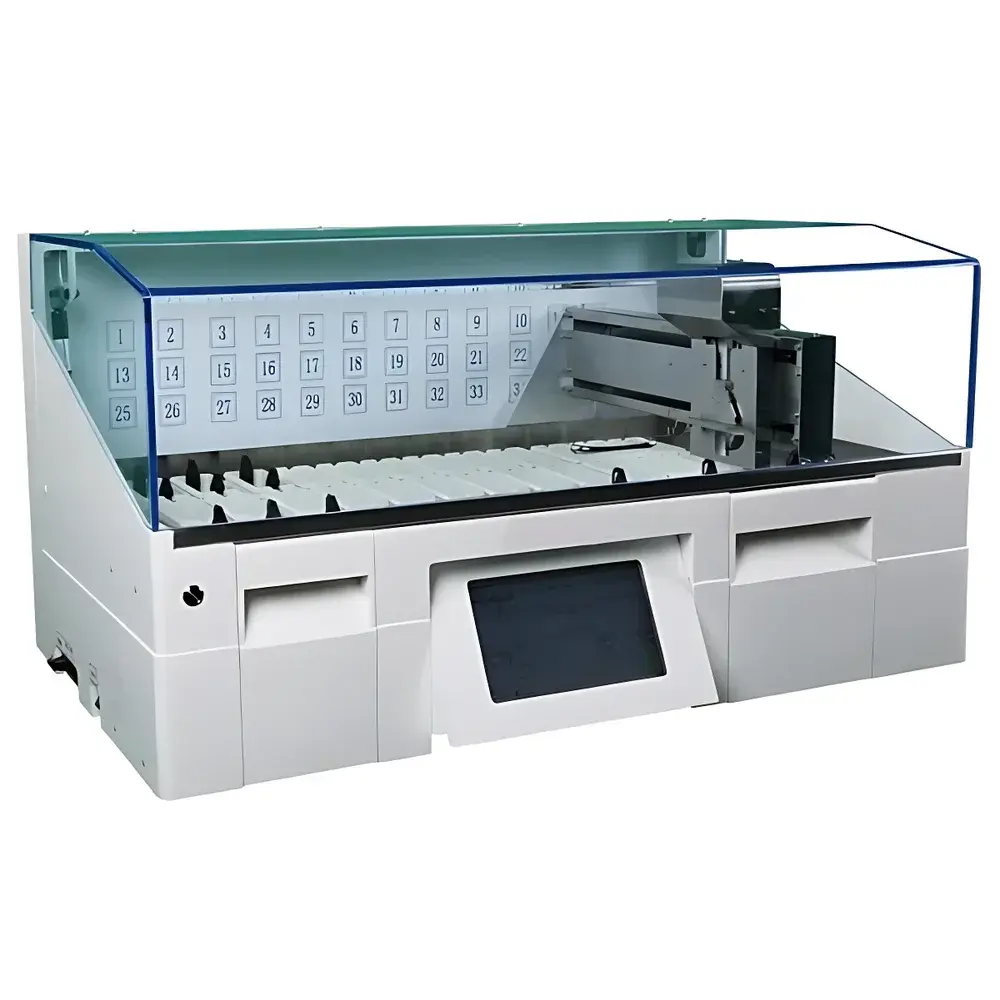
ZEEDO LSS820 Dual-Row Automated Tissue Staining System
| Origin | Zhejiang, China |
|---|---|
| Manufacturer Type | Authorized Distributor |
| Origin Category | Domestic (China) |
| Model | LSS820 |
| Price Range | USD 7,000 – 14,000 |
| Automation Level | Fully Automatic |
| Instrument Type | Rotary-Style Stainer |
| Slide Capacity per Rack | 30 slides |
| Max Concurrent Racks | 10 |
| Total Stations | 36 |
| Reagent Stations | 26 (2 configurable as empty stations) |
| Wash Stations | 5 |
| Reagent Jar Volume | 500 mL |
| Load Stations | 2 |
| Unload Stations | 3 |
| Stored Protocols | 10 |
| Power Supply | 220 VAC ±10%, 50/60 Hz |
| Power Consumption | 200 W |
| Touchscreen | 10.4-inch Color TFT LCD with Graphical User Interface (GUI), Role-Based User Management |
| Dimensions (L×W×H) | 1050 × 615 × 590 mm |
| Throughput | Up to 400 slides/hour |
| Robotic Arm Speed | <1 s station-to-station movement |
| Rack Lift Cycles | Programmable |
Overview
The ZEEDO LSS820 Dual-Row Automated Tissue Staining System is a high-throughput, rotary-style histopathology stainer engineered for precision, reproducibility, and workflow scalability in clinical pathology and research laboratories. Based on a robust carousel architecture with dual-row reagent access, the system executes standardized and customized tissue staining protocols—including Hematoxylin & Eosin (H&E), special stains (e.g., Masson’s Trichrome, PAS), and immunohistochemistry (IHC) pretreatment steps—under tightly controlled temperature, dwell time, and reagent exchange parameters. Its design adheres to core principles of histotechnological consistency: uniform slide immersion depth, minimized cross-contamination via isolated station zoning, and programmable agitation profiles during incubation phases. The LSS820 supports GLP-compliant operations through audit-trail-capable software logging and user-access tiering, making it suitable for laboratories undergoing CAP accreditation or ISO 15189 validation.
Key Features
- Fully automated rotary platform with dual-row station layout, enabling parallel processing of up to 10 independent staining racks (30 slides each) under distinct protocols.
- 36-position station matrix comprising 26 reagent stations (2 of which are dynamically assignable as empty positions to accommodate large-volume or custom reagents), 5 dedicated wash stations, 2 load stations, and 3 unload stations.
- High-speed robotic arm with sub-second positioning accuracy across all stations; programmable vertical lift cycles per rack to optimize reagent drainage and reduce carryover.
- 10.4-inch color touchscreen interface featuring graphical real-time protocol visualization, color-coded program selection, and role-based user authentication (administrator, technician, viewer).
- Modular electrical architecture supporting seamless integration of optional modules (e.g., heated dewaxing station, IHC antigen retrieval module) without hardware retrofitting.
- Intelligent resource scheduling algorithm that dynamically allocates reagent stations and optimizes rack sequencing when multiple protocols run concurrently—minimizing idle time and maximizing throughput.
Sample Compatibility & Compliance
The LSS820 accommodates standard 25 × 75 mm glass microscope slides mounted with paraffin-embedded tissue sections (3–5 µm thickness). It is compatible with conventional aqueous and alcohol-based reagents, including hematoxylin variants, eosin Y, lithium carbonate bluing solution, acid alcohol differentiation agents, and commercial IHC epitope retrieval buffers. All fluid-handling components are chemically resistant to common histology solvents (xylene, ethanol, isopropanol) and corrosion-resistant stainless-steel or PTFE-lined. The system complies with IEC 61010-1:2010 for laboratory equipment safety and meets electromagnetic compatibility requirements per EN 61326-1. For regulated environments, the software supports 21 CFR Part 11–compliant electronic signatures and full audit trail generation (user actions, protocol modifications, runtime logs, error events) exportable in CSV or PDF format.
Software & Data Management
The embedded control software provides intuitive protocol creation via drag-and-drop step sequencing, with adjustable parameters for immersion time (1 s–24 h resolution), agitation frequency (0–60 rpm), temperature setpoints (ambient to 95 °C, if equipped with heating modules), and rinse cycle count. Ten preloaded protocols—including H&E, Giemsa, and Alcian Blue–PAS—are factory-validated. Users may save, duplicate, version-control, and password-protect custom protocols. All operational data—including rack ID tracking, reagent lot registration (manual entry), start/end timestamps, and anomaly flags (e.g., low fluid level, timeout, sensor fault)—are stored locally on an internal industrial-grade SSD with 5-year retention capacity. Data export supports USB drive transfer and networked push to LIS/HIS systems via HL7 v2.5 or ASTM E1384 interfaces.
Applications
- Routine diagnostic H&E staining for surgical pathology specimens with strict turnaround time requirements.
- High-volume special stain workflows (e.g., reticulin, trichrome, mucicarmine) requiring precise timing and reagent sequence integrity.
- Standardized antigen retrieval and buffer conditioning prior to automated IHC staining platforms.
- Research histology labs performing comparative cohort studies where inter-batch staining consistency is critical for digital pathology image analysis.
- Core facilities serving multiple departments, where concurrent execution of divergent protocols (e.g., frozen section H&E + decalcified bone PAS) must be managed without manual intervention.
FAQ
What is the maximum number of slides processed per hour?
Up to 400 slides per hour—achieved when operating at full rack capacity (10 racks × 30 slides) with optimized cycle times for routine H&E.
Can the LSS820 be integrated with existing laboratory information systems (LIS)?
Yes—it supports bidirectional HL7 v2.5 and ASTM E1384 messaging for slide order receipt, status updates, and result association.
Is remote monitoring or troubleshooting supported?
The system includes Ethernet connectivity and optional VPN-enabled remote diagnostics (with user consent and firewall configuration), allowing authorized service engineers to review logs and perform firmware updates.
How does the system prevent reagent cross-contamination between protocols?
Each station is physically isolated; reagent jars are sealed and assigned per protocol; the robotic arm undergoes automatic tip-wash between reagent transfers; and the software enforces mandatory wash steps before station reuse.
Does the LSS820 meet regulatory requirements for clinical diagnostic use?
It is designed to support compliance with CAP, CLIA, ISO 15189, and national medical device regulations for Class II in vitro diagnostic auxiliary equipment; final validation remains the responsibility of the end-user laboratory.



