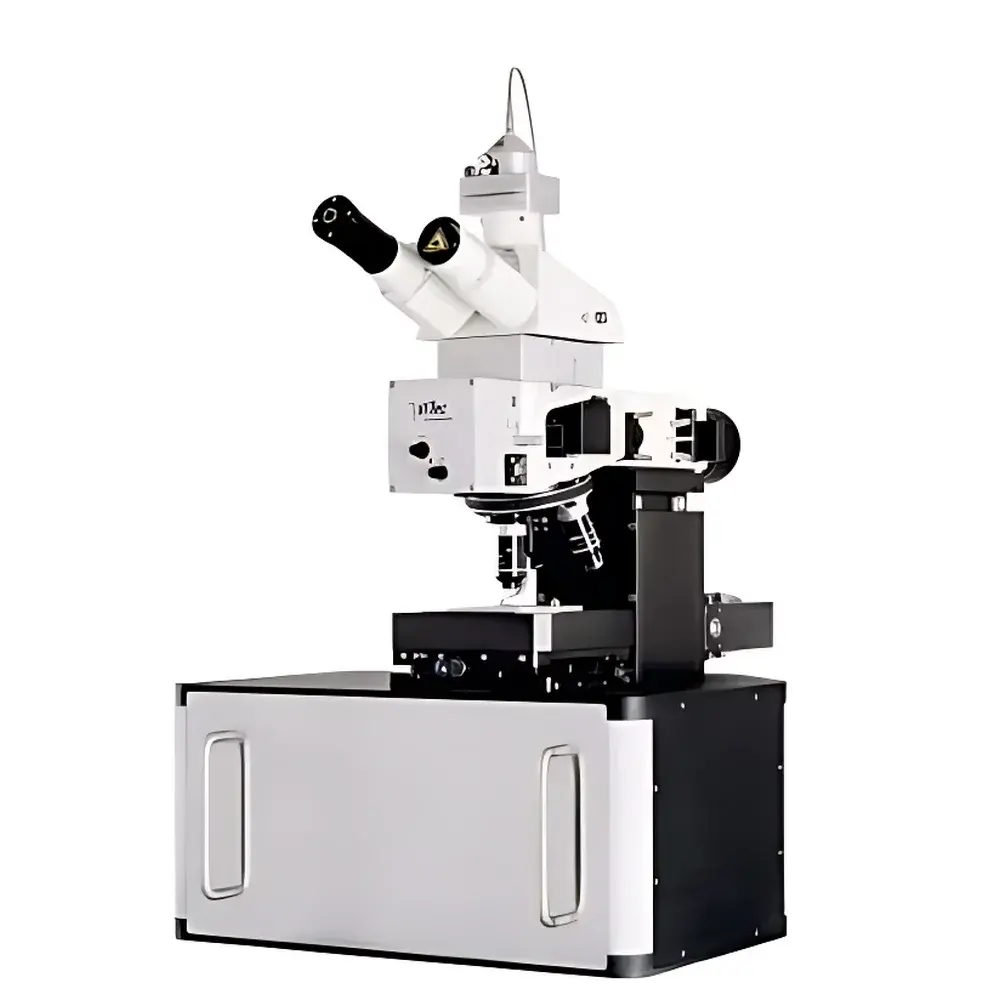
Zeiss AlphaSNOM Advanced Near-Field Optical Microscope
| Origin | Germany |
|---|---|
| Manufacturer Type | Authorized Distributor |
| Origin Category | Imported Instrument |
| Model | AlphaSNOM |
| Pricing | Available Upon Request |
Overview
The Zeiss AlphaSNOM Advanced Near-Field Optical Microscope is a hybrid multimodal scanning probe platform engineered for nanoscale optical and topographic characterization. It integrates near-field scanning optical microscopy (NSOM), confocal laser scanning microscopy (CLSM), and atomic force microscopy (AFM) into a single, synchronized instrumentation architecture. Unlike conventional far-field optical systems limited by the diffraction barrier (~200 nm lateral resolution), the AlphaSNOM achieves true sub-diffraction optical resolution—typically 20–50 nm—by exploiting evanescent field coupling via a sharp, metallized cantilever-based optical probe operating in shear-force feedback mode. The system is built upon a high-stability Zeiss Axio Imager upright microscope frame, ensuring mechanical rigidity, thermal drift control, and precise optical alignment across all modalities.
Key Features
- Triple-modality integration: Simultaneous or sequential acquisition of NSOM, confocal fluorescence/Raman, and AFM topography with pixel-synchronized registration.
- High-efficiency near-field excitation: Custom-designed apertureless cantilever probes with integrated aluminum-coated tips deliver near-field optical intensities 100–1000× greater than standard fiber-based NSOM probes—significantly improving signal-to-noise ratio and enabling low-power, photostable imaging of delicate biological and 2D material samples.
- Robust shear-force feedback mechanism: A compliant micro-cantilever enables non-contact, real-time distance regulation between tip and sample surface with sub-nanometer stability—eliminating tip crash risk while maintaining optimal near-field coupling conditions.
- Modular optical path: Confocal excitation and detection paths are fully decoupled from the near-field channel, preventing cross-talk and enabling independent optimization of laser wavelength, polarization, and detection bandwidth for each modality.
- Vibration-isolated granite base and active acoustic damping enclosure ensure operational stability under standard laboratory conditions without requiring dedicated cleanroom or basement installation.
Sample Compatibility & Compliance
The AlphaSNOM accommodates a broad range of solid-state and soft matter specimens—including semiconductor nanostructures, plasmonic metasurfaces, perovskite thin films, lipid bilayers, fixed and live-cell preparations (with environmental chamber option), and graphene/hBN heterostructures. Sample mounting follows standard 25 mm round or 24 × 50 mm microscope slide formats. All hardware and software components comply with CE marking requirements and meet IEC 61000-6-3 (EMC emission) and IEC 61000-6-2 (immunity) standards. For regulated environments, optional audit trail logging, electronic signature support, and 21 CFR Part 11–compliant user access controls are available through the optional ZEN Blue Compliance Edition software package.
Software & Data Management
Control, acquisition, and analysis are unified within ZEN Blue (v3.6+), Zeiss’ modular scientific imaging platform. The NSOM module provides real-time lock-in demodulation of scattered near-field signals, automatic tip approach routines, and multi-channel correlation mapping (e.g., NSOM intensity vs. AFM phase vs. confocal intensity). Data export supports HDF5, TIFF (with embedded metadata), and MATLAB-compatible .mat formats. Batch processing pipelines enable automated spectral unmixing, point-spread function deconvolution, and quantitative near-field enhancement factor calculation. All raw and processed datasets are timestamped, instrument-parameter-annotated, and stored in a hierarchical folder structure compliant with FAIR (Findable, Accessible, Interoperable, Reusable) data principles.
Applications
- Nanoscale photonic device characterization: Mapping localized surface plasmon resonance (LSPR) hotspots in Au/Ag nanostructures and dielectric metasurfaces.
- 2D material optoelectronics: Correlating exciton diffusion length, defect-associated luminescence quenching, and local strain fields in TMDC monolayers.
- Single-molecule biophysics: Resolving spatially heterogeneous protein clustering dynamics on supported lipid membranes with simultaneous topographic validation.
- Photovoltaic interface analysis: Visualizing carrier recombination pathways at perovskite/HTL and perovskite/ETL interfaces with <50 nm optical resolution.
- Quantitative nanospectroscopy: Performing tip-enhanced Raman spectroscopy (TERS) line scans with spectral resolution down to 1 cm⁻¹ and spatial step sizes ≤10 nm.
FAQ
What is the typical optical resolution achievable with the AlphaSNOM in NSOM mode?
Sub-50 nm lateral resolution is routinely achieved under ambient conditions; resolution depends on tip apex radius, working distance, and sample optical contrast—but is not diffraction-limited.
Can the system operate in liquid or controlled atmosphere?
Yes—optional environmental chambers support operation in nitrogen-purged, humidified, or aqueous environments (with fluid cell compatibility) for in situ biological or electrochemical studies.
Is AFM feedback used during NSOM imaging?
Yes—the system employs shear-force AFM feedback for non-contact tip–sample distance control during all NSOM acquisitions, ensuring consistent near-field coupling and eliminating topographic crosstalk.
Which laser sources are compatible with the confocal and NSOM channels?
Standard configurations include 405 nm, 488 nm, 561 nm, and 640 nm diode lasers; optional OPO or supercontinuum sources extend coverage from 350–1100 nm for broadband NSOM and TERS applications.
Does the software support automated multi-region stitching and 3D optical reconstruction?
Yes—ZEN Blue includes tile-based mosaic acquisition with drift correction, as well as volumetric rendering tools for correlating NSOM z-stacks with AFM-derived height maps and confocal depth sections.