
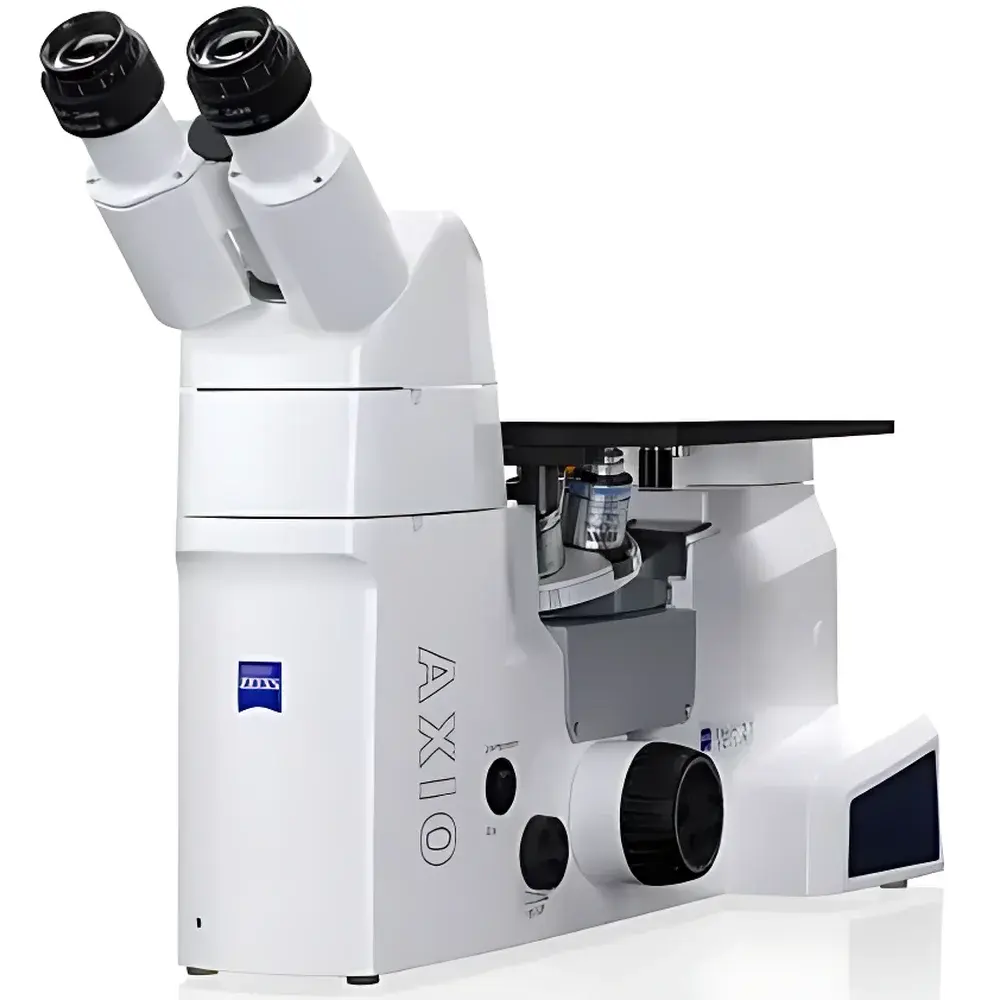
ZEISS Axio Vert.A1 Research-Grade Inverted Materials Microscope
| Brand | ZEISS |
|---|---|
| Origin | Germany |
| Model | Axio Vert.A1 |
| Configuration | Inverted |
| Image Analysis System | Integrated (optional) |
| Total Magnification Range | 50×–1000× |
| Eyepieces | 10×/23 mm field number |
| Objective Lenses | 5×, 10×, 20×, 50×, 100× (oil immersion) |
| optional low-mag objectives | 1.25×, 2.5×, 40×, 150× |
| Optical System | ICCS (Improved Contrast and Color Correction System) |
| Illumination | 12 V / 100 W halogen lamp with reflector bowl |
| Objective Turret | 5-position research-grade brightfield/darkfield turret |
| Mechanical Design | FEM-optimized frame with ACR position encoding |
| Accessories | Eyepiece micrometer, stage micrometer, interference and neutral density filters |
| Compatibility | Motorized scanning stage, heated stage (up to 1200 °C), digital camera modules (sCMOS/CCD), ZEN imaging software suite |
Overview
The ZEISS Axio Vert.A1 is a research-grade inverted materials microscope engineered for high-precision metallurgical, ceramic, polymer, and advanced composite characterization in industrial R&D and academic laboratories. Its inverted optical architecture places the objective lenses beneath the specimen stage—enabling stable, vibration-resistant observation of large, heavy, or temperature-sensitive samples such as castings, weldments, semiconductor wafers, and in-situ thermal test specimens. The system employs ZEISS’s proprietary ICCS (Improved Contrast and Color Correction System) optics, delivering diffraction-limited resolution, exceptional flatness across the entire field of view (FOV), and chromatic aberration correction from 360 nm to 1000 nm. Built upon a finite-element-method (FEM)-optimized mechanical frame, the Axio Vert.A1 ensures long-term dimensional stability under thermal cycling and mechanical load—critical for quantitative metallography, grain size analysis per ASTM E112, and phase distribution mapping. Köhler illumination is fully integrated and precisely adjustable, ensuring uniform intensity and optimal contrast for both brightfield and darkfield imaging without vignetting.
Key Features
- FEM-engineered rigid frame with ACR (Automatic Component Recognition) position encoding for repeatable objective and filter alignment—eliminating manual calibration drift between sessions.
- 5-position research-grade turret supporting simultaneous brightfield and darkfield illumination paths; compatible with DIC (Differential Interference Contrast), polarization, and fluorescence modules via optional beam splitters.
- Modular illumination system featuring a 12 V / 100 W halogen source with precision reflector bowl and integrated heat-absorbing glass—optimized for consistent color temperature (3200 K) and photometric stability over extended acquisition periods.
- Ergonomic inverted design accommodates large-volume samples up to 150 mm in height and 30 kg in mass; motorized Z-axis focus drive (optional) enables programmable focal plane tracking during thermal or mechanical testing.
- Standard 10×/23 mm wide-field eyepieces with diopter adjustment; all objectives are apochromatically corrected and feature anti-reflective multilayer coatings for maximum transmission in visible and near-UV ranges.
Sample Compatibility & Compliance
The Axio Vert.A1 supports standardized metallurgical sample preparation protocols per ISO 2982, ASTM E3, and EN 10365. Its large working distance objectives (e.g., 5× WD = 25.7 mm, 10× WD = 12.7 mm) permit unobstructed access for micro-hardness indentation, thermocouple placement, or in-situ tensile fixture integration. Optional heated stages comply with ASTM E1122 for high-temperature phase transformation studies (operating range: ambient to 1200 °C, ±1 °C stability). All optical components meet RoHS and CE directives; the system architecture supports GLP/GMP-compliant documentation workflows when paired with ZEN Blue software and FDA 21 CFR Part 11–enabled audit trails.
Software & Data Management
ZEN Blue (v3.6+) serves as the native image acquisition and analysis platform—certified for ISO/IEC 17025 traceability in accredited labs. It provides calibrated measurement tools for grain size (ASTM E112, E1382), inclusion rating (ASTM E45), porosity quantification (ISO 4527), and linear intercept analysis. Raw image data is stored in TIFF or ZEN .czi format with embedded metadata (objective ID, magnification, exposure time, stage coordinates, user ID). Export options include CSV for statistical process control (SPC) integration and PDF reports compliant with internal QA templates. Remote operation via LAN/Wi-Fi and API-driven automation (Python/C# SDK) enable integration into automated metrology lines.
Applications
- Quantitative metallography: ferrite/pearlite ratio determination, carbide morphology classification, and intergranular corrosion assessment in stainless steels and superalloys.
- Failure analysis: crack propagation path mapping, inclusion identification (oxide/sulfide types), and weld HAZ (heat-affected zone) microstructure evaluation.
- Advanced materials R&D: grain boundary engineering in Ni-based alloys, phase stability studies in TiAl intermetallics, and sintering behavior analysis of powder metallurgy compacts.
- Quality assurance: incoming raw material inspection per MIL-STD-1507, supplier audit readiness, and ISO 9001 clause 8.5.1 evidence generation.
FAQ
Is the Axio Vert.A1 suitable for automated image acquisition in regulated environments?
Yes—when configured with ZEN Blue Enterprise and validated hardware modules, it supports 21 CFR Part 11 compliance including electronic signatures, audit trails, and role-based access control.
Can the system be upgraded for fluorescence or polarized light imaging?
Yes—via optional beam splitters, polarizer/analyzer kits, and LED illumination modules (365 nm, 470 nm, 550 nm) compatible with standard ICCS objectives.
What is the maximum sample thickness supported without stage modification?
The standard stage accommodates specimens up to 150 mm in height and 30 kg in weight; custom stage inserts are available for specialized fixtures.
Does ZEISS provide application-specific validation packages?
Yes—method qualification kits (including reference standards, SOP templates, and IQ/OQ documentation) are available for ASTM E3, E112, and ISO 643 compliance verification.
How is calibration traceability maintained across instrument lifetime?
ZEISS offers annual calibration services traceable to PTB (Physikalisch-Technische Bundesanstalt) standards, with certificate of conformance and uncertainty budgets provided per ISO/IEC 17025 requirements.




