
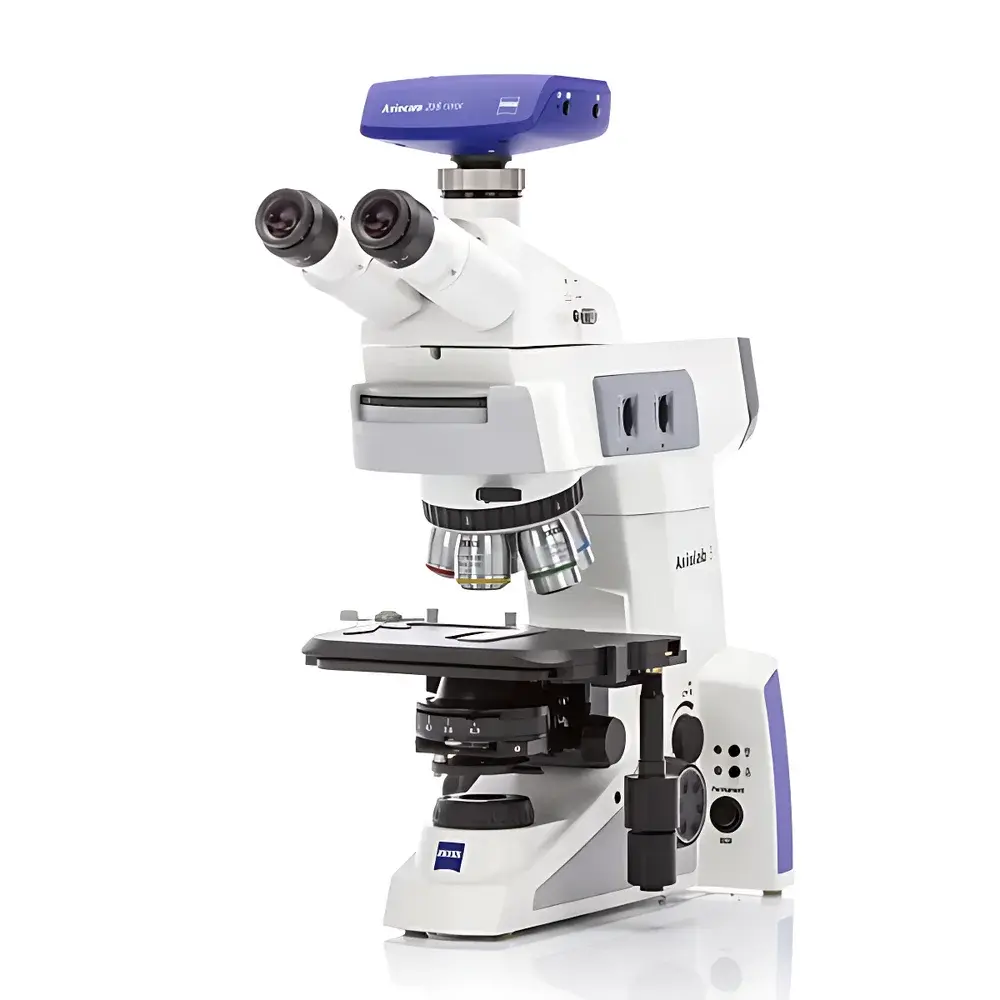
ZEISS Axiolab 5 Intelligent Metallurgical Microscope
| Brand | ZEISS |
|---|---|
| Origin | Germany |
| Model | Axiolab 5 |
| Configuration | Upright |
| Total Magnification Range | 50×–1000× |
| Eyepiece | 10× |
| Objective Lenses | 5×, 10×, 20×, 50×, 100× (M27 thread, HD encoded revolver) |
| Transmitted Illumination | 10 W LED |
| Reflected Illumination | 10 W LED |
| Observation Modes | Brightfield, Darkfield, DIC, C-DIC |
| Field of View | 23 mm |
| Optical System | Infinity-corrected, IC2S optics |
| Focus Travel (Z) | 30 mm |
| Stage | Mechanical, 75 × 30 mm (right-hand operation) |
| Revolving Nosepiece | 5-position, HD encoded, M27 |
| Reflected Light Turret | 4-position, encoded |
| Ergonomic Tube | Ergotube with adjustable height and torque |
| Illumination Management | Auto-brightness compensation across magnifications |
| Image Capture | Integrated Axiocam 208 color camera, single-button capture, on-device scale bar annotation, no PC or software required |
Overview
The ZEISS Axiolab 5 is an upright, infinity-corrected metallurgical microscope engineered for routine materials characterization in quality control laboratories, failure analysis facilities, and academic metallurgy departments. Built upon the IC2S (Improved Contrast and Sharpness) optical platform, it delivers high-fidelity contrast and resolution across all observation modes—including brightfield, darkfield, differential interference contrast (DIC), and cross-polarized DIC (C-DIC)—without requiring external alignment tools or complex setup procedures. Its core design philosophy centers on operational efficiency, ergonomic sustainability, and autonomous digital documentation. Unlike traditional microscopes requiring separate imaging hardware and post-acquisition software, the Axiolab 5 integrates a calibrated 5-megapixel color CMOS sensor (Axiocam 208) directly into the optical path, enabling real-time, true-color image capture with embedded, metrologically traceable scale bars—fully independent of external computing infrastructure.
Key Features
- Integrated intelligent imaging: Single-button acquisition with automatic exposure optimization, white balance correction, and scale bar embedding based on selected objective and tube lens configuration.
- Ergonomic human-machine interface: All primary controls—including focus drive (dual-side fine adjustment), stage translation (75 × 30 mm mechanical stage with right-hand handle), illumination intensity, and image capture—are operable with one hand; Ergotube viewing head supports height and torque customization to reduce musculoskeletal strain during extended sessions.
- Auto-illuminated optical path: Dual 10 W LED sources (transmitted and reflected) provide flicker-free, stable illumination with uniform brightness across magnifications—eliminating manual lamp intensity rebalancing when switching objectives.
- Encoded optical modules: HD 5-position objective revolver (M27 thread) and 4-position reflected-light turret ensure repeatable, software-recognizable configuration tracking—critical for audit-ready workflows compliant with ISO/IEC 17025 and GLP requirements.
- Energy-efficient architecture: LED illumination eliminates warm-up/cool-down cycles, extends service life beyond 25,000 hours, and reduces thermal drift in temperature-sensitive samples—supporting long-duration time-lapse imaging without recalibration.
Sample Compatibility & Compliance
The Axiolab 5 accommodates standard metallurgical specimens up to 30 mm in height (with optional extended Z-travel kits) and supports polished metallographic mounts, coated thin sections, solder joints, additive manufacturing powders, and ceramic fracture surfaces. Its reflected-light path is optimized for opaque, non-transparent materials, while the transmitted-light option enables simultaneous inspection of transparent overlays or embedded polymer layers. The system complies with DIN EN ISO 4287 (surface roughness measurement), ASTM E3 (preparation of metallographic specimens), and ASTM E112 (grain size determination). All optical components meet ZEISS’ internal certification for chromatic aberration correction and flat-field performance across the full 23 mm field of view—ensuring quantitative reproducibility in grain counting, inclusion rating, and phase distribution analysis.
Software & Data Management
No external software or host computer is required for basic operation or image archiving. Metadata—including objective ID, magnification, illumination mode, timestamp, and calibrated scale bar—is written directly into EXIF headers of JPEG/TIFF files stored on internal SD card or USB drive. For laboratories operating under FDA 21 CFR Part 11 or EU Annex 11 requirements, optional ZEN Connect software (sold separately) provides electronic signature support, user role-based access control, audit trail logging, and secure DICOM-compliant export. Raw image data remains fully compatible with third-party image analysis platforms such as ImageJ/Fiji, MATLAB, and commercial packages like Olympus Stream or Thermo Scientific Velox—enabling seamless integration into multi-instrument data pipelines.
Applications
- Metallurgical QC: Grain size evaluation per ASTM E112, inclusion rating per ASTM E45, and heat-affected zone (HAZ) assessment in welded joints.
- Failure analysis: Fractography of fatigue cracks, intergranular corrosion mapping, and solder joint void analysis in electronics packaging.
- Additive manufacturing: Powder morphology screening, melt pool boundary identification, and porosity quantification in as-built metal parts.
- Coating & surface engineering: Thickness measurement of PVD/CVD layers via edge contrast analysis, adhesion failure mode classification, and oxidation layer characterization.
- Academic research: Teaching labs benefit from intuitive operation, consistent image output, and minimal training overhead—enabling students to focus on microstructural interpretation rather than instrument calibration.
FAQ
Does the Axiolab 5 require a computer to capture images?
No. Image acquisition, scaling, and storage are fully self-contained. The integrated Axiocam 208 operates independently using onboard firmware.
Can the system be upgraded to support fluorescence or polarized light?
Fluorescence capability is not natively supported due to the absence of excitation filter turrets and high-intensity mercury/xenon sources. Polarized light observation is achievable via optional accessory analyzers and rotatable polarizers compatible with the IC2S optical train.
Is the scale bar calibration NIST-traceable?
Yes. Each objective lens is individually calibrated at the ZEISS factory using interferometric reference standards. Scale bar values are dynamically updated in real time based on encoder feedback from the revolver and turret positions.
What maintenance is required for long-term optical stability?
Annual verification of Köhler illumination alignment and LED radiant flux output is recommended. No oil immersion cleaning or lamp replacement is necessary—the solid-state illumination system is maintenance-free for ≥5 years under typical lab usage.
How does the Axiolab 5 support laboratory accreditation (e.g., ISO/IEC 17025)?
Encoded hardware modules generate immutable configuration logs; integrated metadata satisfies clause 7.5.2 (technical records) and 7.7 (results reporting) requirements. Optional ZEN Connect adds electronic signature and audit trail functionality for full compliance.





