
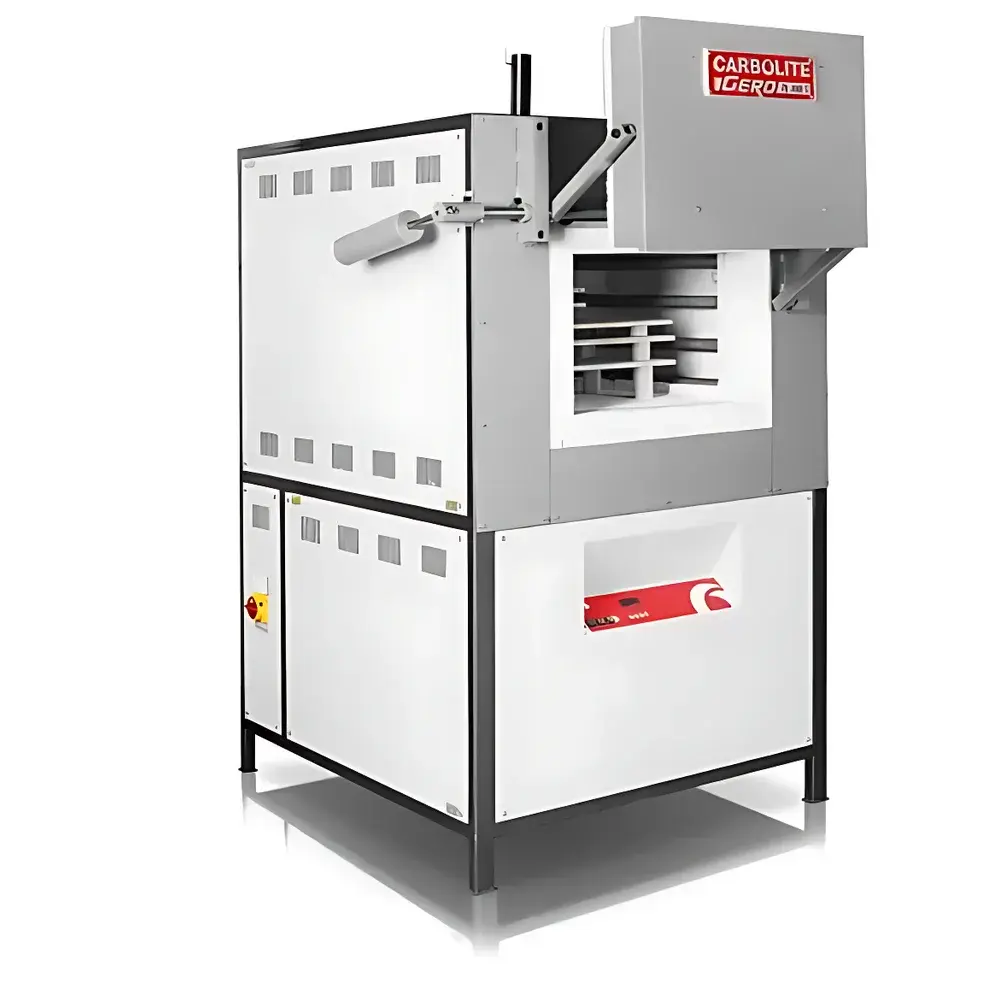
Carbolite Gero GPC Series General-Purpose Industrial Box Furnace
| Brand | Carbolite Gero |
|---|---|
| Origin | Germany |
| Model | GPC |
| Furnace Type | Box-type Muffle Furnace |
| Maximum Operating Temperature | 1200 °C or 1300 °C |
| Chamber Volume | 131–400 L (6 standard sizes) |
| Heating Method | Resistance Wire (NiCr Alloy) |
| Controller | EPC3016P1 Programmable Digital Controller |
| Over-Temperature Protection | Integrated |
| Heating Zone Configuration | Dual-side + top helical heating elements + bottom heating |
| Insulation | Low-density alumina fiber modules (furnace shell, door, hearth) |
| Door Operation | Vertical top-hinged opening |
| Communication Interface | Optional Ethernet (specify at order) |
| Atmosphere Compatibility | Optional inert/protective gas atmosphere box (up to 1100 °C) |
| Compliance | Configurable to AMS2750F (NADCAP) thermal processing requirements |
| Energy Efficiency | Optimized via lightweight insulation and thermal mass reduction |
Overview
The Carbolite Gero GPC Series is a heavy-duty, floor-standing general-purpose box furnace engineered for industrial heat treatment, materials research, and quality-critical thermal processing in laboratories and production environments. Designed and manufactured in Germany, the GPC operates on resistive heating principles using high-stability NiCr alloy resistance wire wound in helical configurations across dual side walls and the roof—supplemented by dedicated bottom heating—to ensure uniform thermal distribution and minimized axial temperature gradients. Its robust construction supports continuous operation at up to 1300 °C (depending on configuration), with chamber volumes spanning 131 L to 400 L across six standardized sizes. The furnace employs low-density, high-purity alumina fiber insulation throughout the hot zone—including the door, hearth, and outer shell—to achieve rapid heat-up rates (typically <60 min to 1000 °C), low standby power consumption, and excellent thermal retention. The vertical top-hinged door design positions the heated surface away from the operator during loading/unloading, enhancing workplace safety without compromising accessibility.
Key Features
- German-engineered thermal architecture compliant with DIN EN 60519-1 and IEC 61000-6-4 electromagnetic compatibility standards
- Triple-zone heating system: independently optimized side-wall helices, roof coil, and integrated hearth heater for ±3 °C uniformity across full working volume at 1200 °C
- EPC3016P1 programmable digital controller with 16-segment ramp-soak profiles, real-time PID tuning, and configurable alarm thresholds
- Standard over-temperature protection via independent K-type thermocouple and mechanical cut-out switch (EN 60519-1 Class II)
- Low thermal mass insulation reduces energy demand by up to 35% compared to traditional ceramic brick designs
- Optional Ethernet interface (IEEE 802.3, TCP/IP stack) enables integration into centralized SCADA or MES platforms for remote monitoring and audit-trail generation
- Hard-anodized aluminum oxide door and hearth linings provide long-term structural integrity and resistance to thermal shock cycling
Sample Compatibility & Compliance
The GPC accommodates diverse sample forms—including crucibles, sintering boats, ceramic setters, metal trays, and custom fixtures—within its vertically oriented chamber. Optional atmosphere control kits (gas-tight stainless steel boxes with inlet/outlet ports) permit operation under N₂, Ar, or forming gas up to 1100 °C, supporting oxidation-sensitive processes such as brazing, annealing of specialty alloys, and catalyst activation. All GPC units are supplied with CE marking and comply with EU Machinery Directive 2006/42/EC and Low Voltage Directive 2014/35/EU. Upon request, furnaces can be factory-configured and documented to meet AMS2750F (NADCAP) pyrometric system requirements—including sensor calibration traceability to NIST, TUS (Temperature Uniformity Survey) reporting, and hardware-level data logging for process validation. This makes the GPC suitable for aerospace, medical device, and automotive Tier-1 suppliers requiring auditable thermal processing records.
Software & Data Management
The EPC3016P1 controller supports native CSV export of time-temperature profiles and event logs via USB memory stick. When equipped with the optional Ethernet module, the furnace interfaces directly with Carbolite Gero’s ThermControl Suite—a Windows-based application enabling multi-furnace scheduling, secure user access levels (admin/operator), electronic signature support, and automatic generation of 21 CFR Part 11–compliant audit trails. All recorded data includes timestamps, operator ID, setpoint history, actual temperature deviation, and alarm status—structured for seamless import into LIMS or ERP systems. Firmware updates are delivered via signed binary packages to ensure integrity and version control.
Applications
- Heat treatment of tool steels, superalloys, and titanium components per ASTM E2865 and ISO 9001-controlled procedures
- Ceramic sintering and glaze firing in R&D and pilot-scale production
- Thermal aging studies for polymer composites and electronic encapsulants (IEC 60216)
- Calibration of thermocouples and RTDs in accredited metrology labs
- Pre- and post-weld heat treatment (PWHT) qualification per ASME BPVC Section IX
- Residue ashing and loss-on-ignition (LOI) analysis in environmental and cement testing labs (ASTM C114, ISO 29581-1)
FAQ
What is the standard temperature uniformity specification across the working volume?
At 1200 °C, the GPC achieves ±3 °C uniformity (9-point TUS per AMS2750F) in the central 60% of the chamber volume. Full-volume uniformity data is provided with each unit’s factory calibration report.
Can the GPC be validated for GMP-compliant manufacturing processes?
Yes—when ordered with the AMS2750F package, it includes IQ/OQ documentation templates, calibrated Class 1 sensors, and firmware enabling 21 CFR Part 11–compliant electronic records.
Is retrofitting of Ethernet communication possible after delivery?
No—Ethernet hardware must be installed at the factory; field retrofitting voids the thermal safety certification and invalidates AMS2750F compliance.
What maintenance intervals are recommended for heating elements and insulation?
Under normal operation (≤12 h/day at ≤1200 °C), heating elements require inspection every 12 months; alumina fiber insulation typically remains functional for >5 years with no scheduled replacement.
Are custom chamber geometries or door configurations available?
Yes—Carbolite Gero offers bespoke engineering services for non-standard dimensions, reinforced hearths, or alternative door actuation (e.g., motorized lift), subject to thermal and structural validation.
Related Products



