
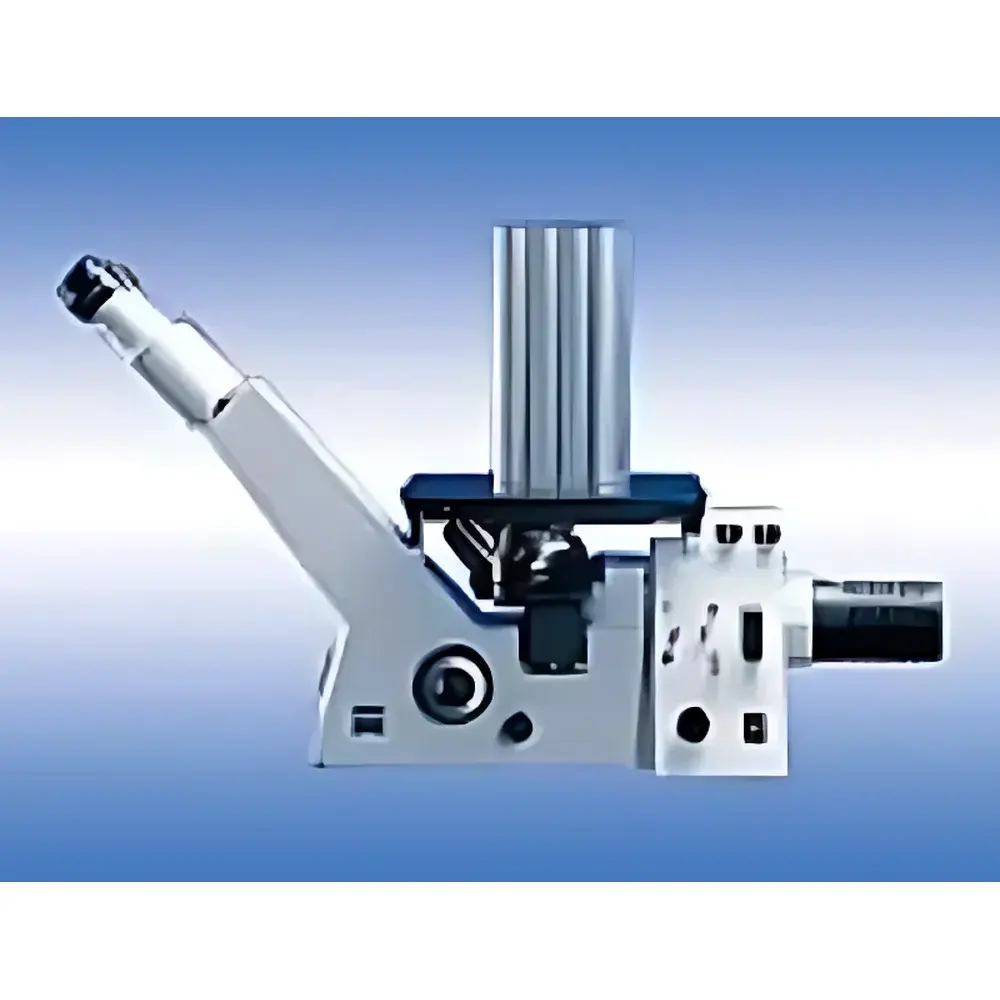
ZEISS Axiovert 40MAT Research-Grade Metallurgical Microscope
| Brand | ZEISS |
|---|---|
| Origin | Germany |
| Model | Axiovert 40MAT |
| Optical System | ICCS (Improved Contrast and Color Correction System) |
| Objective Lenses | 5×, 10×, 20×, 50×, 100× (optional: 1.25×, 2.5×, 150×) |
| Eyepieces | 10×/23 mm field number |
| Nosepiece | 4-position or 5-position brightfield/darkfield turret |
| Illumination | 12 V / 100 W halogen lamp with reflector bowl |
| Observation Modes | Reflected-light: brightfield, ADF (Advanced Darkfield), polarized light, DIC (Differential Interference Contrast), fluorescence |
| Transmitted-light | brightfield, ADF, polarized light, phase contrast |
| Ergonomic Design | FEM-optimized stand with ACR (Automatic Component Recognition) encoding |
| Lifetime Expectancy | ≥60 years (structural and optical longevity under standard laboratory conditions) |
| Compliance | Designed and manufactured in accordance with ISO 9001-certified production processes at ZEISS Oberkochen, Germany |
| Digital Integration | Compatible with high-resolution digital cameras, motorized scanning stages, heating stages (up to 1200 °C), and ZEN imaging & analysis software suite |
Overview
The ZEISS Axiovert 40MAT is a research-grade inverted metallurgical microscope engineered for high-precision microstructural analysis of opaque, reflective, and polished solid materials—including metals, alloys, ceramics, composites, and additive-manufactured specimens. Its inverted configuration places the objective lenses beneath the specimen stage, enabling unobstructed access to large, heavy, or temperature-sensitive samples mounted on custom holders or heating stages. The system operates on the principle of reflected-light microscopy, leveraging Köhler illumination and advanced optical path management to deliver diffraction-limited resolution, exceptional contrast uniformity, and color fidelity across all magnifications. Built upon ZEISS’s proprietary ICCS (Improved Contrast and Color Correction System) optics—compliant with DIN ISO 10938 and ISO 8578 standards—the Axiovert 40MAT ensures consistent image quality independent of magnification, numerical aperture, or illumination mode. Its structural integrity derives from finite element method (FEM)-optimized mechanical design, guaranteeing long-term dimensional stability and vibration resistance essential for quantitative metallography and serial sectioning workflows.
Key Features
- FEM-engineered inverted stand with ACR (Automatic Component Recognition) encoding for precise, repeatable alignment of objectives, filters, and illumination modules
- ICCS-corrected infinity-corrected optical system delivering flat-field, apochromatically corrected images with minimal chromatic and spherical aberration
- Modular observation capability: simultaneous support for reflected-light brightfield, ADF (Advanced Darkfield), polarized light, DIC, and fluorescence; plus transmitted-light brightfield, ADF, phase contrast, and polarization
- Dual-illumination architecture: 12 V / 100 W halogen source with elliptical reflector bowl for homogeneous Köhler illumination in both reflected and transmitted modes
- Ergonomically optimized modular stage design accommodating specimens up to 200 mm × 200 mm × 50 mm (height), with optional motorized XYZ scanning and thermal control integration
- Long-term reliability: engineered for ≥60 years of operational service life under GLP-compliant laboratory conditions, with no domestic joint ventures or localized manufacturing—100% assembled and calibrated in Oberkochen, Germany
Sample Compatibility & Compliance
The Axiovert 40MAT accommodates a broad range of metallurgical and materials science specimens—including bulk castings, cross-sectioned welds, sintered powders, thin-film coatings, and high-temperature alloys. Its inverted geometry permits direct mounting of samples on standard metallographic holders, hot-stage platforms (e.g., Linkam TS1500, up to 1200 °C), or electrochemical cells. The system conforms to ASTM E3, ASTM E407, ISO 643, and EN 10365 for microstructural evaluation and grain size assessment. All optical components meet ZEISS’s internal Class 1 cleanroom assembly standards, and the mechanical platform complies with ISO 14644-1 Class 5 environmental specifications during final calibration. Documentation packages support FDA 21 CFR Part 11 compliance when integrated with ZEN Blue software featuring audit trail, electronic signatures, and secure user role management.
Software & Data Management
The Axiovert 40MAT integrates natively with ZEISS ZEN Core and ZEN Blue software platforms. ZEN Blue provides full GLP/GMP-aligned data handling—including timestamped acquisition metadata, instrument configuration logs, calibration traceability (NIST-traceable reference standards), and encrypted project archiving. Image analysis modules support automated grain sizing (per ASTM E112), phase fraction quantification (ISO 16700), inclusion rating (ASTM E45), and line-profile intensity mapping. Export formats include TIFF (64-bit floating point), OME-TIFF, and HDF5 for interoperability with MATLAB, Python (via Bio-Formats), and third-party metrology suites. Optional DIC quantitative phase retrieval and polarization retardance mapping are supported through licensed add-ons compliant with ISO/IEC 17025 validation protocols.
Applications
- Quantitative metallography: grain boundary delineation, precipitate distribution analysis, porosity assessment in castings and AM parts
- Failure analysis: crack propagation path characterization, intergranular corrosion mapping, fatigue striation measurement
- Coating and surface engineering: thickness profiling of PVD/CVD layers, adhesion interface evaluation, oxidation scale morphology
- High-temperature in situ studies: dynamic recrystallization monitoring, phase transformation kinetics during controlled heating/cooling cycles
- Quality control in aerospace, power generation, and automotive sectors requiring adherence to AS9100, ISO/TS 16949, and NADCAP-accredited inspection protocols
FAQ
Is the Axiovert 40MAT compatible with modern digital imaging standards?
Yes—it supports USB 3.0 and Camera Link interfaces for high-frame-rate CMOS sensors (up to 4096 × 3072 pixels), with hardware-triggered synchronization for time-resolved metallurgical experiments.
Can the system be validated for regulated environments (e.g., ISO 17025 or GMP labs)?
Yes—ZEISS provides IQ/OQ documentation templates, calibration certificates traceable to PTB (Physikalisch-Technische Bundesanstalt), and software validation support packages aligned with Annex 11 and ALCOA+ principles.
What is the maximum working distance achievable with high-magnification objectives?
The 50× and 100× ICCS objectives offer 2.0 mm and 0.5 mm working distances respectively; extended WD options (e.g., 5×/WD 25.5 mm) are available for thick-section or coated-sample observation.
Does the ADF (Advanced Darkfield) module require specialized condensers or alignment procedures?
No—ADF functionality is implemented via an integrated annular stop within the reflected-light path, requiring only standard centering using the built-in alignment telescope; no external condenser adjustment is needed.
Is remote operation and multi-user collaboration supported?
Yes—ZEN Connect enables secure web-based microscope control, real-time image sharing, and synchronized annotation across distributed teams, with TLS 1.3 encryption and SAML 2.0 identity federation support.




