
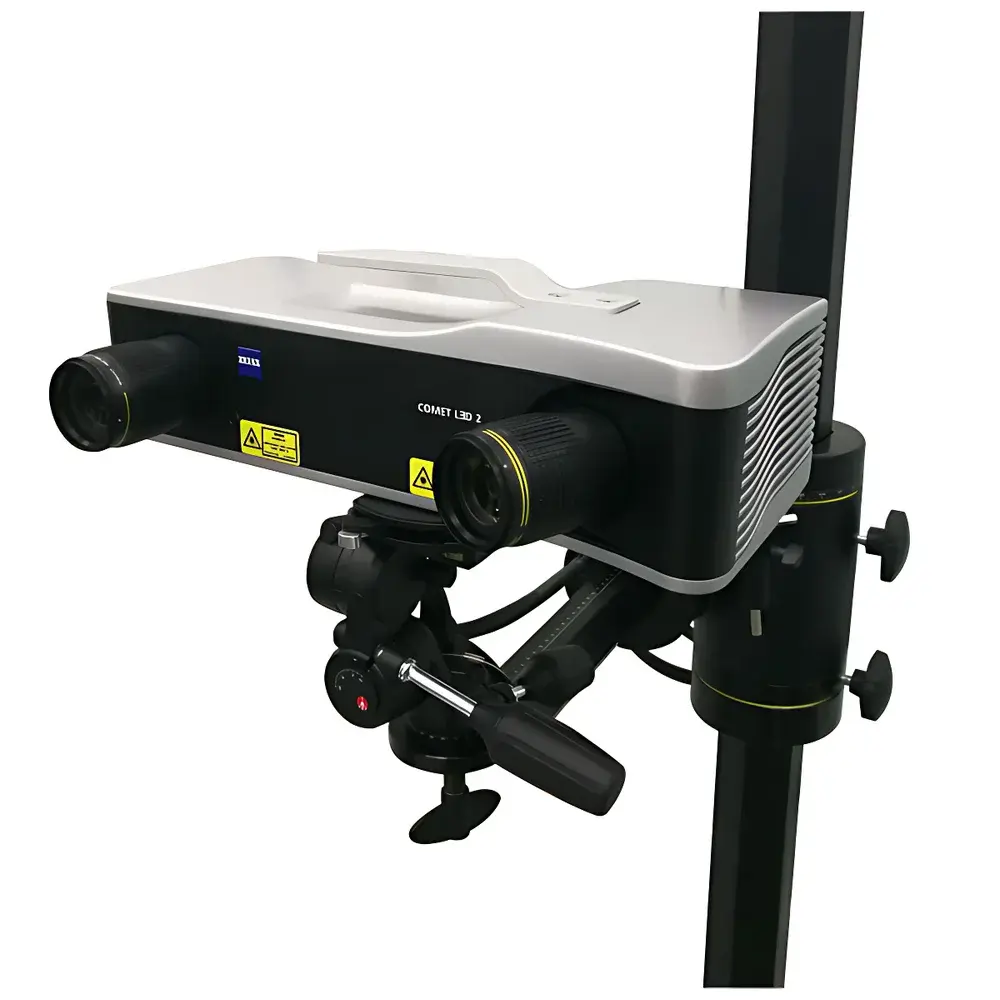
ZEISS COMET L3 Blue Light 3D Scanning System
| Brand | ZEISS |
|---|---|
| Origin | Germany |
| Manufacturer Type | Authorized Distributor |
| Origin Category | Imported |
| Model | COMET L3 |
| Pricing | Available Upon Request |
| Measurement Principle | Structured Light (Blue LED) |
| Resolution | Up to 5 Mpx (2448 × 2050) |
| Point Distance | 50–250 µm (configurable by measurement volume) |
| Scan Speed | 1.5–2 s per frame |
| Measurement Volumes | 100 mm³ / 200 mm³ / 400 mm³ |
| Software | COMETplus (Windows-based, multi-core optimized) |
| Accessories | COMETrotary (single-axis motorized turntable, 30 kg capacity), COMETdual rotary (dual-axis tilt+rotate, 20 kg capacity) |
| Compliance | Designed for ISO/IEC 17025-aligned metrology workflows, supports traceable calibration and GLP/GMP documentation protocols |
Overview
The ZEISS COMET L3 is a high-precision, non-contact blue light 3D scanning system engineered for industrial metrology and digitalization of physical objects. Based on structured light projection and high-resolution CCD imaging, it captures dense point clouds with sub-100 µm spatial resolution across defined volumetric fields (100 mm³, 200 mm³, or 400 mm³). Unlike tactile coordinate measuring machines (CMMs), the COMET L3 enables distortion-free digitization of soft, fragile, or thermally sensitive components—such as foam prototypes, injection-molded plastic parts, elastomeric seals, or heritage artifacts—without mechanical loading or surface preparation. Its optical architecture integrates calibrated blue LED projectors and synchronized 2 Mpx or 5 Mpx CCD cameras, delivering consistent repeatability (< 2 µm volumetric uncertainty under controlled lab conditions) and full-field coverage in under two seconds per acquisition. The system is deployed in quality assurance labs, R&D centers, and reverse engineering facilities where traceable, high-fidelity geometry capture forms the foundation for CAD comparison, GD&T validation, and digital archiving.
Key Features
- Non-contact, high-speed structured light scanning using stable blue LED illumination—immune to ambient light interference and optimized for reflective or matte surfaces.
- Configurable measurement volumes (100/200/400 mm³) with corresponding point spacing from 50 µm to 250 µm—enabling trade-offs between resolution, field-of-view, and throughput.
- Integrated COMETrotary and COMETdual rotary motorized positioning systems for automated multi-angle acquisition—supporting full 360° rotation or combined tilt-and-rotate strategies for complex geometries.
- COMETplus software platform with real-time alignment algorithms, automatic mesh generation (STL/OBJ export), and parallelized data processing leveraging multi-core CPU architectures.
- Native support for ISO 10360-compliant verification routines, including length standard calibration, sphere probe testing, and volumetric error mapping—facilitating internal audit readiness.
- Hardware-level CANbus interface for synchronization with external motion controllers, robotic arms, or environmental monitoring systems in automated inspection cells.
Sample Compatibility & Compliance
The COMET L3 accommodates a broad spectrum of sample types: metallic engine components, composite automotive trim, polymer medical devices, ceramic dental models, wax jewelry patterns, and delicate archaeological fragments. Its non-destructive operation meets ASTM E2924-22 requirements for optical digitization of cultural heritage objects and aligns with ISO 12836:2014 for 3D scanning accuracy assessment. All system configurations are compatible with laboratory accreditation frameworks—including ISO/IEC 17025—and support audit-trail generation for GLP and GMP environments. Calibration certificates traceable to PTB (Physikalisch-Technische Bundesanstalt) standards are available upon request.
Software & Data Management
COMETplus serves as the central control and post-processing environment, running natively on Windows 10/11 x64 platforms with GPU-accelerated rendering and multi-threaded point cloud registration. It provides full support for GD&T evaluation against nominal CAD models (STEP, IGES, JT), deviation color-mapping, cross-section analysis, and automated report generation (PDF/HTML/XML). The software includes built-in tools for noise filtering, hole filling, smoothing, and topology-preserving decimation—critical for downstream use in CAE simulation or additive manufacturing. For regulated industries, optional modules enable 21 CFR Part 11-compliant electronic signatures, user access control hierarchies, and immutable audit logs covering all scan parameters, operator ID, timestamp, and environmental metadata.
Applications
- Automotive: Dimensional validation of A-surface panels, bracket assemblies, and prototype castings; CAV (Comparison Against Virtual) analysis for tooling release sign-off.
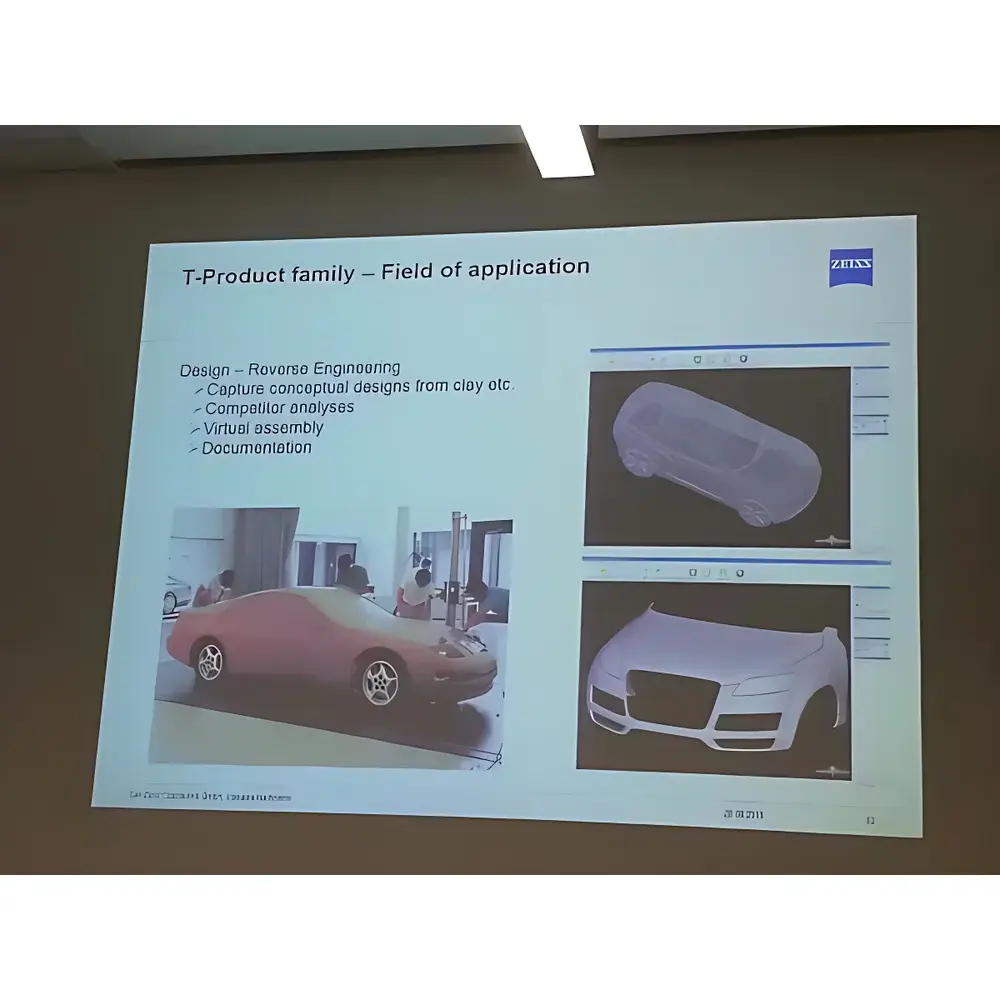
- Reverse Engineering: Rapid conversion of legacy parts into parametric CAD models—particularly for obsolescence management or supplier-independent design reconstruction.
- Cultural Heritage: High-fidelity archival scanning of museum artifacts, statues, and historical documents without physical contact or UV exposure.
- Jewelry & Dental: Precise capture of intricate wax-ups, investment patterns, and intraoral scans for CAD/CAM crown-and-bridge workflows.
- Quality Control: First-article inspection, production line sampling, and supplier part verification—integrated with enterprise QMS platforms via API or batch file export.
FAQ
What materials can be scanned without surface treatment?
Matte-finished metals, plastics, ceramics, and composites typically require no spray coating. Highly reflective or transparent objects may benefit from temporary matting agents compliant with ISO 8502-3.
Is the system suitable for in-line production integration?
Yes—when paired with COMETdual rotary and industrial PC hardware, the COMET L3 supports cycle times under 30 seconds per part and can be embedded into PLC-controlled inspection stations.
Does COMETplus support third-party CAD interoperability?
It imports STEP AP214/AP242, IGES, JT, and STL; exports native formats for Geomagic Control X, PolyWorks, and Siemens NX, with direct links to Teamcenter and Windchill PLM systems.
How is measurement traceability maintained?
Each scan session records calibration certificate IDs, environmental sensor readings (temperature/humidity), and operator credentials—exportable as CSV or XML for metrology database ingestion.
Can the system perform automated GD&T reporting?
Yes—COMETplus includes dedicated GD&T modules for position, profile, concentricity, and flatness evaluation per ASME Y14.5-2018, with configurable tolerance zones and statistical process control (SPC) charting.



