
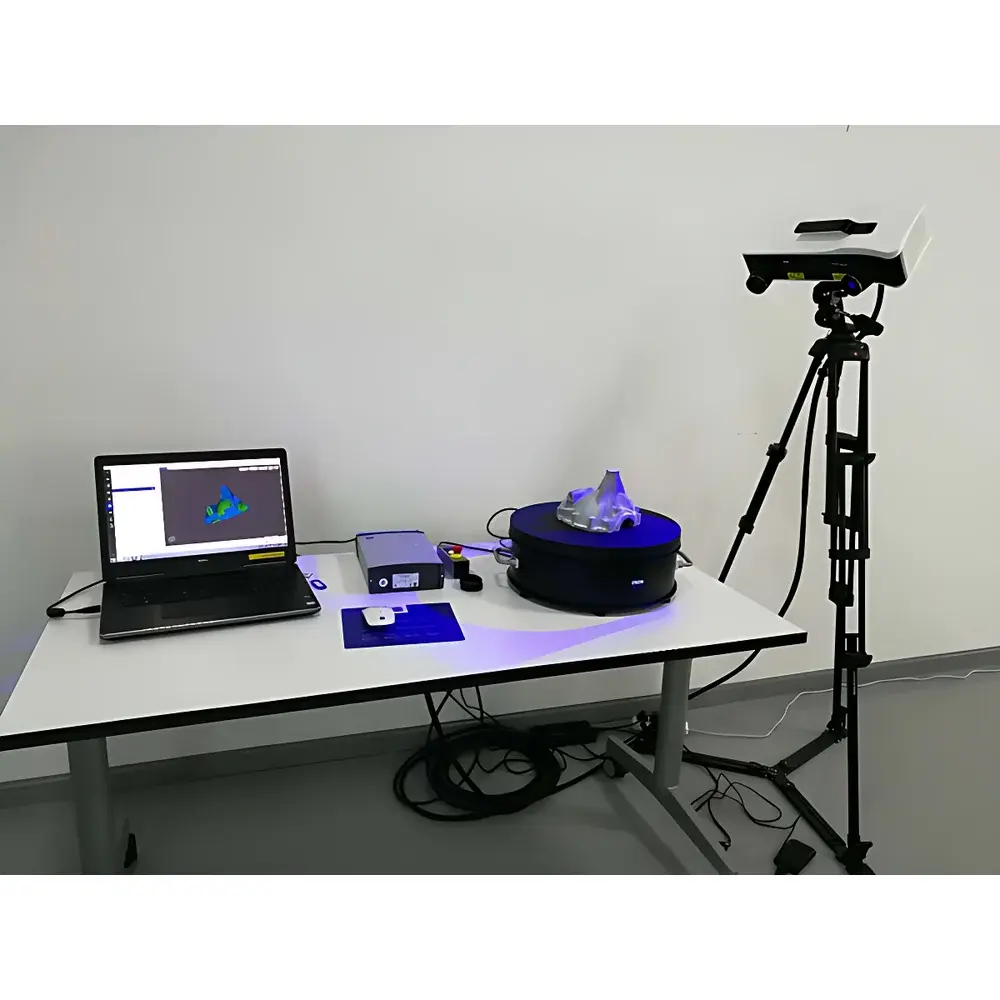
ZEISS L3D 2 5M Blue-Light Structured Light 3D Scanner
| Brand | ZEISS |
|---|---|
| Origin | Germany |
| Model | L3D 2 5M |
| Light Source | Blue-light LED-based structured illumination (not free-electron laser) |
| Detection Principle | Fringe projection photogrammetry with stereo camera triangulation |
| System Type | Contactless, markerless 3D optical coordinate measurement system |
| Compliance | Designed for industrial metrology applications aligned with VDI/VDE 2634 Part 2 and ISO 10360-8 standards |
Overview
The ZEISS L3D 2 5M is a high-accuracy, non-contact blue-light structured light 3D scanner engineered for precision industrial metrology. Unlike laser triangulation or time-of-flight systems, this instrument employs fringe projection photogrammetry—projecting calibrated sinusoidal blue-light patterns onto the object surface and capturing phase-shifted deformations via dual high-resolution CMOS cameras. The resulting stereo image pairs are processed using advanced phase-unwrapping algorithms to reconstruct dense point clouds with sub-50 µm volumetric accuracy across typical working volumes (up to 500 × 400 × 300 mm). Designed for integration into quality control workflows in regulated manufacturing environments, the L3D 2 5M eliminates the need for adhesive reference markers or spray-based surface preparation—enabling rapid, repeatable digitization of reflective, matte, or textured surfaces including machined metals, injection-molded polymers, and composite laminates.
Key Features
- Markerless operation: No surface preparation required—compatible with bare metallic, anodized, painted, or translucent materials without developer spray or fiducial attachment.
- Blue-light LED illumination (450–490 nm): Minimizes ambient light interference and enables stable capture under standard factory lighting conditions; avoids UV-induced material degradation or eye safety concerns associated with Class 3B lasers.
- Dual-camera stereo architecture: 5 MP resolution per sensor with synchronized global shutter exposure, delivering >2 million measured points per frame at up to 12 frames per second.
- Volumetric accuracy certified per VDI/VDE 2634 Part 2: ≤ 0.035 mm + 0.025 mm/m (typical for 300 mm calibration sphere); traceable to PTB (Physikalisch-Technische Bundesanstalt) standards.
- Ruggedized aluminum housing with IP52-rated enclosure: Suitable for shop-floor deployment near CNC machines, robotic cells, or CMM rooms without climate-controlled enclosures.
- Real-time mesh preview and on-device deviation color mapping: Supports immediate pass/fail assessment against CAD nominal geometry during acquisition.
Sample Compatibility & Compliance
The L3D 2 5M accommodates parts ranging from small precision components (e.g., turbine blades, medical implants, connector housings) to large assemblies such as automotive door panels, engine manifolds, and aerospace ducting—provided within its defined depth-of-field and working volume constraints. It supports direct integration with ZEISS CALYPSO and PiWeb software platforms for full GD&T evaluation per ASME Y14.5 and ISO 1101. The system complies with electromagnetic compatibility (EMC) requirements per EN 61326-1 and meets CE marking directives for industrial measurement equipment. While not FDA-cleared as a medical device, its measurement uncertainty profile satisfies ISO 12836 Annex B criteria for dimensional validation in GLP/GMP-regulated R&D labs handling orthopedic or dental prosthetic development.
Software & Data Management
Acquisition and post-processing are managed through ZEISS INSPECT software (v10.12+), which provides automated alignment (best-fit, RPS, datum-based), mesh-to-CAD comparison, cross-section analysis, and reporting compliant with ISO 17025 documentation requirements. Raw point cloud data exports in standard formats—including .STL, .PLY, .XYZ, and native .ZCP—support interoperability with third-party CAE tools (e.g., ANSYS SpaceClaim, PolyWorks, Geomagic Control X). Audit trails, user access controls, and electronic signature capability align with FDA 21 CFR Part 11 expectations when deployed in pharmaceutical or medical device manufacturing QA/QC environments.
Applications
- Automotive: Full-body panel gap-and-flush analysis, die-cast housing dimensional verification, brake caliper thermal deformation tracking, and interior trim assembly tolerance stack-up modeling.
- Aerospace: Blade root geometry inspection of compressor stages, composite wing skin contour validation, and weld seam distortion quantification in titanium airframe structures.
- Energy: Turbine disc runout assessment, nuclear valve seat flatness certification, and wind turbine hub flange concentricity checks.
- Consumer electronics: Smartphone chassis flatness verification, camera module lens alignment validation, and haptic feedback actuator housing warpage analysis.
- Tooling & Moldmaking: Die cavity surface fidelity assessment, shrinkage compensation validation, and EDM electrode wear monitoring.
- Academic & Vocational Training: Metrology curriculum delivery with NIST-traceable artifact libraries and student progress tracking modules embedded in INSPECT Education Edition.
FAQ
Does the L3D 2 5M use a free-electron laser?
No. It utilizes a solid-state blue-light LED array for structured illumination—offering superior stability, longer service life (>20,000 hours), and lower maintenance cost compared to laser-based projection systems.
Can it scan highly reflective or black surfaces without coating?
Yes. Its adaptive exposure control, polarization filtering, and multi-frequency phase-shifting algorithm enable robust capture of polished stainless steel, anodized aluminum, and carbon-fiber-reinforced polymer (CFRP) surfaces without matting spray.
Is this system compatible with automated robotic scanning cells?
Yes. It supports EtherCAT and OPC UA interfaces for synchronization with KUKA, ABB, and Universal Robots platforms; includes trigger I/O and programmable exposure timing for motion-coupled acquisition.
What is the maximum part size that can be scanned in a single setup?
Within a 500 × 400 × 300 mm measurement volume; larger parts require multi-station registration using ZEISS T-MAX photogrammetric targets or hybrid CMM/scan fusion workflows.
Does ZEISS provide calibration services traceable to national standards?
Yes. Certified field calibration and annual verification services are available through ZEISS Metrology Service Centers, with certificates issued per ISO/IEC 17025 and referencing PTB or NIST traceability chains.






