
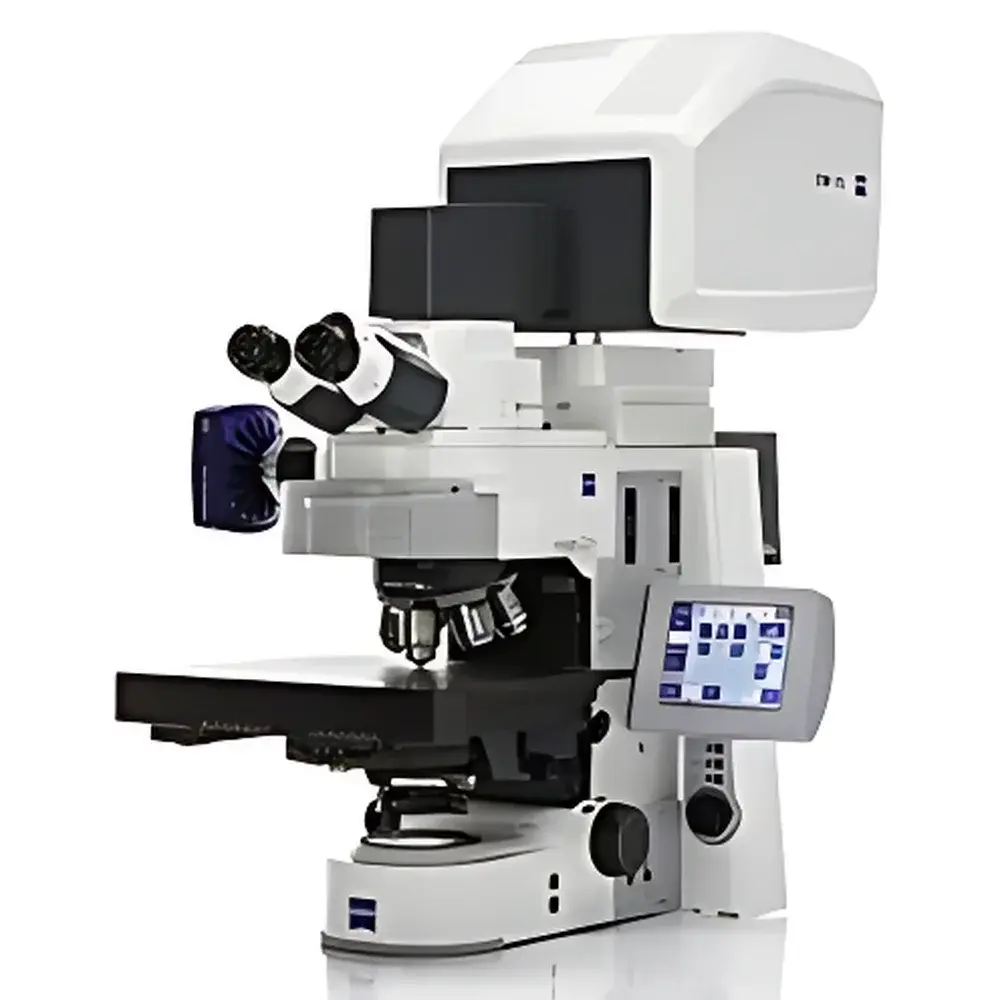
Zeiss LSM 900 Laser Scanning Confocal Microscope
| Brand | Zeiss |
|---|---|
| Origin | Germany |
| Model | LSM 900 |
| Maximum Image Resolution | 6144 × 6144 pixels |
| Laser Sources | Semiconductor lasers at 405 nm (5 mW), 488 nm (10 mW), 561 nm (10 mW), and 640 nm (5 mW) |
| Fluorescence Detectors | ≥2 GaAsP high-sensitivity detectors + ≥2 PMT detectors |
| Scan Module | Integrated scan head with monolithic aberration- and chromatic-correction |
| Scan Modes | xy, xyz, xyt, xyzt, xz, xt, xzt, spot-t, line, arbitrary curve, shear scanning |
| Optical Zoom | 0.5×–40× continuous zoom in 0.1× steps, maintained at all scan speeds |
| Microscope Host | Research-grade fully automated upright microscope (Axio Imager.Z2m) |
| Illumination | 12 V / 100 W halogen lamp with automatic brightness optimization per objective |
| Software & Workstation | ZEN imaging platform with ConfoMap 3D surface analysis (ISO 25178 & ISO 4287 compliant), 2D/3D metrology (height, roughness, volume, surface area, profile), AI-assisted segmentation, MATLAB interoperability via OAD (Open Application Development), Shuttle & Find correlative microscopy module |
| Vibration Isolation Table | 1200 × 900 mm dedicated optical table |
Overview
The Zeiss LSM 900 Laser Scanning Confocal Microscope is an advanced upright confocal platform engineered for quantitative 3D surface topography and microstructural characterization of solid materials. It operates on the principle of point-scanning confocal detection: a focused laser beam illuminates a diffraction-limited spot within the specimen, and emitted or reflected light passes through a spatially matched pinhole aperture—rejecting out-of-focus photons while preserving axial resolution. This optical sectioning capability enables precise depth-resolved acquisition of image stacks (z-stacks), from which height maps, volumetric profiles, and nanoscale surface parameters are reconstructed with sub-micrometer lateral and axial fidelity. Integrated into the Zeiss Axio Imager.Z2m research-grade upright microscope, the LSM 900 extends conventional brightfield, polarized light, and C-DIC observation modalities with non-contact, label-free confocal metrology—eliminating the need for sample coating, vacuum, or conductive preparation required by electron microscopy.
Key Features
- Monolithic scan architecture: All optical components—including galvanometric mirrors, dichroics, and detectors—are rigidly aligned and directly coupled without fiber transmission, ensuring long-term mechanical stability and signal reproducibility across thermal cycles.
- Multi-wavelength excitation: Four solid-state lasers (405 nm, 488 nm, 561 nm, 640 nm) support simultaneous multi-channel fluorescence, reflectance, and autofluorescence contrast mechanisms for hybrid material interrogation.
- Dual-detection pathway: GaAsP detectors deliver quantum efficiency >45% in the visible range for low-light applications; PMTs provide extended dynamic range for high-intensity signals—enabling quantitative intensity calibration per channel.
- Continuous optical zoom: 0.5×–40× zoom in 0.1× increments, maintained independently of scan speed or pixel dwell time—critical for maintaining consistent magnification during multi-scale ROI mapping.
- C Epiplan-APOCHROMAT objectives: Designed specifically for confocal use, these apochromatic objectives correct spherical and chromatic aberrations across the full visible spectrum, achieving Strehl ratios >0.8 at 405 nm—maximizing point spread function integrity and minimizing topographic artifacts.
Sample Compatibility & Compliance
The LSM 900 accommodates standard microscope slides, wafers (up to 200 mm), polished metal sections, ceramic substrates, polymer films, and geological thin sections—without size or conductivity constraints. Its non-destructive, ambient-air operation supports in situ monitoring of surface evolution under controlled environmental stages (optional). The system complies with ISO 25178-2 (areal surface texture), ISO 4287 (profile-based roughness), and ASTM E2927-21 (3D surface metrology validation). Audit trails, electronic signatures, and user-access controls in ZEN software align with GLP and FDA 21 CFR Part 11 requirements for regulated laboratories.
Software & Data Management
ZEN Blue software provides a modular, scriptable interface built on Microsoft .NET architecture. ConfoMap—a certified metrology engine—performs traceable surface analysis including Sa, Sq, Sz, Sdr, and functional parameters (Sk, Spk, Svk) per ISO 25178-2. Open Application Development (OAD) enables bidirectional data exchange with MATLAB, Python (via COM/ActiveX), and third-party statistical or machine learning frameworks. Shuttle & Find links optical coordinates to SEM/EDS or AFM datasets, enabling cross-platform correlation without manual registration. All raw image stacks, metadata (laser power, pinhole size, detector gain), and processing history are stored in vendor-neutral .czi format with embedded MIAME-compliant annotation.
Applications
- Quantitative surface metrology of machined components, additive-manufactured alloys, and MEMS devices.
- 3D porosity and pore-throat network analysis in sandstone, catalysts, and battery electrodes.
- Layer thickness and interfacial roughness measurement in multilayer polymer films and thin-film photovoltaics.
- In-process monitoring of coating delamination, wear track evolution, and corrosion pit growth.
- Correlative workflow integration: Optical screening → targeted SEM/FIB site selection → high-resolution structural validation.
FAQ
Does the LSM 900 require vacuum or conductive sample coating?
No. It performs non-contact, ambient-air surface profiling and fluorescence imaging without vacuum, sputtering, or metallization.
Can I export height maps to CAD or FEA software?
Yes. Surface height matrices (XYZ point clouds) are exportable as ASCII, STL, or Metrology Exchange Format (MEF) for import into SolidWorks, ANSYS, or CloudCompare.
Is the system compatible with existing Axio Imager.Z2m hardware?
Yes. The LSM 900 is a field-upgradeable module that reuses the host microscope’s motorized stage, turret, illumination, and objective library—minimizing capital expenditure.
How is calibration traceability ensured for roughness measurements?
Certified step-height standards (e.g., NIST SRM 2161) are supported via ZEN’s Calibration Manager; all ConfoMap reports include uncertainty budgets per GUM (Guide to the Expression of Uncertainty in Measurement).
What level of technical support is provided post-installation?
Zeiss offers on-site commissioning, application-specific training, annual performance verification (APV), and remote diagnostics via Zeiss Connect—backed by ISO 9001-certified service centers in North America, EMEA, and APAC.






