
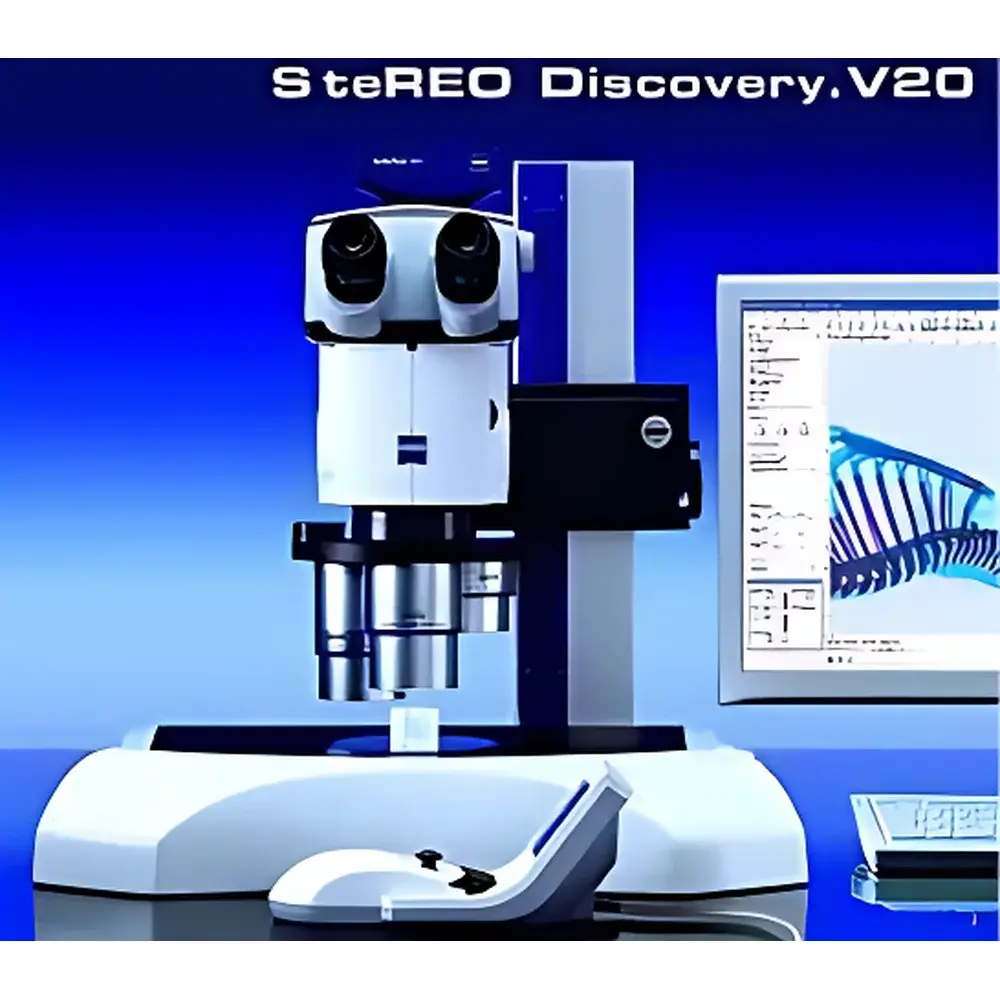
ZEISS SteREO Discovery.V20 Stereo Microscope
| Brand | ZEISS |
|---|---|
| Origin | Germany |
| Model | SteREO Discovery.V20 |
| Total Magnification Range | 4.7×–1312.5× |
| Zoom Ratio | 20:1 |
| Working Distance | 10–253 mm |
| Vertical Travel | 340 mm |
| Focusing Resolution | 350 nm |
| Field of View | 0.18–48.7 mm |
| Illumination | 15 V/150 W or 24 V/250 W Cold Light Source |
| Automation | SyCop System Controller + H.I.P. Human Interface Panel |
| Optical Design | CMO (Common Main Objective) Telecentric Path |
| Anti-Glare Optics | ZEISS Proprietary Technology |
| Structural Architecture | Modular, Open-Frame, Ergonomically Optimized |
Overview
The ZEISS SteREO Discovery.V20 is a high-performance stereo microscope engineered for precision macroscopic inspection and documentation across industrial quality control, materials science, failure analysis, and life science research laboratories. Based on the Common Main Objective (CMO) optical principle — the international benchmark for high-fidelity stereoscopic imaging — the system delivers true telecentric light paths, ensuring minimal perspective distortion, consistent magnification across the entire field, and exceptional depth-of-field fidelity. Unlike Greenough-style stereomicroscopes, the CMO architecture employs a single shared objective lens with dual parallel beam paths, resulting in superior image homogeneity, color fidelity, and long-term optical stability. The instrument’s 20:1 zoom ratio (4.7×–1312.5× with auxiliary objectives and eyepiece combinations), combined with a wide working distance range (10–253 mm), enables non-contact examination of large, irregular, or vertically constrained specimens — from electronic assemblies and metallographic cross-sections to botanical samples and forensic evidence.
Key Features
- Ultra-precise focusing mechanism with 350 nm resolution, supporting repeatable quantitative height profiling and focus-stacking workflows.
- Modular, open-frame mechanical design compliant with ISO 9241-5 ergonomic standards; fully adjustable stage, arm, and viewing head accommodate seated or standing operation over extended shifts.
- Integrated SyCop (System Control Platform) and H.I.P. (Human Interface Panel) automation suite enabling synchronized motorized zoom, focus, illumination intensity, and white-balance calibration — all programmable via intuitive touch interface.
- ZEISS anti-glare optical coating technology minimizes internal reflections and stray light, significantly enhancing contrast and edge definition in low-reflectivity or multi-material interfaces (e.g., solder joints, composite laminates, corroded surfaces).
- Scalable illumination architecture supporting both transmitted (base-mounted) and reflected (ring-light, coaxial, or gooseneck) cold-light sources (15 V/150 W or 24 V/250 W halogen or LED-compatible), with continuous color temperature control (2800–6500 K).
- Designed for >60-year service life per ZEISS engineering lifecycle validation; all optical components are sealed, coated, and assembled in Oberkochen, Germany under DIN EN ISO 9001-certified processes — no local joint ventures or third-country assembly.
Sample Compatibility & Compliance
The SteREO Discovery.V20 accommodates specimens ranging from sub-millimeter microcomponents to full-size castings, PCBs, or biological tissue blocks — without disassembly or sectioning. Its 340 mm vertical travel and broad working distance envelope support integration with motorized XYZ stages, vacuum chucks, and environmental chambers (e.g., humidity or temperature-controlled enclosures). The system meets essential regulatory requirements for documented inspection workflows: optical path traceability aligns with ASTM E2912 (Standard Guide for Stereomicroscopy), mechanical repeatability supports ISO/IEC 17025-compliant calibration protocols, and digital image capture modules comply with FDA 21 CFR Part 11 when configured with audit-trail-enabled software (e.g., ZEN Core with GLP/GMP mode).
Software & Data Management
When paired with ZEISS ZEN Core imaging software (sold separately), the microscope enables automated multi-focus image acquisition, measurement annotation (length, angle, area, particle count), and report generation in PDF or CSV formats — all embedded with EXIF metadata (magnification, objective ID, illumination settings, timestamp). Raw image data is stored in TIFF or ZVI format with lossless compression; batch processing pipelines support ISO 10993-compliant documentation for medical device inspection. Optional DICOM export and LIMS integration modules facilitate enterprise-level traceability in regulated manufacturing environments.
Applications
- Failure analysis of metallurgical fractures (quench cracks, hot tears, fatigue striations) and weld defects (lack of fusion, porosity, undercut) per ASTM E3, E112, and ISO 17873.
- Non-destructive inspection of semiconductor packaging, MEMS devices, and printed circuit board assemblies prior to burn-in or functional testing.
- Forensic toolmark comparison and bullet/ cartridge case examination under controlled lighting geometries.
- Botanical morphology studies requiring high-resolution 3D surface rendering of leaf venation, trichome distribution, or fungal hyphae networks.
- Quality assurance of additive-manufactured parts, including layer adhesion verification, powder residue detection, and dimensional conformity checks against CAD models.
FAQ
Is the SteREO Discovery.V20 compatible with third-party digital cameras?
Yes — via standardized C-mount or F-mount adapters; however, ZEISS-certified cameras (e.g., Axiocam 305 mono/color) ensure full SyCop synchronization and metadata embedding.
Can the system be upgraded with motorized stage control after installation?
Yes — all mechanical interfaces follow ZEISS’s modular expansion standard; retrofit kits for motorized XY stages and encoded Z-drives are available with factory calibration.
Does the CMO optical path support fluorescence observation?
No — the SteREO Discovery.V20 is optimized for brightfield, darkfield, and oblique illumination; fluorescence capability requires the ZEISS Axio Zoom.V16 platform.
What is the warranty coverage for optical components?
ZEISS provides a 10-year limited warranty on all objective lenses and prisms; mechanical components are covered for 5 years, extendable to 15 years under ZEISS ServiceCare contracts.
How is compliance with ISO/IEC 17025 maintained during routine use?
The system includes built-in calibration routines for magnification accuracy (traceable to NIST SRM 2053), focus drift monitoring, and illumination uniformity mapping — all documented in the ZEN Core calibration logbook module.



