
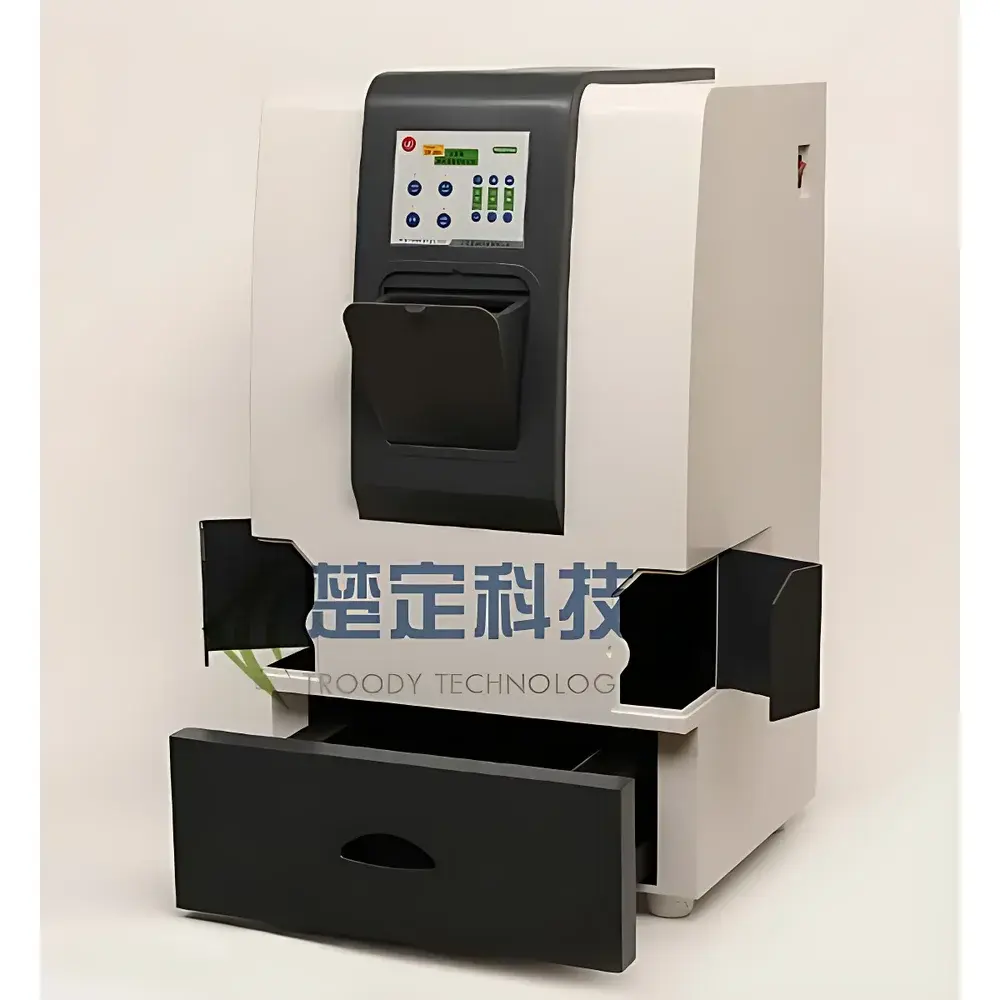
ZF-288 Automated Gel Documentation and Analysis System
| Origin | Shanghai, China |
|---|---|
| Manufacturer Type | Authorized Distributor |
| Origin Category | Domestic (PRC) |
| Model | ZF-288 |
| Price | USD 9,000 (FOB Shanghai) |
| Instrument Type | Standard Gel Imaging System |
| CCD Resolution | 5.0 Megapixels |
| Bit Depth | 16-bit |
| Dynamic Range | >4.5 orders of magnitude |
| CCD Sensor Dimensions | 2592 × 1944 pixels |
| Detection Sensitivity | <20 pg double-stranded DNA stained with ethidium bromide |
| Signal-to-Noise Ratio | ≥56 dB |
| Lens | Motorized zoom lens (Computar, f/1.2, 8–48 mm) |
Overview
The ZF-288 Automated Gel Documentation and Analysis System is a benchtop, darkroom-integrated imaging platform engineered for high-fidelity acquisition and quantitative analysis of nucleic acid and protein electrophoretic gels, blot membranes, autoradiographs, microplates, and thin-layer chromatography (TLC) plates. It operates on the principle of controlled UV transillumination (254 nm and 365 nm), visible white-light transmission/reflection, and optional blue-light excitation (470 nm), coupled with a scientific-grade 16-bit monochrome CCD sensor optimized for low-light fluorescence detection. Designed to meet routine and mid-throughput molecular biology laboratory requirements, the ZF-288 delivers reproducible, publication-ready images while supporting GLP-aligned documentation workflows through timestamped metadata embedding and audit-trail-capable software operation.
Key Features
- Fully motorized optical control: Software- or front-panel-driven adjustment of zoom, focus, iris aperture, and illumination modes—eliminating manual intervention during acquisition.
- Integrated dark chamber with dual-side cut-gel access ports: Enables direct in-chamber excision of DNA bands under UV shielding, minimizing ethidium bromide (EB) exposure and cross-contamination risk.
- Patented safety interlock system: UV lamps automatically deactivate when the drawer-style light box is opened; all illumination sources power down after 10 minutes of inactivity or upon software exit.
- High-sensitivity imaging architecture: Equipped with a Microvision-manufactured low-noise CCD sensor (2592 × 1944 active pixels), f/1.2 Computar zoom lens, and 16-bit analog-to-digital conversion—ensuring linear signal response across a dynamic range exceeding 4.5 log units.
- Dual-mode illumination: Standard 302 nm UV transilluminator (200 × 250 mm) + white-light transmission panel (210 × 260 mm); optional 470 nm blue-light transilluminator and cold-white reflective LED arrays (200 × 50 mm) available for SYBR® Safe and other blue-excitable dyes.
- Ergonomic real-time monitoring: UV-blocking observation window (60 × 125 mm) allows safe visual assessment prior to image capture; integrated preview mode supports live histogram and exposure optimization.
Sample Compatibility & Compliance
The ZF-288 accommodates a broad spectrum of sample formats including agarose and polyacrylamide gels (up to 25 × 20 cm), nitrocellulose and PVDF transfer membranes (Western, Southern, Northern, dot/slot blots), X-ray film and phosphorimager screens, 96-well microtiter plates, TLC aluminum sheets, and Petri dishes for colony counting. Its optical configuration complies with common laboratory safety standards for UV handling (IEC 62471 photobiological safety classification) and supports traceable data acquisition per ISO/IEC 17025 requirements when used with validated software settings. While not FDA 21 CFR Part 11–certified out-of-the-box, the system’s logging functionality—including user ID, timestamp, exposure parameters, and image hash—facilitates internal validation for QC/QA environments operating under GLP or GMP frameworks.
Software & Data Management
The ZF-288 ships with a dual-language (English/Chinese) gel analysis suite developed in collaboration with U.S.-based bioimaging software engineers. The unified interface integrates image acquisition, annotation, normalization, and quantitative analysis without requiring file export/import. Core capabilities include: one-dimensional electrophoretic band profiling with background subtraction and lane/region-of-interest (ROI) definition; molecular weight calibration using reference ladders; relative density quantification with % volume and integrated intensity metrics; spot detection and clustering for dot-blot or colony assays; and customizable report generation (PDF, TIFF, PNG) with embedded EXIF-like metadata (exposure time, lens focal length, gain, date/time). All images are stored with lossless compression; raw 16-bit TIFF output is supported for third-party analysis (e.g., ImageJ, FIJI, or commercial ELN systems).
Applications
- Nucleic acid analysis: Quantitative detection of EB-, SYBR® Gold-, SYBR® Green-, GelStar®-, or Fluorescein-labeled DNA/RNA fragments across standard agarose and PAGE systems.
- Protein characterization: Densitometric evaluation of Coomassie Brilliant Blue– or silver-stained gels, plus fluorescent detection using Sypro® Ruby, Deep Purple™, or Pro-Q® Diamond reagents.
- Membrane-based assays: Semi-quantitative analysis of chemiluminescent, chromogenic, or fluorescent Western/Northern/Southern blots—including multiplexed detection when paired with appropriate filter sets.
- Microbial and enzymatic assays: Colony enumeration from Petri dishes; zymogram activity profiling; and enzyme-linked immunosorbent assay (ELISA) plate scanning via white-light reflectance mode.
- TLC and electrophoresis quality control: Rf value calculation, band purity assessment, and batch-to-batch consistency verification in synthetic biology and pharmaceutical development labs.
FAQ
Is the ZF-288 compatible with Windows 10 and 11?
Yes—the imaging software is fully compatible with Windows 10 (64-bit) and Windows 11 (64-bit), requiring only USB 2.0 connectivity and .NET Framework 4.8.
Can I perform two-dimensional (2D) gel analysis with this system?
The base software includes 1D analysis; optional 2D module licensing is available for spot matching, warping correction, and differential expression mapping.
What safety certifications does the dark chamber carry?
The enclosure meets CE EN 61010-1 (electrical safety) and EN 62471 (UV radiation safety) requirements; UV lamp housings incorporate mechanical shutters and fail-safe interlocks.
Does the system support automated batch acquisition?
Yes—users can define multi-step acquisition protocols (e.g., UV + white-light + filter-swapped sequences) and execute them unattended across multiple gels.
Is technical support and software updates included post-purchase?
Standard warranty covers 24 months parts-and-labor; remote software updates and application troubleshooting are provided free of charge during warranty period.




