
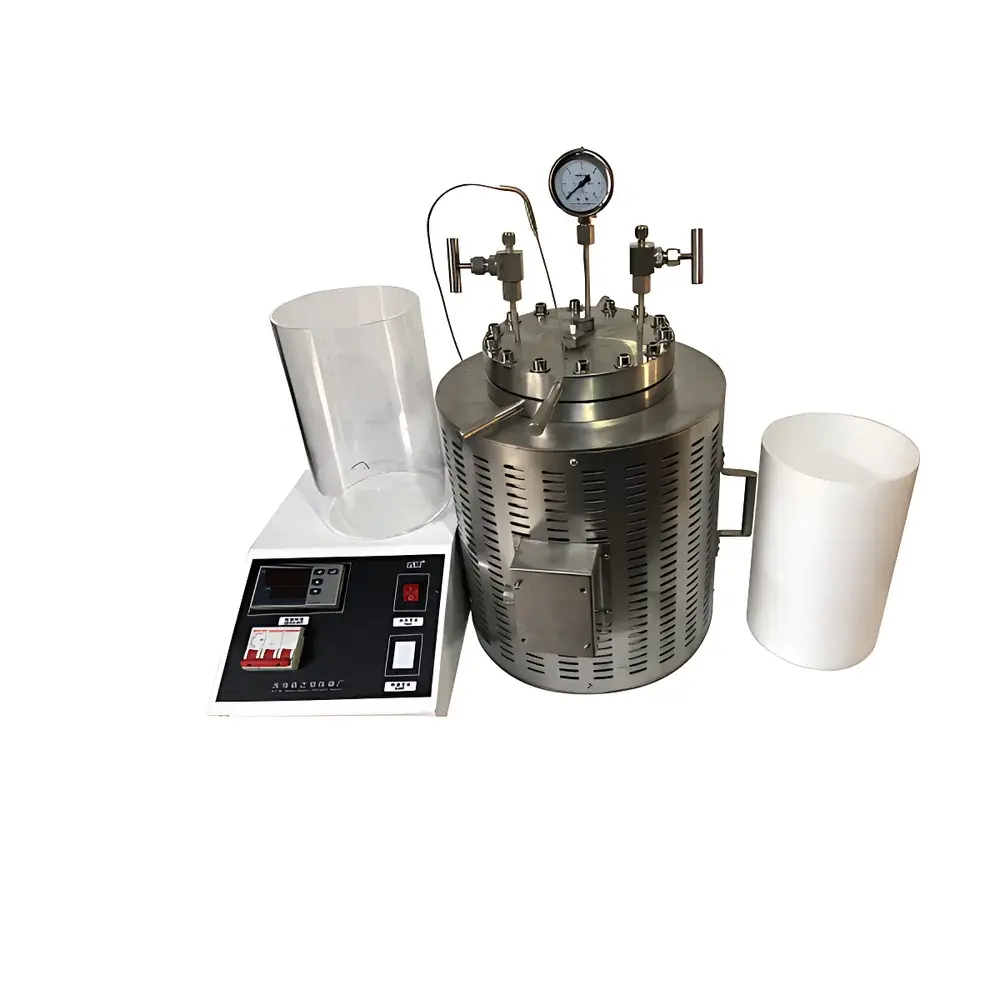
Zhengxin EP-5L High-Temperature High-Pressure Electrochemical Autoclave Reactor
| Brand | Zhengxin Instrument Factory |
|---|---|
| Origin | Jiangsu, China |
| Model | EP-5L |
| Vessel Capacity | 5 L |
| Construction Material | Stainless Steel 304/316L (customizable to Hastelloy, Titanium, Zirconium) |
| Maximum Operating Temperature | 1000 °C |
| Maximum Operating Pressure | 70 MPa |
| Minimum Vacuum Level | –0.1 MPa |
| Heating Method | Integrated Modular Electric Heater |
| Heating Power | 400–3500 W |
| Temperature Control | LCD PID Controller with Auto-Tuning (AT) and 30-Stage Programmable Ramp/Soak |
| Temperature Accuracy | ±1 °C (optional ±0.1 °C) |
| Temperature Ramp Rate | ≤10 °C/min (adjustable) |
| Pressure Monitoring | Stainless Steel Bourdon Tube Pressure Gauge |
| Gas Inlet/Outlet Valves | SS Needle Valves with 1/8″ (3 mm) and 1/4″ (6 mm) Swagelok®-compatible fittings |
| Safety Systems | Spring-Loaded Pressure Relief Valve, Explosion-Proof Housing, Finned Heat Dissipation Structure |
| Optional Accessories | Quartz or Metal Liners, Sampling Tube, Electrode Feedthroughs, Vacuum Pump Interface |
Overview
The Zhengxin EP-5L High-Temperature High-Pressure Electrochemical Autoclave Reactor is an engineered platform for conducting controlled chemical synthesis, catalytic reaction studies, hydrothermal crystallization, and electrochemical investigations under extreme thermodynamic conditions. Designed around a robust coaxial autoclave architecture, the system operates on the principle of sealed-vessel batch reaction kinetics, where precise regulation of temperature, pressure, gas composition, and electrochemical potential enables reproducible process development in research and pilot-scale applications. Its modular construction—featuring separable heating jacket and reactor body—facilitates rapid cleaning, liner replacement, and electrode integration, making it suitable for corrosive media, high-ionic-strength electrolytes, and reactive gas environments (e.g., H₂, CO₂, NH₃, O₂). The reactor conforms to fundamental mechanical integrity requirements outlined in ASME BPVC Section VIII Div. 1 for pressure containment and supports traceable calibration per ISO/IEC 17025 when paired with certified sensors.
Key Features
- Modular thermal design: Fixed-position electric heating modules ensure uniform axial and radial heat distribution; external stainless steel housing provides structural rigidity and IP65-rated environmental protection.
- Advanced temperature management: PID-based controller with auto-tuning (AT), real-time deviation compensation, and 30-segment programmable ramp/soak profiles—enabling complex thermal protocols required for nucleation-controlled crystal growth or kinetic isothermal holds.
- High-fidelity metrology: K-type thermocouple (IEC 60584-compliant) with cold-junction compensation; calibrated stainless steel pressure gauge (0–70 MPa full scale, Class 1.6 accuracy) mounted directly on the vessel head.
- Gas handling interface: Dual high-pressure needle valves (inlet and vent) with Swagelok®-compatible 1/8″ and 1/4″ ferrule fittings support vacuum evacuation (< 0.1 MPa abs), inert gas purging, and controlled repressurization—critical for oxygen-sensitive electrocatalysis or supercritical fluid reactions.
- Enhanced safety architecture: Integrated spring-loaded pressure relief valve set at user-defined threshold (typically 10–15% above max operating pressure); explosion-proof outer casing; finned aluminum heat sink for passive thermal dissipation during cooldown cycles.
- Electrode-ready configuration: Standardized electrical feedthroughs (optional) accommodate working, reference, and counter electrodes—enabling in situ voltammetry, impedance spectroscopy, or potentiostatic control within the pressurized environment.
Sample Compatibility & Compliance
The EP-5L accommodates heterogeneous and homogeneous reaction mixtures including aqueous electrolytes, organic solvents, molten salts, and slurry-phase catalysts. Vessel liners—available in quartz, PTFE-lined stainless steel, Hastelloy C-276, titanium Grade 2, or zirconium—allow compatibility with HF-containing media, strong oxidizers (e.g., fuming nitric acid), or reducing atmospheres up to 1000 °C. All wetted materials comply with ASTM A240/A240M for stainless alloys and ASTM B575/B575M for nickel-based superalloys. The system supports GLP-aligned documentation workflows: temperature and pressure logs are timestamped and exportable via RS485/Modbus RTU, enabling alignment with FDA 21 CFR Part 11 requirements when integrated with validated data acquisition software.
Software & Data Management
While the base unit features a standalone LCD PID controller, optional RS485 serial interface permits bidirectional communication with third-party SCADA platforms (e.g., LabVIEW, MATLAB, or custom Python-based DAQ systems). Real-time sensor data—including temperature, pressure, and (when equipped) electrode potential—can be streamed at configurable intervals (100 ms–5 s resolution) and stored in CSV or TDMS format. Audit trails include operator ID, parameter change history, and system event timestamps (e.g., valve actuation, overtemperature alarm). Firmware updates are performed via USB port without hardware modification, ensuring long-term maintainability and regulatory adaptability.
Applications
- Hydrothermal synthesis of metal oxides, MOFs, and quantum dots under controlled pH and redox potential.
- Electrocatalytic CO₂ reduction and water splitting studies at elevated pressures (>10 bar) to enhance mass transfer and Faradaic efficiency.
- Accelerated aging tests of battery electrode materials (e.g., NMC, LFP) in carbonate-based electrolytes at 60–85 °C and 2–5 MPa.
- Supercritical water oxidation (SCWO) of organic waste streams with real-time pH and conductivity monitoring.
- Geochemical simulation experiments replicating crustal/mantle conditions for mineral dissolution–precipitation kinetics.
- Pharmaceutical polymorph screening via high-pressure crystallization with in situ Raman coupling (via optional quartz viewport).
FAQ
What materials are available for vessel liners, and how do I select the appropriate one for my reaction medium?
Standard liner options include quartz (for UV-transparent, low-metal-contamination work), 316L stainless steel (general corrosion resistance), Hastelloy C-276 (resistant to hot concentrated acids and chlorides), titanium Grade 2 (excellent for oxidizing halogen environments), and zirconium (superior resistance to alkalis and sulfuric acid). Selection depends on pH, halide concentration, temperature, and redox potential—application engineering support is available to cross-reference NACE MR0175/ISO 15156 compatibility tables.
Can the reactor be integrated with external potentiostats or gas chromatography systems?
Yes. Electrical feedthroughs (up to 4 channels, rated to 1000 V DC and 5 A) are available for electrochemical instrumentation. For GC coupling, a heated transfer line (up to 300 °C) with a septum-sealed sampling port and back-pressure regulator can be factory-installed.
Is validation documentation (IQ/OQ/PQ) provided for regulated environments?
Factory calibration certificates for temperature and pressure sensors are included. Full IQ/OQ/PQ protocol templates aligned with ASTM E2500 and EU Annex 15 are available upon request and may be executed onsite by qualified engineers.



