
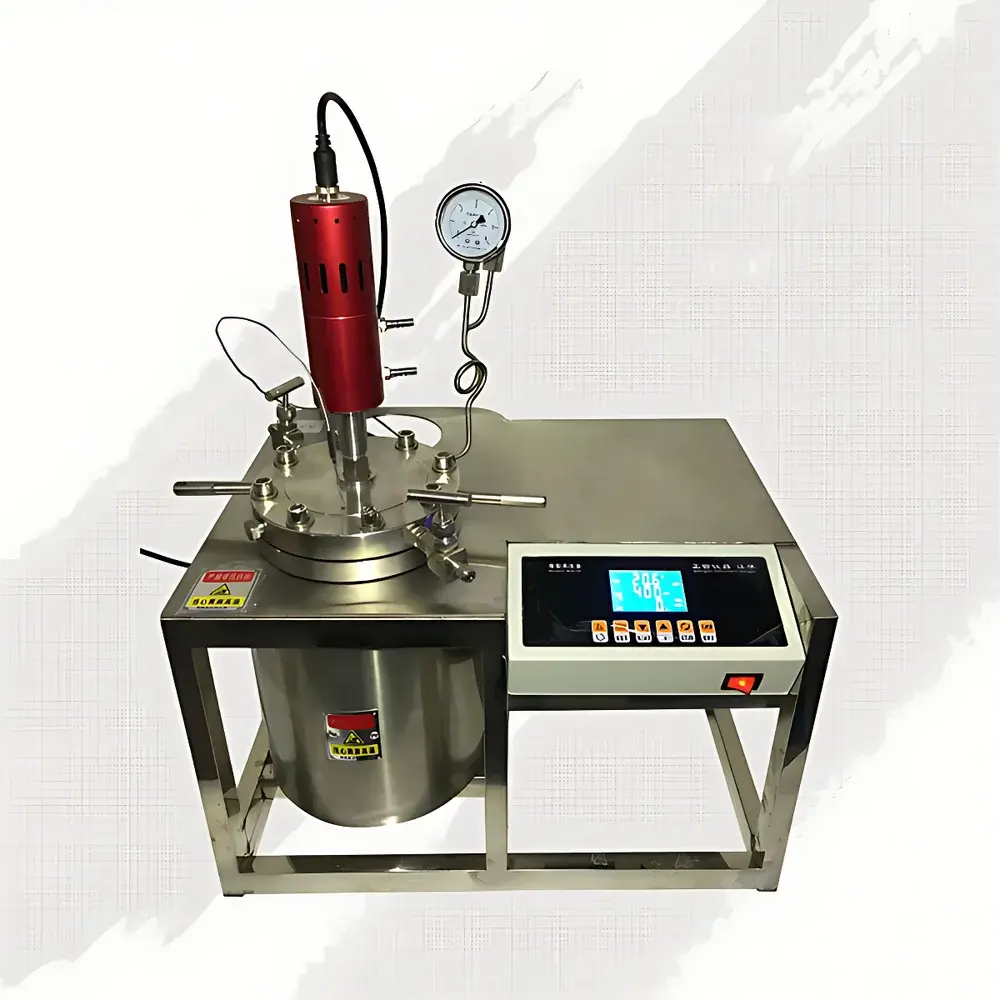
Zhengxin K-PS-2L Mechanical Stirring High-Pressure Reactor
| Brand | Zhengxin Instruments |
|---|---|
| Origin | Jiangsu, China |
| Manufacturer Type | Authorized Distributor |
| Country of Origin | China |
| Model | K-PS-2L |
| Capacity | 2 L |
| Vessel Material | Stainless Steel (304/316L standard) |
| Working Pressure Range | –0.1 to 10 MPa (Note: “Vacuum degree: 10 MPa” is physically invalid |
| Operating Temperature Range | 0–600 °C |
| Stirring Speed | 0–1000 rpm |
| Heating Power | 0–2500 W |
| Control Mode | PID Dual-Channel Intelligent Temperature Control |
| Temperature Accuracy | ±1 °C |
| Sealing Options | Soft (PTFE/gasket) or Hard (metal-to-metal) Seal |
| Safety Features | Overtemperature/overpressure auto-alarm, rupture disc (Hastelloy), mechanical pressure relief |
| Stirring Torque | Up to 40 N·m |
| Optional Linings | PTFE, Quartz, PPL |
| External Interfaces | Dual-clamp fittings, condenser ports, thermocouple (K-type, Φ2.0 mm, 316L sheath) |
| Compliance | Designed for GLP-compliant lab environments |
Overview
The Zhengxin K-PS-2L Mechanical Stirring High-Pressure Reactor is a precision-engineered benchtop synthesis system designed for controlled, reproducible chemical reactions under elevated temperature and pressure conditions. Based on Couette-type axial stirring mechanics and robust pressure containment architecture, it enables safe execution of catalytic hydrogenation, polymerization, supercritical fluid synthesis, and inert-atmosphere reactions in academic research labs and R&D facilities. The reactor vessel is CNC-machined as a single monolithic unit from high-purity stainless steel (standard 304 or optional 316L/310S/Hastelloy/Ti), ensuring dimensional stability, leak integrity, and resistance to thermal cycling fatigue. Its flanged closure system—secured via 4, 6, or 10 high-tensile bolts—minimizes manual effort during loading/unloading while maintaining uniform gasket compression across the sealing surface. The K-PS series complies with fundamental design principles outlined in ASME BPVC Section VIII Div. 1 (for non-certified lab-scale vessels) and incorporates fail-safe mechanisms aligned with IEC 61508 functional safety concepts.
Key Features
- Monolithic CNC-machined reactor body with integrated flange interface for structural rigidity and zero weld-induced stress concentration
- Dual-channel PID temperature control with independent heating and monitoring circuits; prevents thermal overshoot and supports ramp-hold programming (optional)
- High-torque DC brushless motor drive (0–1000 rpm, adjustable direction) coupled to a precision-ground stainless steel shaft and detachable impeller assembly (max torque: 40 N·m)
- Modular heating system: fully enclosed stainless steel heating jacket with rapid thermal response and uniform heat distribution (0–2500 W, adjustable)
- Multi-layer safety architecture: real-time pressure/temperature monitoring, audible/visual alarm triggers, Hastelloy burst disc, and passive mechanical pressure relief valve
- Configurable sealing: PTFE-faced soft seal for corrosive media or metal-seated hard seal for ultra-high-purity or high-temperature applications (up to 600 °C)
- Standardized 1/4″–1/2″ NPT or Swagelok-compatible external ports for gas inlet/outlet, sampling, condenser attachment, and thermocouple insertion
Sample Compatibility & Compliance
The K-PS-2L accommodates heterogeneous, viscous, and gas-liquid multiphase systems typical in fine chemical synthesis, pharmaceutical process development, and materials science. Compatible liners—including PTFE, quartz, and PPL—extend operational range to highly aggressive reagents (e.g., HF, fuming HNO₃) or UV-transparent photochemical studies. All wetted components meet USP Class VI biocompatibility requirements when specified. The system supports operation under inert (N₂, Ar), reducing (H₂), or oxidizing (O₂) atmospheres with leak rates <1×10⁻⁹ mbar·L/s (helium tested). Documentation packages include material traceability certificates, pressure test reports (hydrostatic at 1.5× MAWP), and calibration records for integrated sensors—facilitating internal QA audits and alignment with ISO/IEC 17025 Clause 6.4 and FDA 21 CFR Part 11 data integrity expectations for electronic records.
Software & Data Management
While the base unit operates via front-panel LCD interface with real-time numeric display of T, P, rpm, and timer, optional RS485/Modbus RTU or USB-C connectivity enables integration with third-party SCADA or LIMS platforms. Logged parameters (timestamped temperature, pressure, speed, and alarm events) are stored onboard for ≥30 days and exportable as CSV for statistical process analysis (SPC). Firmware supports user-defined alarm thresholds, password-protected parameter locking, and event-driven data capture—meeting GLP traceability requirements for method validation and regulatory submissions. Audit trails record all configuration changes, including operator ID, timestamp, and pre-/post-value states.
Applications
- Catalytic hydrogenation of unsaturated organic compounds under controlled H₂ partial pressure (0.1–10 MPa)
- Step-growth and chain-growth polymerizations requiring precise thermal history control and viscosity management
- Supercritical CO₂-mediated extractions and reactions (T > 31 °C, P > 7.38 MPa)
- Hydrothermal synthesis of metal oxides, MOFs, and nanomaterials (up to 600 °C, 10 MPa)
- Corrosion-resistant reaction screening for API intermediates in acidic or halogenated media
- Small-scale kinetic studies with inline sampling via PTFE-coated withdrawal tube
FAQ
What pressure rating is certified for the K-PS-2L?
The vessel is rated for continuous operation up to 10 MPa (1450 psi) at 200 °C; maximum allowable working pressure decreases with increasing temperature per ASME derating curves.
Can the reactor be used for exothermic reactions requiring cooling?
Yes—external cooling jackets or coil inserts (not included) can be mounted via standardized ports; maximum cooling rate depends on chiller capacity and thermal mass of the medium.
Is the stirring system suitable for highly viscous polymer melts?
With the 40 N·m torque capability and low-speed high-torque impeller options (e.g., anchor or helical ribbon), it handles viscosities up to 10⁶ mPa·s at elevated temperatures.
Does the system support automated sequential dosing?
Not natively—but programmable syringe pumps or mass flow controllers can be interfaced externally using analog 0–10 V or 4–20 mA signals with custom PLC integration.
Are calibration certificates provided for temperature and pressure sensors?
Yes—NIST-traceable calibration reports (as-tested) are supplied with each unit; field recalibration services are available upon request.
Related Products



