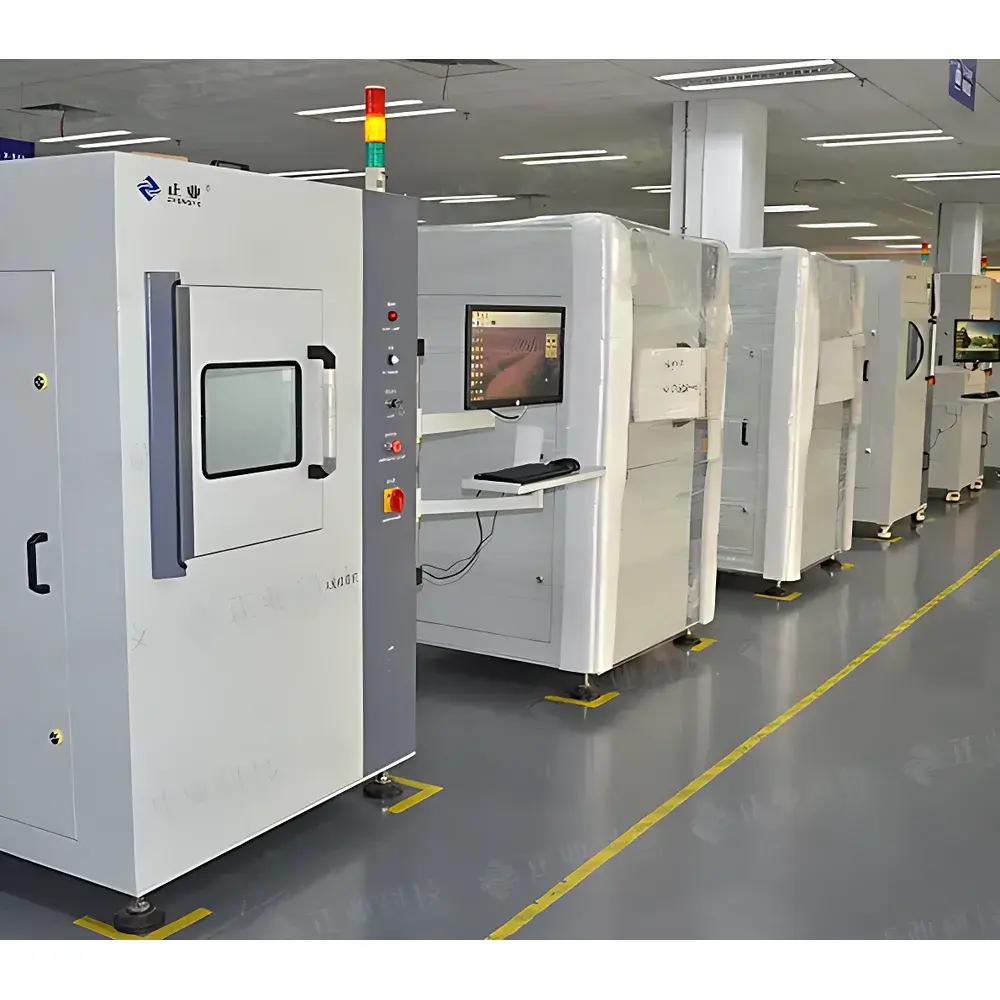
Zhengye BL32 Industrial X-ray Inspection System for Finished Lithium-ion Battery Cells
| Brand | Zhengye |
|---|---|
| Origin | Guangdong, China |
| Manufacturer Type | OEM/ODM Manufacturer |
| Country of Origin | China |
| Model | BL32 |
| X-ray Tube Voltage | 90–130 kV (configurable) |
| X-ray Tube Current | 89–455 µA (configurable) |
| Focal Spot Size | 5–15 µm |
| Cooling Method | Forced Air Cooling |
| Detector Type | Image Intensifier or Flat Panel Detector |
| Field of View | Φ100 mm or 114.9 mm × 64.6 mm (configurable) |
| Image Resolution | 1392 × 1040 or 1536 × 864 pixels (configurable) |
| Geometric Magnification | 12×–48× |
| Repeatability Accuracy | ±60 µm |
| Inspection Speed | ≥1.5 points/sec (excluding loading/unloading and stage motion) |
| Stage Dimensions | 515 mm × 460 mm |
| Effective Inspection Area | 450 mm × 410 mm |
| Max Payload | ≤5 kg |
| Radiation Safety | ≤1 µSv/hr (compliant with IEC 61331-1 and GBZ 138–2002) |
| Computer | 22" touchscreen LCD, Intel Core i5, 4 GB RAM, 500 GB HDD |
| Overall Dimensions | 1136 mm × 1076 mm × 1730 mm |
| Weight | ~750 kg |
| Power Supply | AC 220 V, 10 A |
| Operating Environment | 25 °C ± 3 °C, RH 50% ± 10% |
Overview
The Zhengye BL32 Industrial X-ray Inspection System is a purpose-built non-destructive testing (NDT) platform engineered for high-throughput, high-fidelity internal structural analysis of finished lithium-ion battery cells. Leveraging transmission X-ray imaging physics—where differential X-ray attenuation across material densities generates contrast in real time—the system enables sub-millimeter resolution visualization of internal electrode alignment, separator integrity, weld quality, foreign object debris (FOD), voids, delamination, and anode/cathode dimensional anomalies. Designed specifically for QC/QA laboratories and inline production environments in battery manufacturing, the BL32 integrates radiographic imaging with metrological measurement capability to support both pass/fail classification and quantitative defect characterization per ISO 17025-aligned inspection workflows.
Key Features
- 2.5D Metrology Engine: Supports calibrated linear distance, circle diameter, concentricity, point-to-center offset, and edge-to-edge gap measurements directly on X-ray images—enabling traceable geometric verification without physical contact.
- CNC Path Programming: Records and replays multi-axis inspection trajectories with micron-level positional repeatability; ideal for batch validation of identical cell formats during pilot runs or low-volume custom production.
- Intuitive Navigation Interface: Large-scale real-time image navigation window allows mouse-driven click-to-move targeting—reducing operator training time and minimizing manual stage positioning errors.
- Configurable Imaging Hardware: Modular detector and X-ray source options—including selectable focal spot size (5–15 µm), voltage (90–130 kV), and current (89–455 µA)—permit optimization for varying cell thicknesses (e.g., prismatic, pouch, cylindrical) and material compositions (Al/Cu foils, Ni-rich cathodes, Si-anodes).
- Radiation-Safe Enclosure: Fully interlocked cabinet meeting IEC 61331-1 requirements, with lead-equivalent shielding and continuous dose monitoring ensuring ≤1 µSv/hr ambient exposure during operation.
Sample Compatibility & Compliance
The BL32 accommodates standard commercial lithium-ion cell formats up to 450 mm × 410 mm in footprint and 5 kg in mass—including 21700/4680 cylindrical cells, JIS-standard prismatic modules, and large-format pouch cells used in EV and ESS applications. All mechanical, electrical, and radiation safety designs conform to GBZ 138–2002 (China’s X-ray equipment safety standard) and align with international NDT best practices referenced in ASTM E2737 (Standard Guide for Digital Radiography) and ISO 17636-2 (Radiographic testing of welds). Optional documentation packages support GLP/GMP audit readiness, including IQ/OQ protocols and calibration traceability to national metrology institutes.
Software & Data Management
The proprietary XG5010 inspection software provides automated defect recognition via rule-based thresholding and region-of-interest (ROI) analysis—not AI-based classification—to ensure deterministic, repeatable decision logic required in regulated manufacturing. Image data is stored in DICOM-compliant format with embedded metadata (exposure parameters, stage coordinates, timestamp, operator ID). Audit trails log all user actions, parameter changes, and pass/fail decisions in accordance with FDA 21 CFR Part 11 principles. Raw images and measurement reports export to CSV, PDF, or XML for integration into MES or LIMS platforms. Software supports dual-monitor operation and optional touchscreen control for glove-compatible use in cleanroom or production-floor settings.
Applications
- Verification of electrode stack alignment and compression uniformity in dry-room assembled pouch cells
- Detection of tab weld cracks, misaligned busbars, or solder voids in prismatic module interconnects
- Identification of metallic contaminants (e.g., Cu/Al shavings, stainless steel fragments) introduced during slitting or stacking
- Quantitative assessment of separator wrinkling, cathode cracking, or anode swelling post-cycling or thermal abuse
- Root-cause analysis of field-failure units under failure analysis (FA) lab conditions
FAQ
Does the BL32 support automated defect classification beyond binary pass/fail?
No—it implements deterministic, user-defined measurement thresholds and spatial rules rather than machine learning models, ensuring full interpretability and regulatory acceptability in GMP environments.
Can the system be integrated into a fully automated production line?
Yes—via Ethernet/IP or Modbus TCP interfaces, the BL32 supports external trigger input for synchronized inspection cycles and digital I/O signals for OK/NG output to PLC-controlled sorters.
Is radiation shielding certification provided with delivery?
Yes—each unit ships with a third-party radiation survey report confirming compliance with ≤1 µSv/hr at 5 cm from any external surface, as required by local occupational health authorities.
What maintenance intervals are recommended for the X-ray tube and detector?
Annual preventive maintenance is advised, including tube warm-up calibration, detector flat-field correction, and mechanical stage backlash verification—full service logs are retained within the software audit trail.
Are software updates included post-purchase?
Minor version updates (e.g., bug fixes, UI enhancements) are provided free of charge for 24 months; major releases (e.g., new measurement algorithms or protocol extensions) are available under optional annual support contracts.