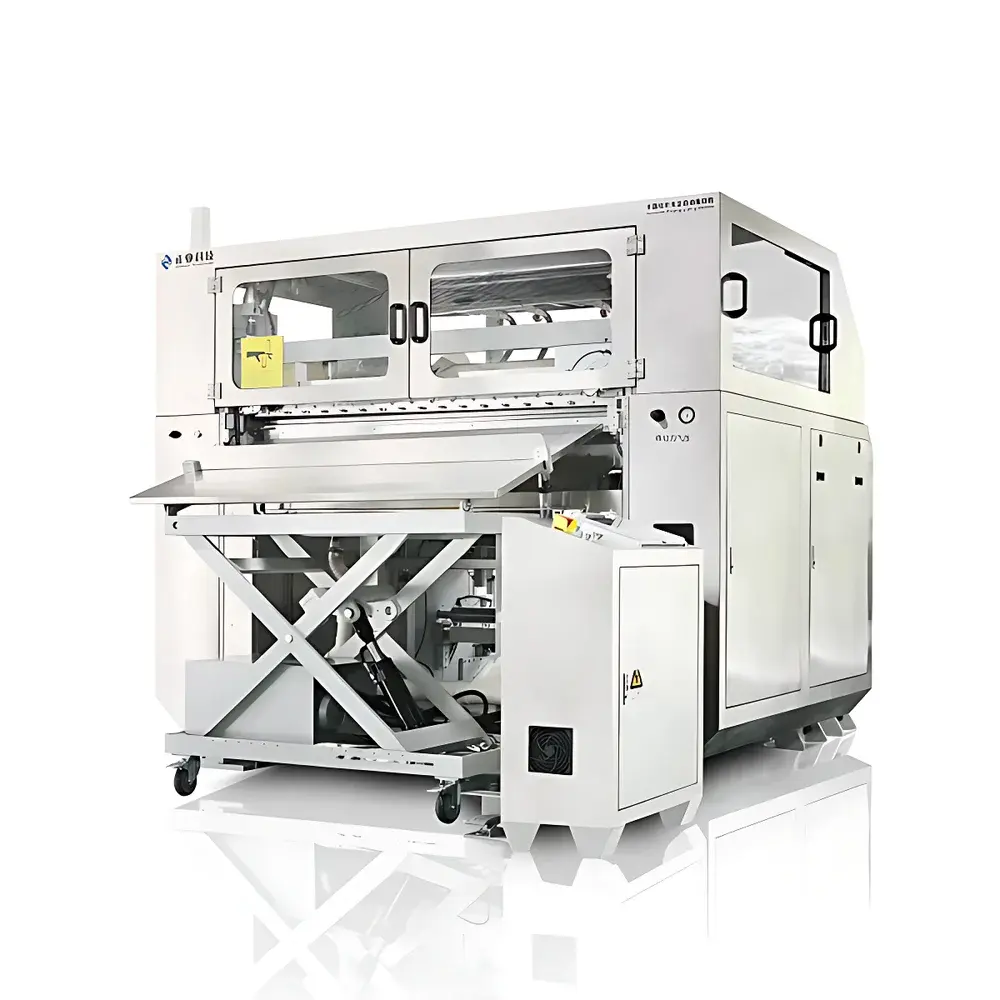
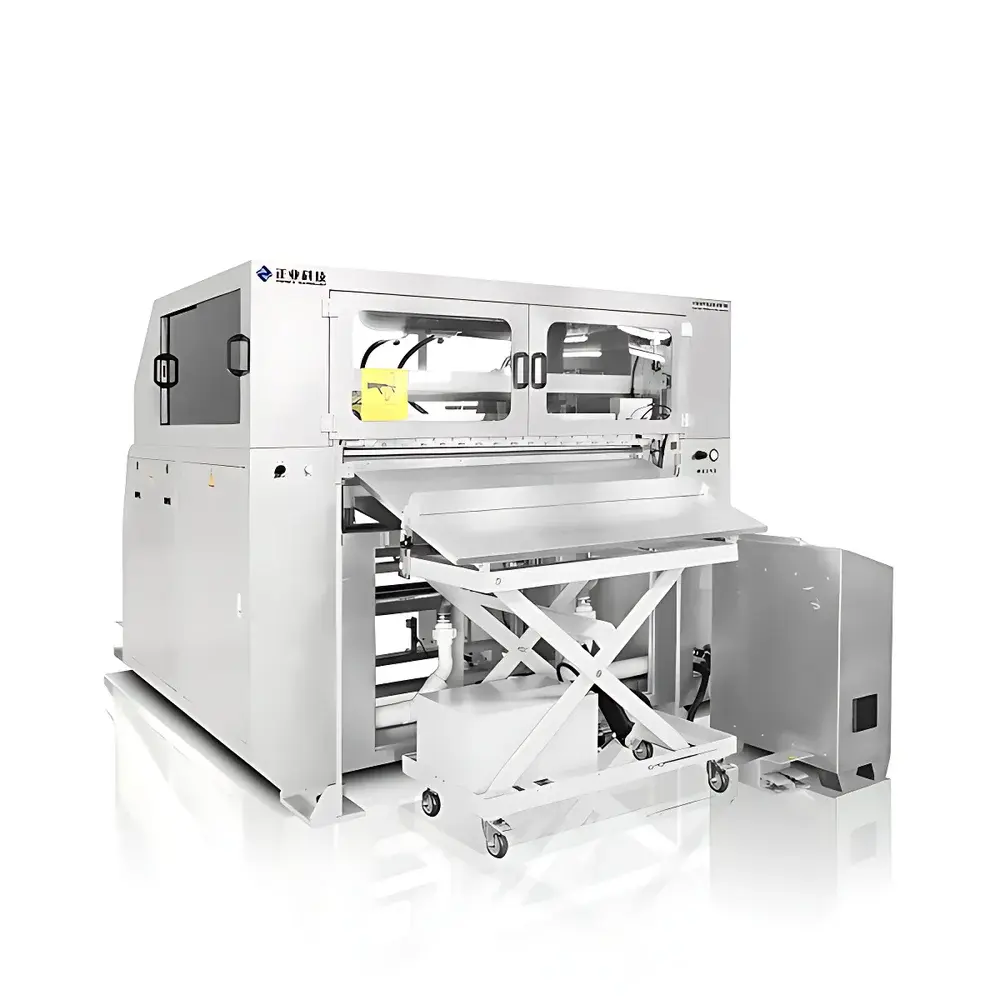
Zhengye CQ2000C Infrared-Heated Dust-Free PP Film Slitting & Cutting Machine
| Brand | Zhengye |
|---|---|
| Origin | Guangdong, China |
| Manufacturer Type | Direct Manufacturer |
| Country of Origin | China |
| Model | CQ2000C |
| Pricing | Upon Request |
| Cutting Accuracy | ±1 mm |
| Dust Reduction | >98% vs. conventional mechanical cutting |
| Max. Cutting Frequency (500 mm length) | ≤23 cuts/min |
| Cut Length Range | 250–750 mm |
| Cut Width Range | 200–1270 mm |
| Material Thickness Range | 0.02–0.3 mm |
| Slitting Method | Manual-adjustable rotary shear or press-cut |
| Feeding Mode | Continuous, uninterrupted |
| Edge Scrap Collection | Integrated rewind/recovery unit |
| Sealing Mechanism | In-line infrared thermal edge sealing |
Overview
The Zhengye CQ2000C Infrared-Heated Dust-Free PP Film Slitting & Cutting Machine is an engineered solution for precision processing of prepreg-compatible polypropylene (PP) carrier films used in printed circuit board (PCB), flexible electronics, and advanced composite manufacturing. Unlike conventional mechanical slitting systems that generate abrasive particulates and thermally unstable edges, the CQ2000C employs a controlled infrared (IR) thermal pre-conditioning stage immediately prior to cutting—enabling clean, melt-sealed edge formation without charring, delamination, or micro-fraying. This principle leverages localized IR absorption by PP polymer chains (peak absorption at ~3.4 µm), softening the material just below its melting point (~160–170 °C) to minimize mechanical shear stress during separation. The result is a deterministic, non-contact-assisted mechanical cut with integrated edge encapsulation—eliminating post-processing steps such as edge trimming, vacuum cleaning, or secondary sealing.
Key Features
- Infrared thermal pre-heating system: First-in-class implementation for PP film processing; enables simultaneous edge sealing and dust suppression via controlled surface softening prior to blade engagement.
- Dust-optimized fluid-dynamic enclosure: Integrated high-efficiency particulate air (HEPA)-compatible suction manifold, designed using computational fluid dynamics (CFD) modeling to capture >98% of airborne particulates generated during cutting—meeting ISO 14644-1 Class 8 cleanroom compatibility requirements for adjacent operation zones.
- High-fidelity motion control architecture: Dual-axis synchronized servo drive system with real-time position feedback (±0.02 mm repeatability), ensuring consistent dimensional accuracy across variable feed speeds and material thicknesses (0.02–0.3 mm).
- Modular slitting configuration: Manual-adjustable rotary shear or press-cut head supports both longitudinal slitting and transverse die-cutting; accommodates continuous web feeding with automatic edge scrap rewind and tension regulation.
- Parameter recall & recipe management: Onboard HMI stores up to 99 user-defined cutting profiles—including length, width, feed rate, IR dwell time, and blade pressure—retrievable via alphanumeric ID or barcode scan.
Sample Compatibility & Compliance
The CQ2000C is validated for use with standard-grade and flame-retardant (FR-PP) polypropylene films, including those meeting IPC-4101D specifications for dielectric carriers. It supports roll widths up to 1270 mm and accommodates core diameters compliant with DIN 1520 standard (e.g., 3″ and 6″ cores). All electrical subsystems conform to IEC 60204-1 safety standards; IR emitters are CE-marked and UL-recognized for industrial thermal equipment. The machine’s operational emissions profile complies with GB/T 16758–2008 (Chinese national standard for local exhaust ventilation design) and aligns with OSHA 1910.94 guidelines for airborne particulate exposure control in manufacturing environments.
Software & Data Management
The embedded control system runs on a real-time Linux kernel with deterministic I/O scheduling. All process parameters—including actual cut count, cumulative operating hours, IR temperature log (recorded at 10 Hz), and servo torque diagnostics—are timestamped and exportable via USB or Ethernet (Modbus TCP). Audit trails meet GLP/GMP documentation requirements: user login sessions, parameter changes, and emergency stop events are logged with SHA-256 hashed integrity verification. Optional OPC UA server integration enables seamless connectivity with MES platforms (e.g., Siemens Opcenter, Rockwell FactoryTalk) for SPC-based quality monitoring and traceability.
Applications
Primary deployment includes PCB fabrication lines requiring dust-free PP release film segmentation for automated layup stations; battery separator handling in lithium-ion pouch cell assembly; and cleanroom-compatible packaging film division for medical device blister packaging. Secondary applications span aerospace prepreg handling (where fiber misalignment from static-induced dust adhesion must be avoided), and R&D labs conducting peel strength, dielectric breakdown, or thermal cycling validation on sealed-edge PP substrates.
FAQ
Does the CQ2000C support automated edge inspection or vision-guided alignment?
No—vision integration is not included as standard; however, the machine features 4× M6 threaded mounting points and GigE Vision-compliant I/O triggers for third-party camera system retrofitting.
Can the infrared heating zone be disabled for non-thermal cutting modes?
Yes—the IR module operates independently via dedicated PLC-controlled SSR output; it may be bypassed entirely while retaining full mechanical cutting functionality.
What maintenance intervals are recommended for the slitting blades and IR emitter arrays?
Rotary shear blades require replacement every 200–300 km of cumulative web travel; IR emitter quartz tubes are rated for ≥10,000 hours under nominal power cycling and should be inspected quarterly for coating degradation or microfracture.
Is remote firmware update capability available?
Firmware updates are performed locally via encrypted USB key; over-the-air (OTA) updates are not supported due to industrial cybersecurity policy constraints.