
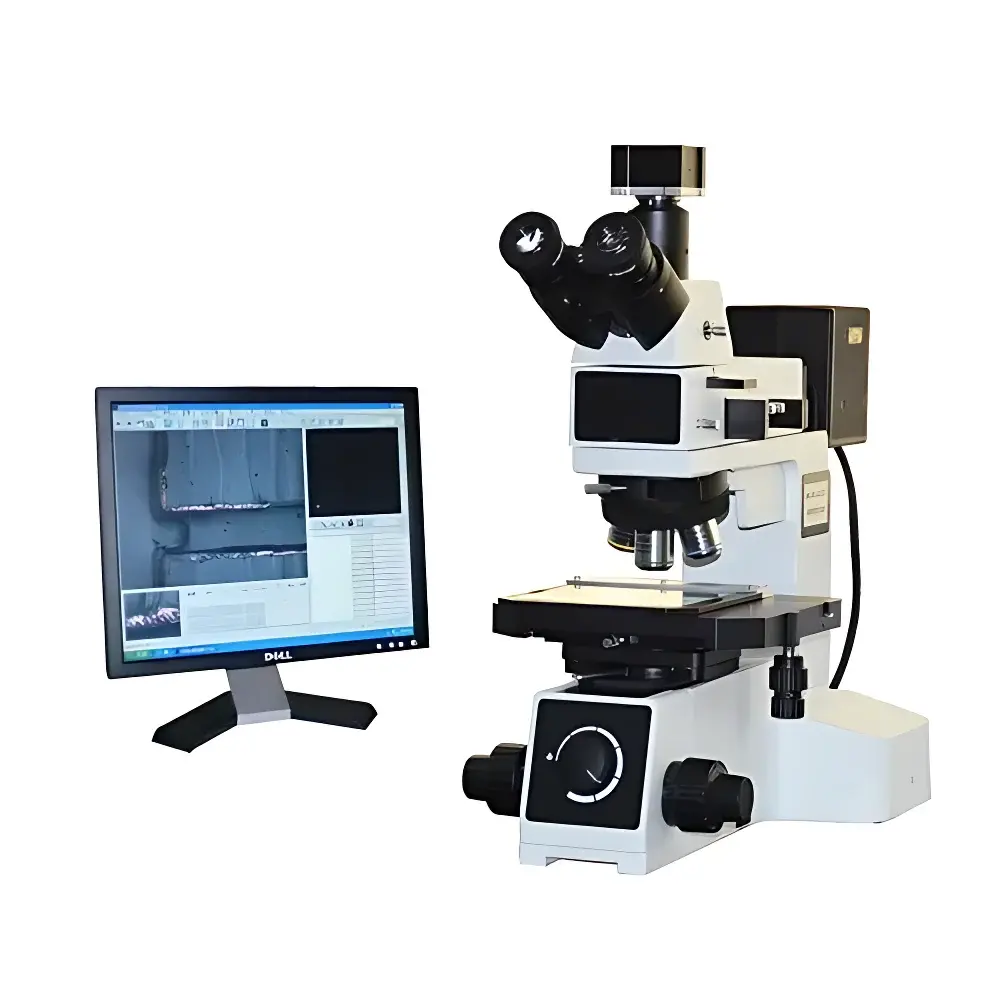
Zhengye JX23-RT Upright Metallurgical Microscope with Integrated Measurement Software
| Brand | Zhengye |
|---|---|
| Origin | Guangdong, China |
| Manufacturer Type | Direct Manufacturer |
| Product Origin | Domestic (China) |
| Model | JX23-RT |
| Configuration | Upright |
| Total Magnification | 1000× (Optical: 50×–500× |
| Digital | 90×–900×) |
| Eyepiece | 10× Wide-Field |
| Objective Lenses | 5×, 10×, 20×, 50× (100× optional) |
| Darkfield Illumination | Yes |
| Illumination | 12 V / 100 W Halogen Transmitted & Reflected Light, Adjustable Brightness, Equipped with Polarizer |
| CCD Camera | WD-300C2/TCC-2.0CL, 3 MP Resolution |
| Measurement Accuracy | ±0.0006 mm |
| Special Function | ASTM E112-compliant Grain Size Analysis |
Overview
The Zhengye JX23-RT Upright Metallurgical Microscope is a precision optical instrument engineered for high-fidelity microstructural analysis of opaque, reflective specimens—particularly in printed circuit board (PCB), semiconductor packaging, and metallurgical quality control laboratories. Unlike biological microscopes, this system employs epi-illumination (incident light) optics optimized for reflected-light observation, enabling detailed visualization of polished metal cross-sections, solder joints, wire bonds, die attach layers, and green solder mask (solder resist) features. Its upright configuration provides ergonomic access to large or rigid samples—including PCB coupons, wafer fragments, and encapsulated IC packages—without requiring specimen inversion. The optical path integrates plan achromat objectives and wide-field 10× eyepieces to deliver flat, color-corrected images across the full field of view, minimizing edge distortion critical for quantitative metrology.
Key Features
- Optimized epi-illumination pathway with 12 V / 100 W halogen lamp, offering stable, high-CRI illumination for both brightfield and darkfield contrast modes—darkfield capability enables reliable detection of micro-cracks, voids, and green solder mask defects.
- Polarized light module integrated into the illumination train, supporting birefringence analysis of stress-induced anisotropy in solder alloys and polymer underfills.
- Four standard plan achromat objectives (5×, 10×, 20×, 50×) with optional 100× oil-immersion lens, delivering calibrated magnifications from 50× to 500× optical, extendable to 900× digitally via high-resolution 3 MP CCD imaging.
- Sub-micron measurement repeatability: certified linear measurement accuracy of ±0.0006 mm (0.6 µm) across the entire field, traceable to NIST-traceable stage calibration standards.
- Dedicated metallurgical software platform with intuitive GUI, supporting ISO/IEC 17025-aligned measurement workflows—including point-to-point distance, chord length, radius/diameter of curvature, angular deviation, and multi-segment profile analysis.
Sample Compatibility & Compliance
The JX23-RT accommodates standard 25 mm and 32 mm diameter metallurgical sample mounts, as well as custom-sized PCB sections up to 120 mm × 120 mm using optional extended-stage accessories. Specimen height clearance exceeds 45 mm, permitting direct imaging of BGA arrays, stacked-die packages, and thick FR-4 substrates. All optical components comply with ISO 8578 (microscope performance testing) and meet mechanical stability requirements per ASTM E883 (standard guide for light microscopy of electronics). Grain size analysis functionality adheres to ASTM E112–22 methodology, generating report-ready outputs compliant with internal QA protocols and third-party audit documentation (e.g., IATF 16949, IPC-A-610 Class 3).
Software & Data Management
The proprietary measurement software includes full audit trail logging (user ID, timestamp, parameter changes), exportable CSV/Excel reports with embedded image thumbnails, and configurable pass/fail tolerance overlays. It supports 21 CFR Part 11–ready configurations upon request—including electronic signatures, role-based access control, and immutable data archiving. Image metadata (magnification, objective used, illumination mode, calibration date) is automatically embedded in TIFF and PNG exports. Batch processing enables automated grain counting and distribution histogram generation across multiple fields of view, reducing operator-dependent variability in microstructure evaluation.
Applications
- PCB cross-sectional analysis: solder joint wetting angle, intermetallic compound (IMC) layer thickness, via fill integrity, and delamination detection at copper–resin interfaces.
- Semiconductor packaging inspection: wire bond heel cracks, die attach void fraction, mold compound filler distribution, and leadframe corrosion assessment.
- Metallographic QC: ferrite/pearlite ratio quantification, inclusion rating per ASTM E45, recrystallization extent in cold-worked alloys, and heat-affected zone (HAZ) characterization in laser-welded joints.
- Failure analysis labs: root cause identification of thermal fatigue, electromigration voids, and brittle fracture surfaces via high-contrast darkfield and polarized imaging.
FAQ
Is the JX23-RT compatible with third-party image analysis software such as ImageJ or Olympus Stream?
Yes—the system outputs standard TIFF and BMP files with embedded scale bar metadata, fully interoperable with open-source and commercial platforms. SDK documentation is available for API integration.
Can the microscope be upgraded to support fluorescence or DIC contrast later?
Fluorescence is not supported due to the absence of excitation filter cubes and UV-capable optics; however, differential interference contrast (DIC) can be retrofitted with a dedicated prism turret and Nomarski condenser (optional accessory).
What calibration documentation is provided with the system?
Each unit ships with a factory calibration certificate covering stage linearity, magnification fidelity, and illumination uniformity—valid for 12 months. Optional annual recalibration services include ISO/IEC 17025-accredited reporting.
Does the software support multi-user environments with permission levels?
Yes—administrator, technician, and viewer roles are configurable, with password-protected method saving, report generation, and calibration adjustment privileges.
Is remote technical support available for software troubleshooting?
Yes—secure TeamViewer-assisted diagnostics and firmware updates are included for the first 24 months post-purchase.





