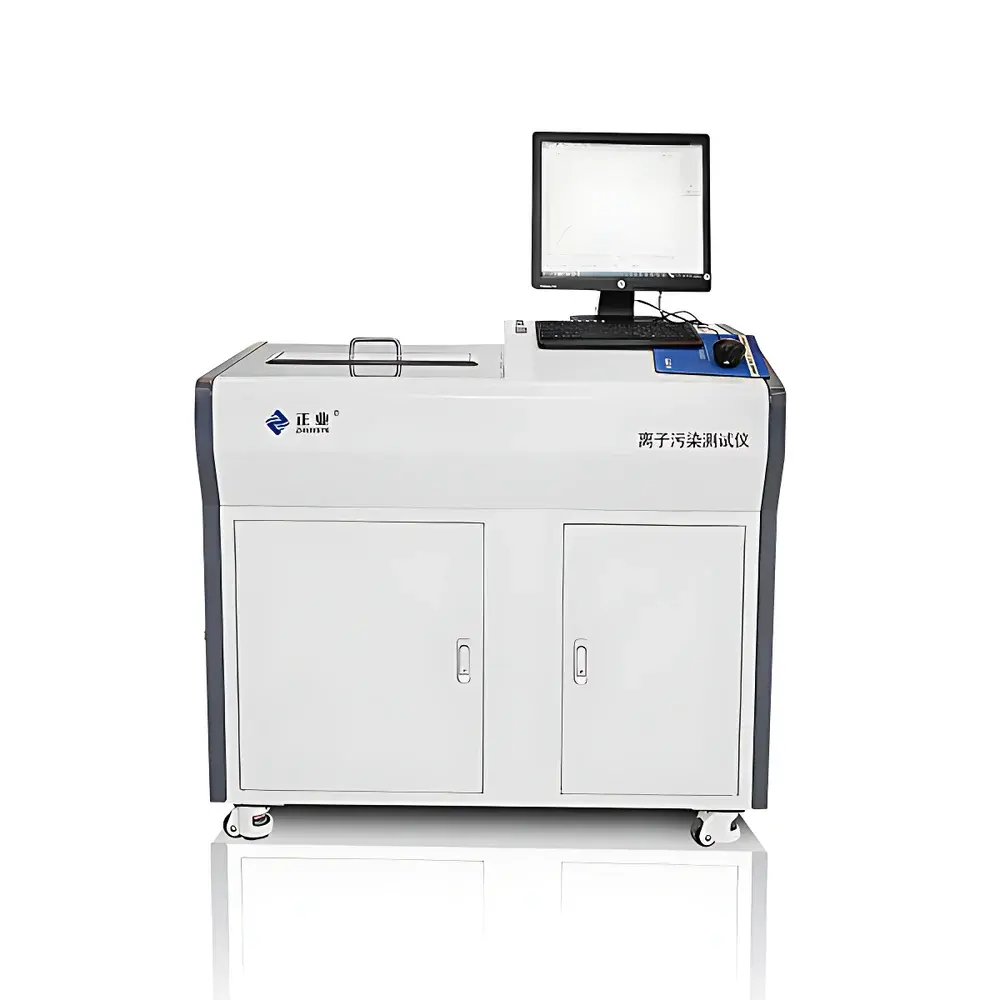
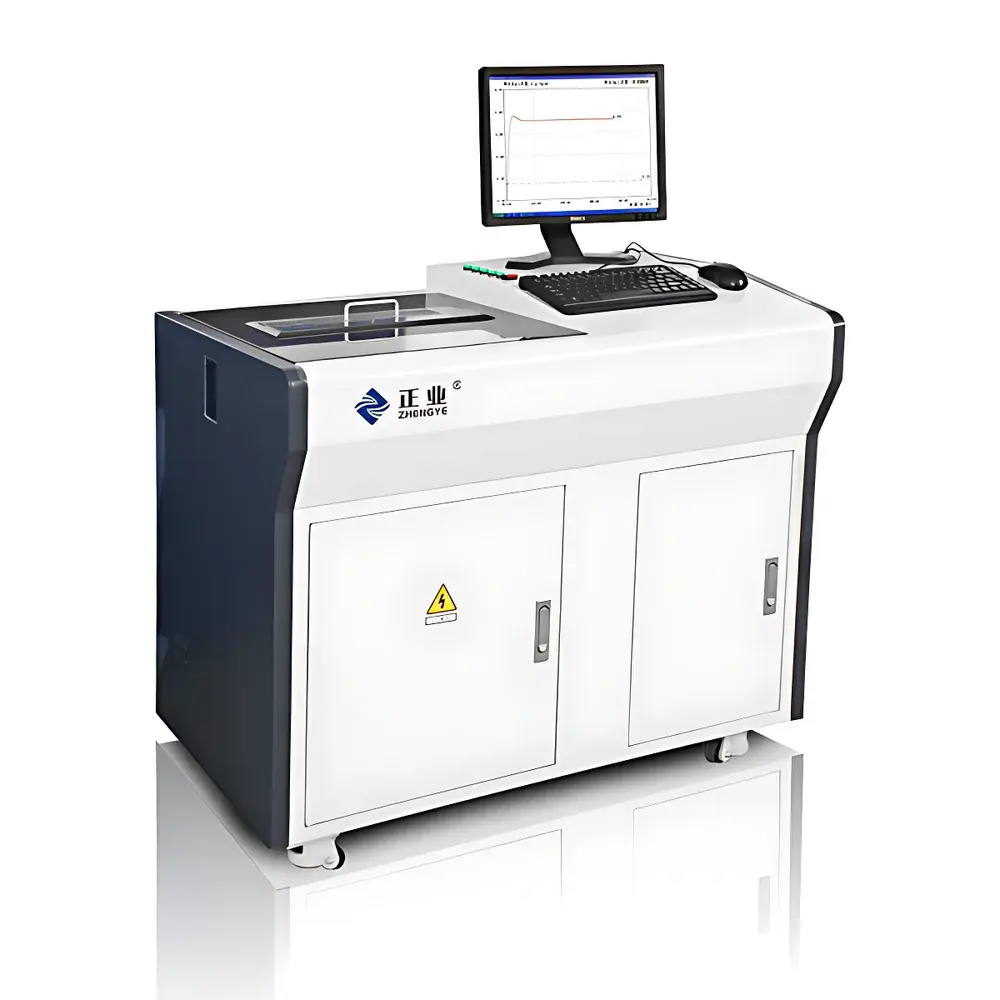
Zhengye LZ22A Ion Contamination Tester
| Brand | Zhengye |
|---|---|
| Origin | Guangdong, China |
| Manufacturer Type | Manufacturer |
| Origin Category | Domestic |
| Model | LZ22A |
| Price Range | USD 14,000 – 70,000 |
| Tank Dimensions (L×W×H) | 680 mm × 65 mm × 680 mm |
| Sample Area Range | 10 cm × 40 cm to 68 cm × 68 cm |
| Conductivity Resolution | 0.001 µS/cm |
| Conductivity Range | 0.001–20 µS/cm (equivalent to NaCl contamination: 300–10,000 µg/cm²) |
| Measurement Accuracy | ±5% |
| Extractant Specific Gravity | 0.80–0.855 |
| Electrode Temperature Compensation | Integrated real-time compensation |
| Test Modes | Dynamic and Static extraction |
| Resin System | Mixed-bed anion/cation exchange resin |
| Extraction Method | Heated solvent circulation with high-velocity rinse |
| Net Weight | ≈180 kg |
| Compliance | Designed for IPC-J-STD-001, IPC-TM-650 2.3.25, and MIL-STD-2000A pre-qualification workflows |
| Software | Onboard touchscreen interface with audit-trail-capable data logging |
Overview
The Zhengye LZ22A Ion Contamination Tester is a dedicated analytical instrument engineered for quantitative assessment of ionic residues on printed circuit board (PCB) surfaces prior to and following critical manufacturing processes—including solder paste printing, reflow, cleaning, conformal coating, and final assembly. It operates on the principle of resistivity-based ion extraction, in accordance with IPC-TM-650 Test Method 2.3.25 (“Ionic Contamination by Resistivity of Solvent Extract”) and aligned with IPC-J-STD-001 requirements for cleanliness validation. The system employs a precisely controlled heated solvent (typically isopropanol/water mixture) circulation process to extract soluble ionic species—such as chloride, bromide, sodium, potassium, and flux activators—from the PCB surface. Extracted ions alter the electrical conductivity of the solvent, which is measured in real time using a high-stability, temperature-compensated conductivity cell. The resulting conductivity value is converted to equivalent NaCl mass per unit area (µg/cm²) via NIST-traceable calibration curves.
Key Features
- Integrated dual-mode operation: supports both dynamic (continuous-flow) and static (immersion-based) extraction protocols—enabling method flexibility for R&D, process qualification, and routine QC.
- High-fidelity conductivity measurement: 0.001 µS/cm resolution with ±5% overall measurement uncertainty across the full operational range (0.001–20 µS/cm), validated per ASTM D1125 and ISO 7888.
- Thermally stabilized extraction: PID-controlled heating maintains solvent temperature within ±0.3°C during extraction, minimizing thermal drift and ensuring reproducibility between runs.
- Sealed recirculation architecture: fully enclosed fluid path with mixed-bed ion exchange resin regeneration loop minimizes environmental contamination and extends solvent life.
- Real-time algorithmic correction: embedded firmware applies dynamic temperature compensation, baseline drift correction, and conductivity-to-NaCl conversion using polynomial curve fitting derived from certified reference standards.
- Rugged industrial design: stainless-steel chassis, IP54-rated enclosure, and vibration-damped mounting suitable for integration into SMT line environments or QA laboratories.
Sample Compatibility & Compliance
The LZ22A accommodates PCBs up to 68 cm × 68 cm (26.8 in × 26.8 in), supporting standard panel sizes used in automotive, aerospace, and high-reliability electronics manufacturing. Its adjustable sample tray and programmable immersion depth ensure uniform extraction across irregular geometries and multi-layer boards with through-hole or edge-mount components. All test methods are documented to support GLP/GMP compliance, with built-in user access control, electronic signature capability, and 21 CFR Part 11–ready audit trail generation (when paired with optional Zhengye DataLink software). Instrument validation packages—including IQ/OQ documentation templates—are available upon request for FDA-regulated or AS9100-certified facilities.
Software & Data Management
The onboard 7-inch capacitive touchscreen interface provides intuitive navigation through test setup, calibration, run execution, and result review. All measurements are timestamped, user-logged, and stored locally with automatic backup to USB or network share. Data export is supported in CSV and PDF formats, including raw conductivity vs. time plots, summary statistics (mean, SD, CV%), and pass/fail status against configurable IPC-defined thresholds (e.g., ≤1.56 µg/cm² NaCl-equivalent for Class 3 assemblies). Optional Zhengye DataLink software enables centralized fleet management, SPC charting (X̄/R, Cpk), trend analysis across shifts or lines, and automated report generation for internal audits or customer-facing documentation.
Applications
- Validation of aqueous and semi-aqueous cleaning efficacy post-reflow or wave soldering.
- Process capability studies for new cleaning chemistries or equipment upgrades.
- Root cause analysis of electrochemical migration (ECM), dendritic growth, or field failures linked to residual halides.
- Supplier qualification and incoming material inspection per IPC-A-610 or J-STD-001 Section 8.
- Support for zero-defect initiatives in medical device PCB manufacturing under ISO 13485.
- Research-grade quantification of flux residue composition when coupled with ion chromatography correlation studies.
FAQ
What extraction solvents are compatible with the LZ22A?
The system is optimized for 75/25 isopropanol/water (v/v), though other low-conductivity solvents—including ethanol/water blends and proprietary formulations—can be configured via custom calibration.
Does the LZ22A meet IPC-TM-650 2.3.25 revision G requirements?
Yes—the hardware design, sensor calibration protocol, and software reporting logic comply with the latest revision, including mandatory temperature monitoring, minimum immersion time verification, and conductivity stability criteria.
Can the instrument be integrated into a factory MES or SCADA system?
Via optional RS-485 Modbus RTU or Ethernet TCP/IP interface, the LZ22A supports bi-directional communication for recipe loading, status polling, and real-time result push to enterprise systems.
Is on-site installation and qualification support available?
Zhengye offers international commissioning services, including site survey, mechanical/electrical integration, operational qualification (OQ), and staff training delivered by certified applications engineers.
How often does the conductivity cell require recalibration?
Annual calibration is recommended; however, daily verification using NIST-traceable KCl standards (100 µS/cm and 1,413 µS/cm) is required per internal quality procedures and ISO/IEC 17025 accreditation guidelines.