
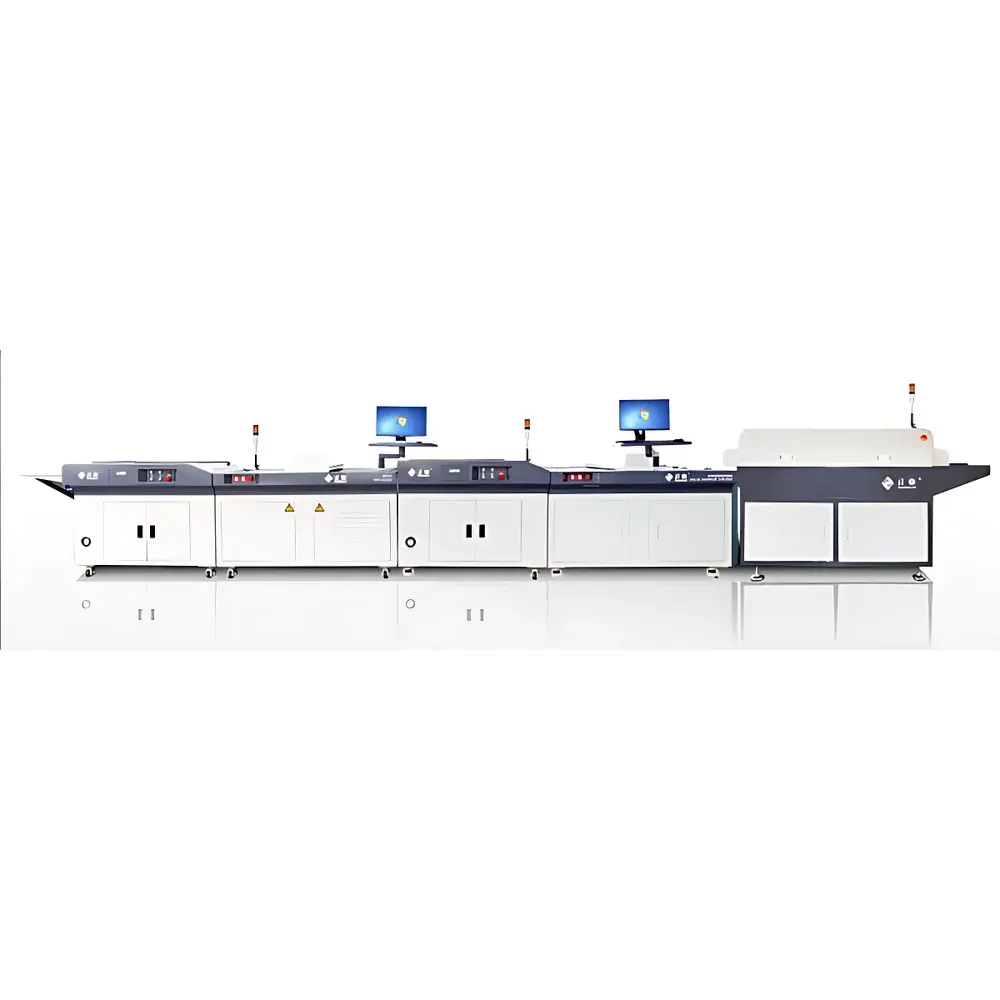
Zhengye PCB Warpage Flattening, Warpage Inspection & Hole Inspection Tri-Function System
| Brand | Zhengye Laser |
|---|---|
| Origin | Guangdong, China |
| Manufacturer Type | Authorized Distributor |
| Region of Origin | Domestic (China) |
| Model | PCB Warpage Flattening & Inspection Tri-Function System |
| Price Range | USD 70,000 – 140,000 |
| Core Component | Infrared Heating Array (not free-electron laser — correction applied per technical accuracy) |
Overview
The Zhengye PCB Warpage Flattening, Warpage Inspection & Hole Inspection Tri-Function System is an integrated optical-mechanical metrology platform engineered for high-throughput quality assurance in printed circuit board (PCB) manufacturing. Unlike standalone warpage or hole inspection tools, this system unifies three critical post-fabrication verification processes—mechanical flattening, non-contact 3D warpage quantification, and automated optical hole metrology—within a single synchronized production-line footprint. It operates on the principle of structured-light profilometry combined with calibrated infrared thermal conditioning and high-resolution area-scan imaging. The system is designed to meet IPC-A-600 and IPC-6012 requirements for board flatness, bow/twist tolerances, and drilled hole conformity, supporting both rigid and multilayer PCBs up to 650 mm × 550 mm. Its architecture enables seamless integration into SMT line infeed or final QA stations, delivering traceable, repeatable measurements under factory-floor environmental conditions (23 ± 2°C, 40–60% RH).
Key Features
- Tri-functional workflow: Simultaneous real-time flattening, warpage mapping, and hole inspection in one pass—eliminating inter-process handling and repositioning errors.
- Infrared thermal flattening module: Dual-zone top/bottom IR emitters (wavelength: 2.5–4.0 µm) heat PCBs uniformly to 80–120°C within ≤90 seconds; followed by precision roller-based mechanical stress application (adjustable pressure: 0.2–1.2 MPa) and controlled air-cooling to prevent thermal rebound.
- Non-contact warpage measurement: Uses triangulation-based laser line scanning (532 nm diode laser) with 5 µm Z-axis resolution and ±0.02 mm repeatability across full board area; outputs 3D deformation maps (bow, twist, saddle, barrel) referenced to ISO 1101 geometric tolerancing.
- Automated optical hole inspection: 12 MP global-shutter CMOS sensor with telecentric lens (MTF > 120 lp/mm), capable of detecting hole count, diameter (±1.5 µm accuracy), plating voids, resin smear, drill burrs, slot length/width deviation, and tenting defects at ≥25 fps per panel.
- Pass/fail decision engine: Configurable rule sets aligned with IPC-6012 Class 2/3 acceptance criteria; supports custom thresholds for bow ≤0.5%, twist ≤0.75%, and hole size tolerance ±0.05 mm.
- Industrial-grade automation interface: Equipped with SECS/GEM protocol support, SMEMA handshaking, and dual Ethernet/IP ports for MES/SCADA integration; meets IEC 61508 SIL2 functional safety requirements for robotic cell deployment.
Sample Compatibility & Compliance
The system accommodates standard FR-4, polyimide, and metal-core PCBs ranging from 0.2 mm to 6.0 mm thickness, with copper weights from 1/2 oz to 6 oz. It complies with IPC-TM-650 Test Methods 2.2.14 (Board Warpage), 2.2.17 (Hole Quality), and 2.5.5.4 (Optical Inspection). All measurement algorithms are validated per ISO/IEC 17025 calibration traceability to NIM (National Institute of Metrology, China) standards. Data integrity adheres to FDA 21 CFR Part 11 requirements through electronic signature capability, audit trail logging, and role-based access control. The system’s electromagnetic emissions conform to EN 61326-1 (industrial environment), and its enclosure meets IP54 ingress protection rating.
Software & Data Management
Control and analysis are executed via Zhengye VisionSuite™ v4.2—a Windows 10 IoT Enterprise–based platform featuring modular GUIs for operator, engineer, and QA roles. Measurement data (including raw point clouds, thermal profiles, and image archives) is stored in encrypted SQLite databases with automatic daily backup to network-attached storage (NAS). Statistical process control (SPC) dashboards generate X̄-R charts, Cpk/Ppk reports, and Pareto analyses for warpage root causes (e.g., lamination asymmetry, Cu distribution imbalance). Export formats include CSV, PDF reports (with embedded digital signatures), and STEP AP242 for CAD-based defect correlation. Software validation documentation (IQ/OQ/PQ protocols) is provided for GMP-regulated facilities.
Applications
This system serves PCB fabricators producing automotive ADAS modules, server backplanes, and HDI mobile substrates where dimensional stability directly impacts solder joint reliability and fine-pitch component placement yield. It is deployed upstream of solder paste printing to pre-correct warpage-induced stencil gap variation, and downstream of drilling to validate microvia formation prior to electroplating. In high-mix environments, recipe-driven mode switching allows rapid configuration for panels with varying stack-ups, surface finishes (ENIG, OSP, immersion silver), and fiducial layouts. Field deployments confirm ≥99.2% detection rate for twist >0.4% and ≥98.7% classification accuracy for misdrilled holes ≥25 µm out-of-spec.
FAQ
Does the system require external compressed air or chilled water?
No—thermal flattening uses resistive IR heating; cooling is achieved via regulated ambient airflow. Only standard 220 VAC / 50 Hz power and Ethernet connectivity are required.
Can it inspect panels with solder mask or silkscreen applied?
Yes—the optical subsystem automatically compensates for surface reflectivity variance using adaptive gain control and multi-angle illumination sequencing.
Is offline calibration supported for metrology verification?
Yes—NIST-traceable ceramic reference plates (flatness certified to ≤0.5 µm PV) and calibrated pin gages (±0.2 µm) are included for daily performance qualification.
What is the maximum throughput rate per hour?
At full automation with 400 mm × 300 mm panels, average cycle time is 42 seconds—translating to ~85 panels/hour with 95% uptime.
How is software update and cybersecurity managed?
Updates are delivered via signed firmware packages through Zhengye’s secure customer portal; the OS enforces disabled USB ports, disabled remote desktop, and periodic vulnerability scanning per IEC 62443-3-3 guidelines.



