
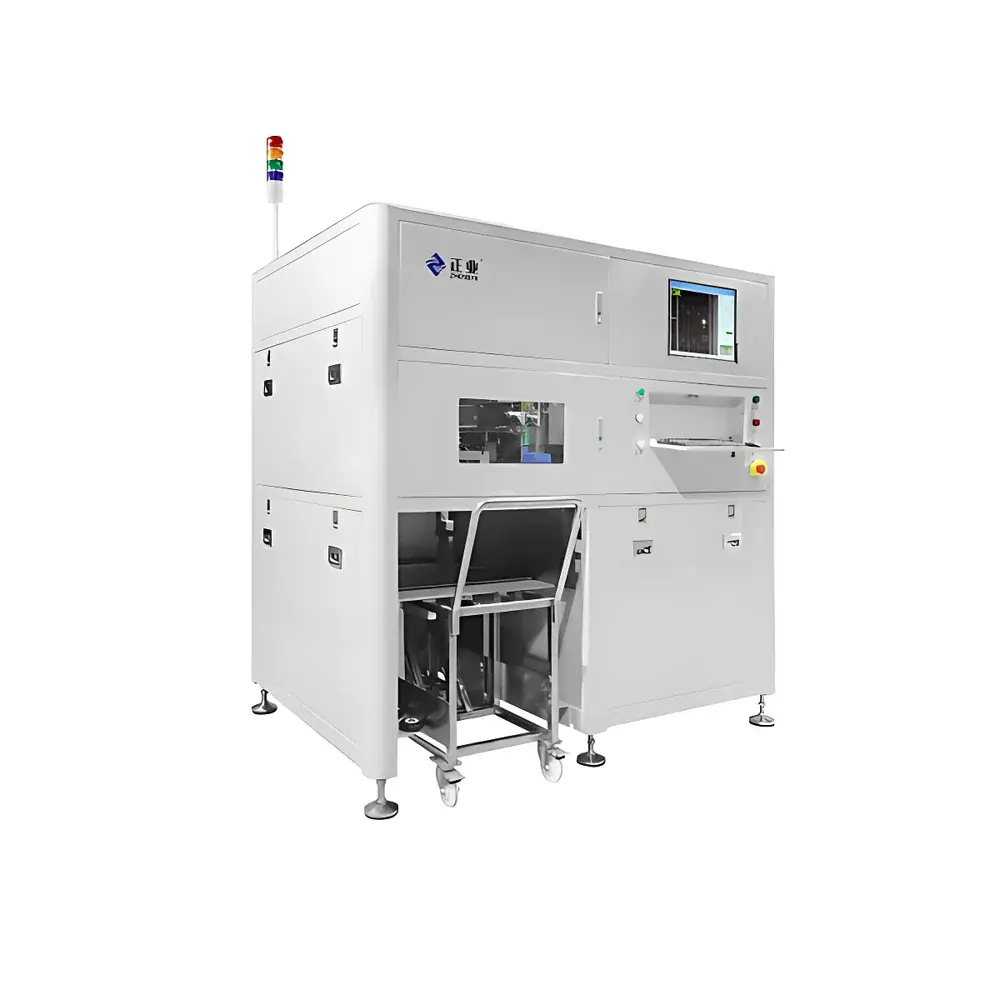
Zhengye X-ray Target Drilling Automated Loading and Unloading System
| Brand | Zhengye |
|---|---|
| Origin | Guangdong, China |
| Manufacturer Type | Direct Manufacturer |
| Product Category | Domestic |
| Model | Automatic Loading & Unloading System for X-ray Target Drilling |
| Price Range | USD $68,000 – $136,000 (FOB Guangdong) |
| Configuration | Mobile or Fixed Mounting Options |
| Radiation Geometry | Circumferential (360°) |
| Radiation Beam Angle | 180° |
| Penetration Capability | High-Energy X-ray Compatible (Designed for ≥160 kV Industrial X-ray Sources) |
| Focus Size | Custom-Optimized (Configurable per X-ray Tube Integration) |
Overview
The Zhengye X-ray Target Drilling Automated Loading and Unloading System is an integrated material-handling subsystem engineered specifically for high-throughput, precision-oriented PCB target drilling operations within industrial X-ray radiographic inspection lines. It operates as a synchronized peripheral to high-energy X-ray target alignment and drilling stations—typically deployed downstream of automated optical inspection (AOI) and upstream of post-drill verification or plating processes. The system employs servo-driven linear motion, vision-guided positioning, and programmable logic control (PLC) architecture to execute repeatable, traceable, and operator-independent handling of rigid printed circuit boards (PCBs). Its core measurement and control principle relies on fiducial-based geometric registration: using machine vision to detect reference holes (tooling or datum holes) on incoming PCBs, the system calculates real-time board orientation and positional offset, then actuates precision rotary and tilt stages to align each board to the X-ray beam axis prior to target drilling. This ensures consistent focal spot-to-target geometry—a critical requirement for minimizing drill eccentricity and maintaining sub-50 µm targeting accuracy across batch production.
Key Features
- Vision-Guided Board Orientation Recognition: Integrated high-resolution monochrome camera with telecentric lens detects standard PCB tooling holes (≥0.3 mm diameter) to determine board rotation angle and X/Y offset with ±0.15° angular repeatability and ±0.08 mm positional accuracy.
- Multi-Stage Handling Architecture: Combines a top-loading magazine (capacity: up to 50 × 1.6 mm thick PCBs), servo-rotary indexing table (0–360° continuous positioning), dual-axis tilt module (±15° pitch/yaw adjustment), and vacuum-assisted transfer gripper for zero-slip board handling.
- Intelligent Defect-Driven Sorting: Interfaces directly with host X-ray inspection software via Ethernet/IP or Modbus TCP to receive pass/fail and positional deviation data; automatically routes out-of-spec boards (e.g., misaligned target zones or excessive drill offset) into segregated reject trays with mechanical gate actuators.
- Seamless Line Integration: Equipped with standardized SECS/GEM-compliant I/O ports and dual-side conveyor interfaces (width-adjustable 150–400 mm); supports synchronous handshaking with upstream automatic depaneling systems and downstream storage buffer modules.
- Non-Invasive Marking Option: Optional inkjet station uses FDA-compliant aqueous pigment ink (ISO 8601 traceable lot coding) for direct part marking (DPM) without thermal stress or surface contamination—validated for solder mask and ENIG-finished substrates.
Sample Compatibility & Compliance
The system accommodates rigid PCBs ranging from 100 × 100 mm to 510 × 460 mm in footprint and 0.6–3.2 mm in thickness, including FR-4, metal-core (MCPCB), and high-Tg laminates. All motion components comply with ISO 13849-1 PL e / Category 4 safety architecture, with dual-channel emergency stop circuits and light curtain interlocks (IEC 61496-1). Radiation shielding integration follows IEC 61000-6-4 (EMC immunity) and ANSI N43.3 (X-ray facility safety) guidelines. Mechanical design adheres to IPC-A-600H Class 2/3 handling tolerances, and material contact surfaces meet RoHS 2015/863 and REACH SVHC compliance.
Software & Data Management
Control firmware runs on a deterministic real-time OS with embedded web server (HTTP/HTTPS) for remote monitoring and parameter configuration. Each loading cycle logs timestamp, board ID (via optional OCR or barcode scan), orientation correction values, and reject reason code—stored locally on industrial-grade SSD with 12-month retention. Audit trail functionality satisfies FDA 21 CFR Part 11 requirements when paired with enterprise-level MES integration (OPC UA 1.04 support included). Firmware updates are digitally signed and validated via SHA-256 checksum.
Applications
- Automated X-ray guided micro-via drilling for HDI and IC substrate manufacturing
- High-mix, low-volume PCB assembly lines requiring rapid changeover between board families
- Automotive electronics production where AS9100-relevant traceability and process validation are mandated
- Medical device PCB fabrication under ISO 13485 quality management systems
- Contract manufacturing services (EMS) seeking GLP-aligned documentation for customer audits
FAQ
What X-ray generator models is this system certified to interface with?
It is mechanically and electrically compatible with standard 160 kV industrial X-ray sources from YXLON, Nikon Metrology, and North Star Imaging; custom integration kits available for Varian PaxScan and PerkinElmer XRD platforms.
Does the system support panel-level handling or only individual PCBs?
Configurable for both single-board and panelized formats (up to 2 × 3 array); panel recognition requires additional fiducial mapping in setup mode.
Is radiation safety interlock logic embedded in the controller?
Yes—hardware-level interlocks disable all motion axes if X-ray enable signal is absent or if door safety switches are triggered; log entries include interlock event timestamps and cause codes.
Can historical loading data be exported to SQL databases?
Yes—ODBC-compliant data export module supports direct push to Microsoft SQL Server, PostgreSQL, or Oracle DB instances with configurable field mapping and encryption (AES-256).
What maintenance intervals are recommended for vacuum grippers and vision optics?
Vacuum filters require replacement every 6 months or 2,000 operating hours; telecentric lenses undergo quarterly calibration verification using NIST-traceable grid targets.



