
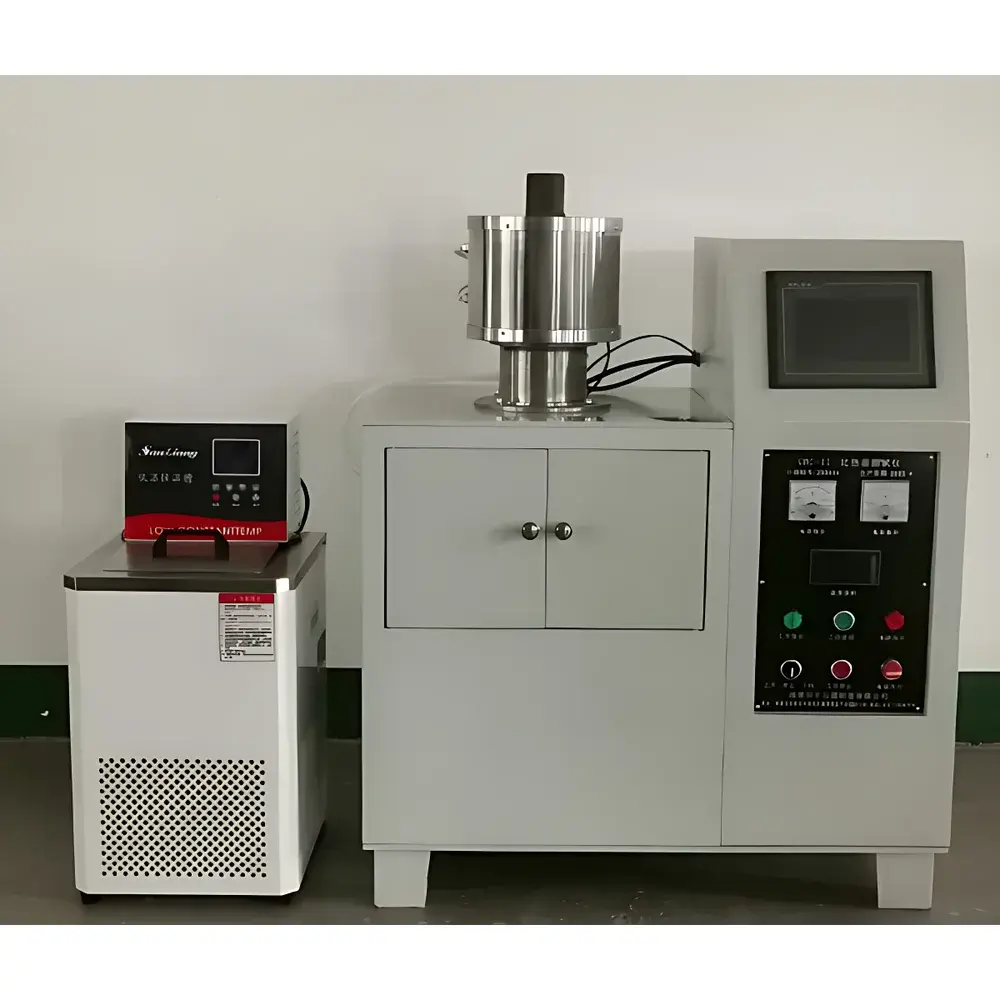
ZHENHUAFENXI DHC-211 Low-Temperature Specific Heat Capacity Measurement System
| Brand | ZHENHUAFENXI |
|---|---|
| Origin | Hunan, China |
| Manufacturer Type | Authorized Distributor |
| Country of Origin | China |
| Model | DHC-211 |
| Price | Upon Request |
| Specific Heat Range | 0.05–5 kJ/(kg·K) |
| Accuracy | ≤1% ± 0.002 for granular/powder samples |
| Temperature Range | −40 °C to 100 °C |
| Sample Volume | ~55 cm³ (granules or powders) |
| Calorimetric Resolution | 0.001 °C |
| Calorimeter Power Supply | 0–24 V (1 mV resolution), 0–1 A (0.01 mA resolution) |
| Vacuum Capability | −0.095 MPa |
| Primary Method | Adiabatic Mixing Calorimetry |
| Compliance | GJB 330A–2000 |
Overview
The ZHENHUAFENXI DHC-211 Low-Temperature Specific Heat Capacity Measurement System is a precision calorimetric instrument engineered for the accurate determination of specific heat capacity (cp) of solid materials—primarily granular and powdered specimens—across a controlled thermal range from −40 °C to 100 °C. It operates on the principle of adiabatic mixing calorimetry (also referred to as the “method of mixtures”), wherein a pre-conditioned sample is rapidly introduced into a thermally isolated calorimeter containing a known mass of reference material at a different, precisely measured temperature. The resulting equilibrium temperature shift, combined with calibrated thermal properties of the system components, enables calculation of cp via energy conservation principles. This approach avoids assumptions inherent in dynamic or differential scanning methods and delivers high reproducibility for heterogeneous or low-conductivity solids where uniform heating is challenging. The system integrates real-time digital temperature acquisition, programmable power control, and vacuum-assisted thermal isolation to minimize parasitic heat exchange—critical for achieving the stated accuracy of ≤1% ± 0.002 kJ/(kg·K) under GJB 330A–2000 compliance conditions.
Key Features
- Adiabatic mixing architecture with vacuum enclosure (−0.095 MPa) to suppress convective and conductive losses during measurement
- Dual-channel high-resolution temperature sensing (0.001 °C resolution) with Pt100 RTD probes traceable to NIST standards
- Digitally regulated calorimeter power supply: 0–24 V (1 mV resolution), 0–1 A (0.01 mA resolution) for precise Joule heating calibration
- Integrated low-temperature恒温 water bath (−40 °C to 100 °C) with PID-controlled circulation and ±0.02 °C stability over 30 min
- Modular sample handling: standardized 55 cm³ sample containers compatible with insulating spacers and thermal mass compensation protocols
- Rugged industrial-grade chassis with electromagnetic shielding and grounded thermal isolation platforms to reduce environmental noise
Sample Compatibility & Compliance
The DHC-211 is optimized for granular and powdered solids—including metal alloys, ceramics, polymers, geological samples, and battery electrode materials—where particle size distribution and packing density are documented per GJB 330A–2000 Annex B. It does not support bulk metallic ingots, liquids, or gaseous phases. Sample volume is fixed at approximately 55 cm³ to ensure consistent thermal mass ratios and minimize boundary-layer effects. All hardware and software workflows comply with GJB 330A–2000 “Test Method for Specific Heat Capacity of Solid Materials”, including mandatory procedural controls for thermal equilibration time, ambient drift correction, and blank subtraction. While not certified to ISO/IEC 17025, the system’s calibration protocol supports traceability to national metrology institutes through documented reference standards and annual verification logs.
Software & Data Management
The included Windows-based measurement software provides full instrument control, real-time thermal curve visualization, and automated cp computation using embedded GJB 330A–2000 algorithms. Raw sensor data (temperature, voltage, current, time) are logged at 10 Hz with timestamped binary storage (.bin) and exportable CSV formats. Audit trails record operator ID, calibration status, environmental conditions (ambient T/P), and sequence metadata—supporting GLP-aligned documentation requirements. Software features include batch processing for multi-sample series, uncertainty propagation modeling based on input parameter tolerances, and customizable report templates compliant with institutional thesis and journal submission standards. No cloud connectivity or remote access is implemented; all data reside locally to meet institutional IT security policies.
Applications
- Thermophysical property characterization of novel battery cathode/anode powders across operational temperature windows
- Validation of lattice vibration models (Debye/Einstein approximations) in inorganic dielectrics and semiconductors
- Quality control of refractory ceramic batches prior to sintering—correlating cp anomalies with stoichiometric deviations
- Supporting thermodynamic database development for aerospace composites under cryogenic service conditions
- Undergraduate and graduate laboratory instruction in statistical thermodynamics and calorimetric methodology
FAQ
What sample preparation is required prior to testing?
Samples must be dried, sieved to ≤1 mm nominal particle size, and packed consistently into the supplied 55 cm³ container without compaction. Moisture content must be reported and factored into mass normalization.
Is liquid nitrogen cooling integrated into the system?
No. The DHC-211 relies on an external low-temperature circulating bath (supplied) capable of reaching −40 °C; cryogenic fluids are not handled or stored within the instrument enclosure.
Can the system measure specific heat at constant pressure (cp) and constant volume (cv)?
It measures cp only. The adiabatic mixing method inherently yields constant-pressure specific heat under atmospheric-equivalent internal pressure conditions.
Does the software support 21 CFR Part 11 compliance?
No. Electronic signatures, role-based access control, and audit trail encryption are not implemented; users requiring FDA-regulated environments must deploy supplemental validation protocols.
What maintenance intervals are recommended?
Calorimeter thermal insulation integrity should be verified quarterly; RTD probes require annual recalibration against certified reference thermometers; vacuum pump oil must be replaced every 500 operating hours.
Related Products



