
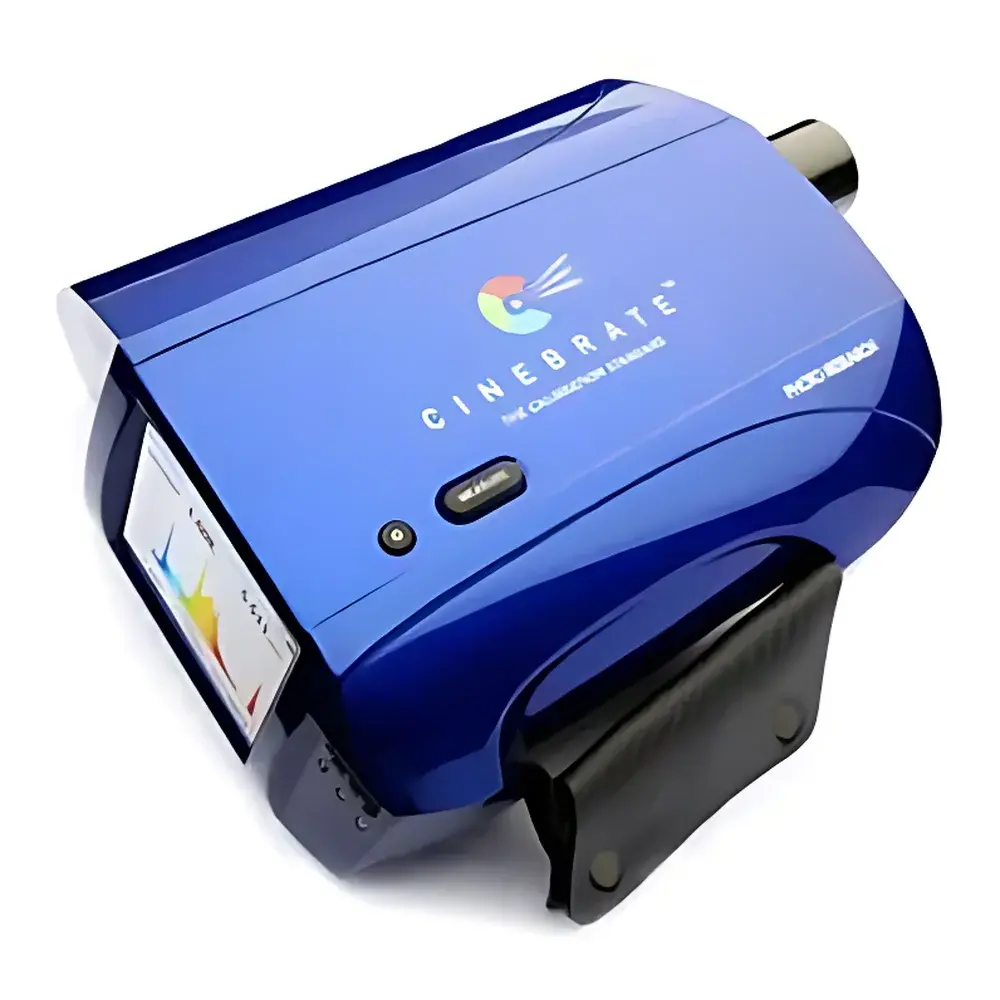
Photo Research CINEBRATE Spectroradiometer for Cinematic Display Calibration
| Brand | Photo Research |
|---|---|
| Origin | USA |
| Model | CINEBRATE |
| Wavelength Range | 380–780 nm |
| Detector | 126-element linear array |
| Lens | Fixed-focus 75 mm |
| Focusing Distance | 3–30 m |
| Target Acquisition | Integrated laser alignment system |
| Measurement Spot Size | 99–987 mm (at specified distance) |
| Integration Time | 3 ms – 30 s |
| Spectral Bandwidth | 5 nm |
| Spectral Resolution | 4 nm |
| Luminance Range | 0.171–171 cd/m² |
| Luminance Accuracy (NIST-traceable) | ±2% @ 3.43 cd/m² |
| Luminance Repeatability | <1% @ 3.43 cd/m² |
| Chromaticity Accuracy (CIE Standard Illuminant A) | ±0.0015 CIEx,y @ 3.43 cd/m² |
| Chromaticity Repeatability | ±0.0015 CIEx,y @ 3.43 cd/m² |
| Frame Synchronization Frequency | 20–400 Hz |
| Field of View | 2° |
| Power Supply | Rechargeable Li-ion battery or AC adapter |
| Data Interface | USB 2.0 |
| Display | 640×480 full-color touchscreen LCD |
| Dimensions | 335.6 × 201.7 × 81.5 mm |
| Weight | 1.7 kg |
Overview
The Photo Research CINEBRATE Spectroradiometer is the world’s first purpose-built, spectral-based instrument engineered exclusively for calibration and verification of digital cinema projection systems—including DCI-compliant 2K, 4K, and next-generation laser phosphor and RGB laser projectors. Unlike filter-based colorimeters, the CINEBRATE employs high-fidelity spectral radiometry: it captures the full spectral power distribution (SPD) across the visible range (380–780 nm) using a 126-element linear CCD array and a diffraction-grating monochromator with 4 nm spectral resolution and 5 nm bandwidth. This spectral foundation enables traceable, technology-agnostic measurement—critical when characterizing complex emission spectra from laser light sources, which exhibit narrowband peaks and non-Planckian distributions that conventional tristimulus devices cannot resolve accurately. Designed to meet the stringent requirements of SMPTE RP 431-2, DCI Specification v1.4, and ISO 12232 Annex E, the CINEBRATE delivers NIST-traceable luminance accuracy (±2% at 3.43 cd/m²) and chromaticity stability (±0.0015 CIEx,y), ensuring compliance with theatrical exhibition standards and enabling repeatable, auditable calibration workflows in both mastering theaters and post-production facilities.
Key Features
- Spectral measurement architecture with 4 nm resolution and 5 nm bandwidth—enabling accurate characterization of laser, LED, and xenon-based projection spectra
- Integrated Class II laser alignment system for rapid, unambiguous targeting of projection screen center without manual aiming aids
- Real-time frame synchronization (20–400 Hz) via HDMI/SDI trigger input—ensuring measurements are locked to projector refresh cycles and eliminating temporal aliasing
- Onboard 640×480 full-color touchscreen display with intuitive GUI—supporting standalone operation without external computing hardware
- Rechargeable lithium-ion battery (up to 4 hours continuous use) and universal AC adapter—optimized for mobile deployment in theater booths and screening rooms
- Fixed 75 mm focal-length lens with 2° field-of-view and 3–30 m focusing range—providing consistent spot geometry across typical projection distances
- USB 2.0 interface with vendor-agnostic data export (CSV, XML, CIE 15:2018-compliant SPD files)—compatible with industry-standard calibration software including CalMAN, LightSpace CMS, and DVS
Sample Compatibility & Compliance
The CINEBRATE is validated for use with all major digital cinema projector technologies: xenon lamp-based 2K/4K systems (e.g., Barco DP2K, Christie CP series), laser phosphor (e.g., NEC NC Series, Sony SRX-R series), and pure RGB laser projectors (e.g., IMAX Laser, Dolby Cinema). Its spectral design eliminates metamerism-related errors inherent in tristimulus instruments when measuring non-white stimuli or wide-gamut primaries. The device conforms to key international standards governing display metrology: ISO/CIE 11664 (colorimetry), ISO 12232:2019 (exposure index determination), and ASTM E308-22 (computation of CIE tristimulus values from spectral data). All factory calibrations are NIST-traceable and documented per ISO/IEC 17025 requirements. For regulated environments, raw spectral data logging supports audit-ready GLP/GMP documentation—meeting FDA 21 CFR Part 11 criteria when used with validated software platforms.
Software & Data Management
The CINEBRATE operates natively via its embedded touchscreen interface but also integrates seamlessly with PC and macOS platforms through the Photo Research PR-788 SDK and open API (C/C++, Python bindings available). Measurement data—including full SPDs, CIE XYZ, CIExyY, u’v’, and gamma curves—is exported in machine-readable formats compliant with CIE 15:2018 and SMPTE ST 2065-1 (ACES IDTs). Time-stamped metadata (integration time, sync status, battery level, GPS coordinates if enabled via optional module) is embedded in every dataset. Firmware updates and configuration profiles are managed over USB; no cloud dependency or proprietary dongles are required. The device supports automated batch calibration sequences—ideal for multi-projector auditoriums—and generates PDF reports with pass/fail thresholds aligned to DCI-P3 and Rec. 2020 gamut boundaries.
Applications
- Digital cinema projector commissioning and periodic verification per DCI compliance protocols
- Color grading suite validation and reference monitor alignment in HDR mastering environments
- Laser projector spectral stability monitoring during extended runtime (e.g., 12+ hour screenings)
- Research into perceptual uniformity of wide-gamut projection systems under varying ambient light conditions
- Third-party certification testing for projector manufacturers seeking SMPTE EG 28 or ISO 21118 validation
- Academic studies on temporal luminance modulation (flicker) and its impact on viewer fatigue
FAQ
Does the CINEBRATE require annual recalibration?
Yes—Photo Research recommends NIST-traceable recalibration every 12 months or after 200 hours of operational use, whichever occurs first, to maintain stated accuracy specifications.
Can the CINEBRATE measure HDR peak brightness beyond 100 cd/m²?
Yes—the instrument’s luminance range extends to 171 cd/m² with full spectral fidelity; for higher intensities, neutral density filters compliant with ISO 14889 may be employed without compromising spectral integrity.
Is frame synchronization mandatory for accurate measurement?
It is strongly recommended for pulsed-light sources (e.g., laser scanning, DLP with PWM dimming); unsynchronized acquisition may introduce ±5–10% luminance error due to duty-cycle sampling bias.
What spectral file format does the CINEBRATE output?
Native export includes ASCII CSV (wavelength vs. irradiance) and XML-encoded CIE 15:2018 SPD files—both compatible with MATLAB, Python (NumPy/Pandas), and commercial color science toolkits.
Does the device support Bluetooth or Wi-Fi connectivity?
No—wireless interfaces are intentionally omitted to eliminate electromagnetic interference risks in electrically noisy theater environments and ensure deterministic USB 2.0 data transfer latency.






