
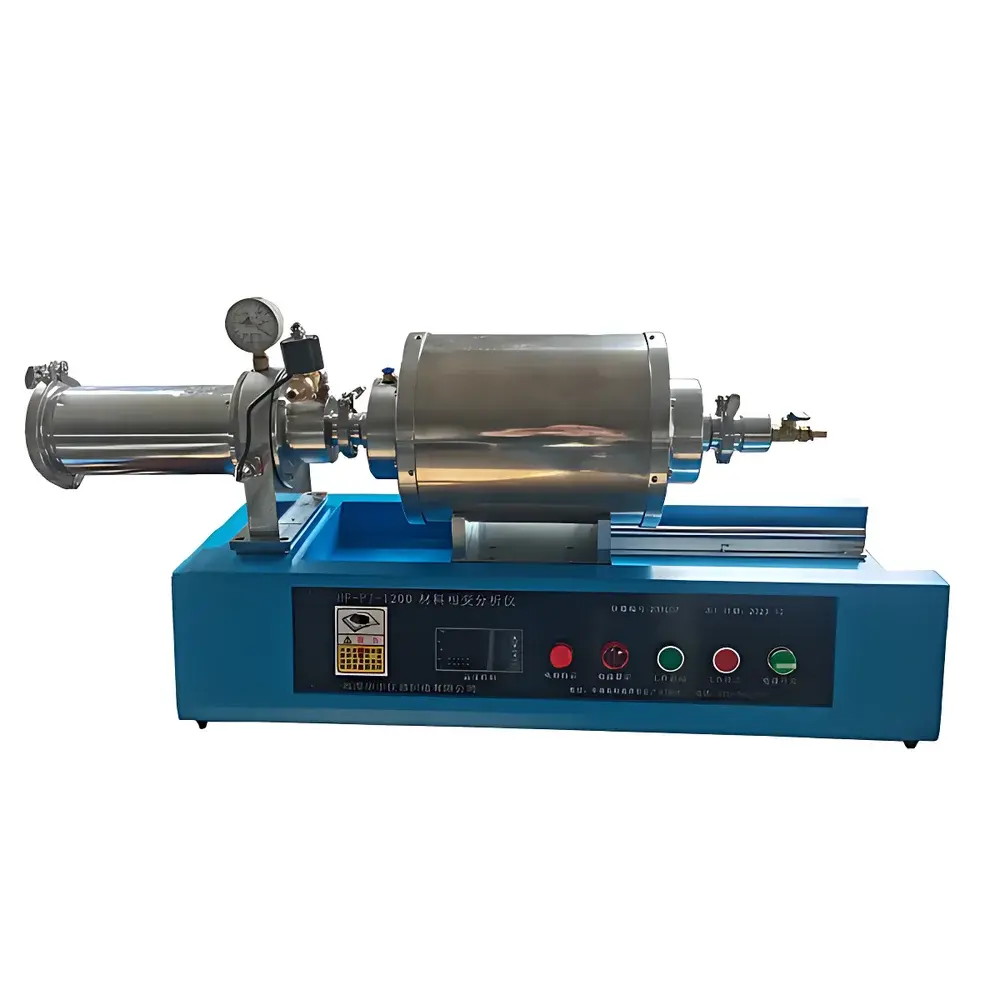
ZHENHUAFENXI HF-PJ-12 Thermal Dilatometer for Phase Transition Analysis
| Brand | ZHENHUAFENXI |
|---|---|
| Origin | Hunan, China |
| Model | HF-PJ-12 |
| Temperature Range | 1200 °C |
| Heating Rate | 5 °C/min (standard), up to 20 °C/min (customizable) |
| Temperature Accuracy | ±1 °C |
| Sample Diameter/Width | 6 mm (cylindrical or square cross-section) |
| Sample Length | 50 mm |
| Expansion Measurement Range | 0–5 mm |
| Resolution | 0.1 µm |
| Atmosphere Options | Vacuum (base pressure −0.1 MPa), Argon, Inert Gas |
| Cooling Rates | 30–200 °C/s (air, gas, liquid nitrogen options) |
Overview
The ZHENHUAFENXI HF-PJ-12 Thermal Dilatometer is a precision instrument engineered for quantitative thermal expansion and solid-state phase transition analysis of inorganic and metallic materials. It operates on the principle of contact dilatometry—measuring dimensional changes (linear strain) of a solid sample as a function of temperature under controlled heating or cooling cycles. By tracking length variation with high-resolution inductive displacement sensing (0.1 µm resolution), the system captures subtle thermal expansion anomalies associated with structural transformations—including austenite–ferrite, martensitic, peritectic, and polymorphic transitions—as well as glass transitions in ceramics and refractories. The instrument supports both continuous heating and interrupted cooling protocols, enabling construction of Time–Temperature–Transformation (TTT), Continuous Heating Transformation (CHT), and Continuous Cooling Transformation (CCT) diagrams essential for metallurgical process design and materials qualification.
Key Features
- High-temperature capability up to 1200 °C, with ±1 °C temperature accuracy across the full range, validated per ASTM E228 and ISO 7991 calibration standards.
- Dual heating configuration: standard resistive tube furnace (max 10 °C/min) or optional high-frequency induction furnace (reaches 1000 °C in ≈7 minutes), allowing rapid thermal cycling for kinetic studies.
- Modular atmosphere control: integrated vacuum line (−0.1 MPa base pressure), configurable inert gas (Ar/N₂) purging, and optional ultra-high vacuum upgrade (<10⁻³ Pa) for oxide-sensitive or low-vapor-pressure materials.
- Multi-mode cooling system: selectable air, compressed gas, or liquid nitrogen quenching, delivering programmable cooling rates from 30 °C/s to >200 °C/s—critical for CCT curve generation and metastable phase trapping.
- High-fidelity displacement measurement: LVDT-based transducer with digital signal conditioning, 0.1 µm resolution, and full-scale range of 0–5 mm; thermal drift compensation algorithms applied in real time to isolate sample-specific expansion from mechanical/thermal artifacts.
- Robust mechanical architecture: rigid granite base, precision-guided sample carriage, and quartz or alumina sample holders compatible with aggressive thermal cycling and chemically inert environments.
Sample Compatibility & Compliance
The HF-PJ-12 accommodates cylindrical (Φ6 × 50 mm) or prismatic (6 × 6 × 50 mm) specimens—ideal for sintered ceramics, refractory bricks, investment casting shell materials, ferritic/austenitic steels, and technical oxides (e.g., Al₂O₃, ZrO₂, SiC). Sample containment uses high-purity quartz or stabilized alumina tubes to minimize chemical interaction and thermal mass interference. All operational parameters—including temperature ramp profiles, dwell times, atmosphere switching sequences, and cooling triggers—are fully programmable and logged with timestamped metadata. The system complies with GLP documentation requirements and supports audit-ready data export (CSV, XML) for regulatory submissions under ISO/IEC 17025-accredited laboratories. Optional traceable calibration with NIST-traceable quartz reference standards ensures metrological continuity.
Software & Data Management
The bundled analytical software provides a deterministic, scriptable environment for experiment definition, real-time monitoring, and post-acquisition transformation analysis. Users define multi-step thermal protocols—including isothermal holds, ramp-and-hold segments, and dynamic cooling triggers—with full parameter logging at 10 Hz temporal resolution. Strain–temperature curves are automatically processed to identify inflection points, derivative maxima, and onset/offset temperatures using second-derivative thresholding (per ASTM E831 and ISO 11359-2). TTT/CCT diagrams are generated via manual or semi-automated critical point annotation, with overlay support for literature datasets. Raw data files include embedded instrument configuration, sensor calibration coefficients, and environmental metadata—ensuring full traceability and reproducibility. Export formats comply with FAIR principles and integrate seamlessly into LIMS or ELN platforms.
Applications
- Determination of linear thermal expansion coefficients (CTE) for ceramic glazes, refractory linings, and composite substrates per ASTM C372 and ISO 7991.
- Phase transformation mapping in alloy development: quantification of A₁, A₃, Mₛ, and Mf temperatures in carbon steels, stainless grades, and Ni-based superalloys.
- Sintering behavior analysis of powder metallurgy components, including densification onset, shrinkage kinetics, and pore closure thresholds.
- Thermal stability assessment of battery cathode materials (e.g., NMC, LFP) and solid electrolytes under inert or reducing atmospheres.
- Qualification of investment casting mold materials (e.g., zircon–silica shell systems) for thermal shock resistance and dimensional fidelity during dewaxing and firing.
- Research into martensitic shape-memory alloys (NiTi, CuAlBe), where reversible strain hysteresis and transformation width correlate directly with functional performance.
FAQ
What sample geometries are supported?
Standard configurations accept cylindrical (Φ6 × 50 mm) or square-section (6 × 6 × 50 mm) specimens. Custom fixtures are available for irregular shapes upon request.
Can the system operate under high vacuum (≤10⁻³ Pa)?
Yes—this requires specification at order entry and includes upgraded vacuum pumping hardware and sealing components; pricing is adjusted accordingly.
Is the software compliant with FDA 21 CFR Part 11 requirements?
The base software supports user authentication, electronic signatures, and audit trail generation. Full Part 11 compliance requires optional validation package and documented IQ/OQ/PQ protocols.
How is thermal drift compensated during long-duration tests?
Real-time compensation uses dual-sensor referencing (sample + dummy rod) and pre-characterized thermal expansion models of the mechanical train, applied during acquisition and post-processing.
What cooling media are supported, and what are their maximum rates?
Compressed air: ≤30 °C/s; inert gas (N₂/Ar): ≤100 °C/s; liquid nitrogen: ≥150 °C/s—rates depend on nozzle geometry, flow control, and sample thermal mass.



