
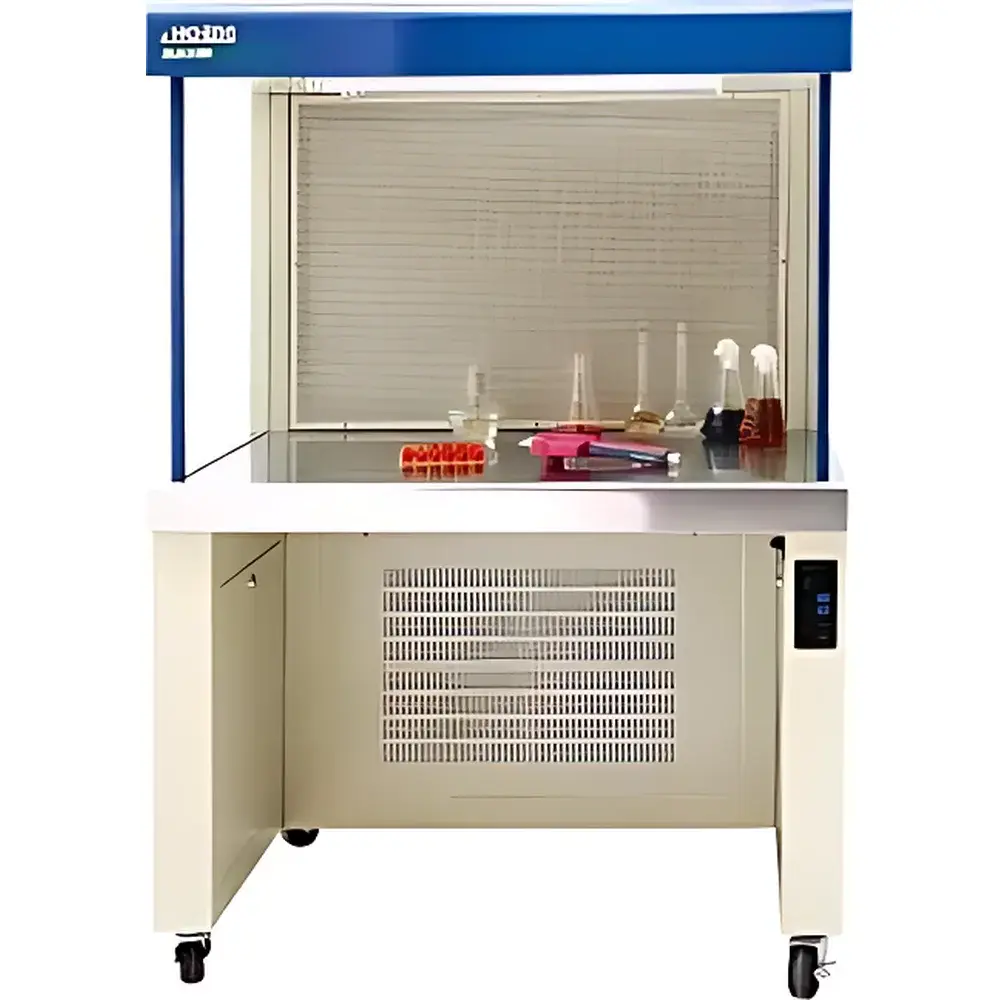
Zhicheng ZHJH-C2109B Horizontal Laminar Flow Clean Bench
| Brand | Zhicheng |
|---|---|
| Origin | Shanghai, China |
| Manufacturer Type | Direct Manufacturer |
| Product Category | Domestic |
| Model | ZHJH-C2109B |
| Pricing | Upon Request |
| Airflow Pattern | Horizontal Laminar Flow |
| Work Surface | Single-sided |
| Filtration Efficiency | ≥99.99% @ 0.3 µm (HEPA H14) |
| Cleanliness Class | ISO Class 5 (equivalent to US FED-STD-209E Class 100 @ ≥0.5 µm) |
| Microbial Recovery | ≤0.5 CFU/plate (90 mm Petri dish) |
| Adjustable Air Velocity | 0.3–0.6 m/s (7-step LED digital control) |
| Noise Level | ≤62 dB(A) |
| Vibration Peak-to-Peak | ≤8 µm |
| Illumination | ≥300 lx |
| Pre-filter Initial Resistance | ≤120 Pa (at max airflow) |
| Working Area Dimensions (W×D×H) | 900 × 590 × 570 mm |
| External Dimensions (W×D×H) | 980 × 790 × 1440 mm |
| Net Weight | 150 kg |
| Power Consumption | 380 W |
| Input Voltage | AC 220 V, 50/60 Hz |
| Construction | Electrophoretically coated steel frame with 304 stainless steel work surface |
| Safety Window | Dual-side transparent acrylic viewing panels |
| Lighting | Integrated fluorescent lamp + UV-C germicidal lamp (254 nm) |
| Mobility | Four swivel casters with locking brakes |
Overview
The Zhicheng ZHJH-C2109B Horizontal Laminar Flow Clean Bench is an ISO Class 5-certified laboratory containment system engineered for unidirectional, particle-free airflow across a single-sided working area. It operates on the principle of horizontal laminar flow: ambient air is drawn through a pre-filter to capture coarse particulates, then pressurized by a high-efficiency centrifugal blower into a plenum chamber, and finally discharged uniformly across the work surface after passing through an H14-grade HEPA filter (EN 1822-1, ≥99.995% efficiency at 0.3 µm). This configuration ensures continuous, low-turbulence airflow from the rear filter wall toward the operator, minimizing cross-contamination and protecting both samples and personnel in non-hazardous applications. Designed for strict compliance with cleanroom hygiene protocols, the unit meets U.S. Federal Standard 209E Class 100 requirements (≥0.5 µm particles) and supports routine validation per ISO 14644-1 and EU GMP Annex 1 for Grade A environments—when operated under controlled room conditions (ISO Class 7 or better background).
Key Features
- Single-sided horizontal laminar flow architecture optimized for microbiological handling, cell culture preparation, and precision instrumentation assembly.
- H14 HEPA filtration system with integrated pre-filter; validated initial resistance ≤120 Pa at rated airflow, ensuring long service life and consistent pressure drop performance.
- Seven-step digitally controlled air velocity regulation (0.3–0.6 m/s), displayed via LED interface for repeatable process setup and SOP alignment.
- Electrostatically powder-coated structural frame and seamless 304 stainless steel work surface—corrosion-resistant, non-porous, and compatible with common disinfectants (e.g., 70% ethanol, hydrogen peroxide vapor).
- Dual full-height transparent acrylic side windows provide 180° lateral visibility, ergonomic access, and uniform ambient light transmission without optical distortion.
- Dedicated dual-lamp system: daylight-balanced fluorescent illumination (≥300 lx at work surface) and 254 nm UV-C germicidal lamp with safety interlock to prevent accidental exposure.
- Four omnidirectional locking casters enable repositioning within lab zones while maintaining mechanical stability during operation (vibration ≤4 µm peak-to-peak).
Sample Compatibility & Compliance
The ZHJH-C2109B is intended for use with non-toxic, non-volatile, and non-hazardous biological or physical samples—including microbial cultures, tissue explants, sterile media preparations, optical components, and semiconductor wafers. It is not suitable for handling volatile organic compounds, radioactive materials, or biohazards requiring biosafety level (BSL-2 or higher) containment. The unit complies with IEC 61000-6-3 (EMC emission standards) and IEC 61000-6-2 (immunity), and its electrical design conforms to IEC 61010-1 for laboratory equipment safety. While not certified to NSF/ANSI 49 (as it lacks inward inflow and exhaust ducting), its performance metrics align with ISO 14644-1:2015 testing methodologies for airborne particle concentration and airflow uniformity. Routine certification per ASTM E2500-13 (verification of clean bench performance) is supported through third-party validation services.
Software & Data Management
This clean bench operates as a standalone hardware platform with no embedded microprocessor-based software or network connectivity. All operational parameters—including fan speed setting, UV lamp activation status, and runtime hours—are managed locally via tactile membrane switches with LED feedback. For quality assurance traceability, users are advised to log operational settings, filter replacement dates, and periodic particle count verification results (per ISO 14644-2) in paper-based or electronic laboratory notebooks compliant with 21 CFR Part 11 when deployed in regulated environments (e.g., pharmaceutical QC labs). Optional external data loggers may be interfaced via analog voltage outputs (0–10 V) for airflow velocity monitoring, subject to user-configured calibration.
Applications
The ZHJH-C2109B serves critical functions across multiple regulated and research-intensive domains: aseptic transfer of bacterial/fungal isolates in clinical microbiology; preparation of monoclonal antibody formulations under Grade A conditions; sterile filling of diagnostic reagents; handling of sensitive photonic sensors in optoelectronics R&D; and environmental sampling kit assembly for ISO/IEC 17025-accredited testing laboratories. Its dimensional footprint (980 × 790 × 1440 mm) and 900 mm work width make it ideal for integration into modular lab furniture systems and ISO Class 7 cleanrooms where spatial efficiency and operator ergonomics are prioritized.
FAQ
What is the recommended frequency for HEPA filter replacement?
Under typical usage (8 hrs/day, ISO Class 7 ambient), annual replacement is advised; however, filter life must be verified quarterly via DOP/PAO leak testing per ISO 14644-3.
Can this unit be installed in a standard laboratory without HVAC upgrades?
Yes—provided the room maintains ≤352,000 particles/m³ (≥0.5 µm) and relative humidity between 30–70%, though optimal performance requires ISO Class 7 background air.
Is UV-C irradiation dose validated per ISO 15714?
No—UV lamp intensity is not factory-calibrated; users must perform radiometric validation using NIST-traceable UV-C meters prior to first use and after each lamp replacement.
Does the unit support GLP-compliant audit trails?
Not natively; manual logs or externally integrated SCADA systems must fulfill ALCOA+ data integrity requirements for regulated workflows.
What maintenance certifications are required for ISO 13485 compliance?
Preventive maintenance records—including blower balancing, vibration analysis, and airflow mapping—must be retained per clause 7.5.4 of ISO 13485:2016 for medical device manufacturing environments.



