
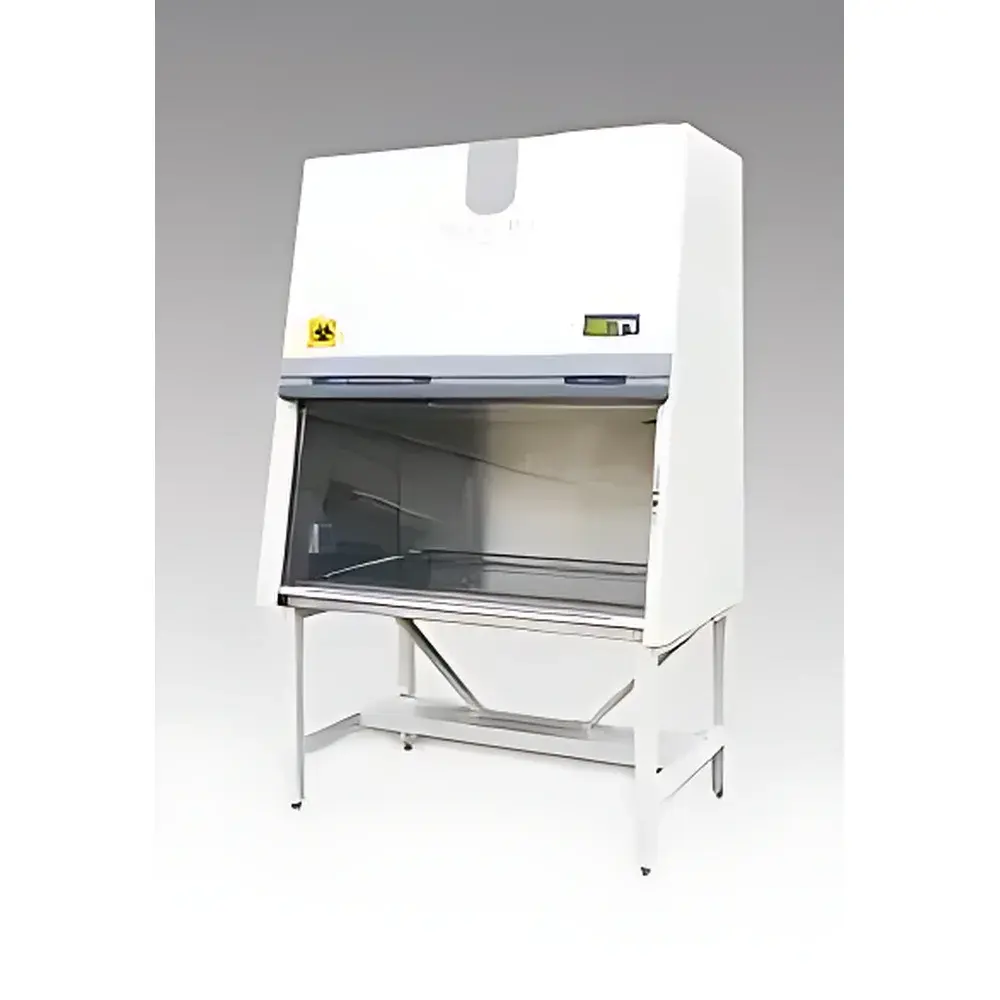
Zhicheng ZSB-900IIA2 Class II A2 Biological Safety Cabinet
| Origin | Shanghai, China |
|---|---|
| Manufacturer Type | Authorized Distributor |
| Origin Category | Domestic (China) |
| Model | ZSB-900IIA2 |
| Pricing | Upon Request |
| Primary Filtration | ULPA (≥99.999% @ 0.1–0.2 µm) |
| Exhaust Filtration | HEPA (≥99.99% @ 0.3 µm) |
| Inflow Velocity | 0.5–0.6 m/s |
| Downflow Velocity | 0.25–0.5 m/s |
| Downflow Control Accuracy | ±0.015 m/s |
| Airflow Resolution | 0.01 m/s |
| Pressure Differential Range | 0–500 Pa |
| Noise Level | <67 dB(A) |
| Vibration Half-Peak | ≤5 µm |
| Illumination | ≥650 lx |
| Work Area Dimensions | 930 × 635 × 655 mm |
| External Dimensions | 1120 × 805 × 2270 mm |
| Net Weight | 205 kg |
| Power Supply | AC 220 V, 50/60 Hz |
| Power Consumption | 550 W |
Overview
The Zhicheng ZSB-900IIA2 is a certified Class II, Type A2 biological safety cabinet engineered for precision containment in biosafety level 2 (BSL-2) and select BSL-3 applications. It operates on the principle of inward airflow (inflow) and downward laminar airflow (downflow), both conditioned through high-efficiency filtration to protect personnel, product, and environment simultaneously. With 70% of the total air recirculated after passing through an Ultra-Low Penetration Air (ULPA) filter and 30% exhausted via a dedicated ducted or thimble-connected system, the unit complies with NSF/ANSI 49–2022 and EN 12469:2000 standards for Class II A2 cabinets. Its core architecture integrates dynamic airflow stabilization, real-time multi-parameter monitoring, and fail-safe redundancy—addressing persistent engineering challenges such as voltage-induced airflow drift, filter resistance variability, and latent filter degradation.
Key Features
- Constant Air Velocity Technology: An adaptive control system continuously adjusts fan speed to maintain stable inflow (0.5–0.6 m/s) and downflow (0.25–0.5 m/s) velocities despite fluctuations in supply voltage or increasing ULPA filter resistance—ensuring consistent negative pressure integrity.
- Dual-Stage Filtration Architecture: Primary ULPA filtration (≥99.999% efficiency for 0.1–0.2 µm particles) safeguards the work area; secondary HEPA exhaust filtration (≥99.99% @ 0.3 µm) ensures safe discharge of contaminated air.
- Redundant Alarm System: Includes independent low-velocity alarm circuitry that activates if primary control fails—providing audible, visual, and on-screen alerts without reliance on main controller logic.
- ULPA/HEPA Health Monitoring Suite: Real-time detection of filter performance decline, end-of-life prediction, and physical breach via differential pressure tracking, airflow profiling, and integrated sensor fusion.
- Full-Parameter LCD Interface: 7-inch backlit display shows live readings for inflow/downflow velocity, static pressure differential (0–500 Pa, ±1% accuracy), cumulative runtime, UV lamp status, and filter operational health—all in English-language UI with configurable units.
- Ergonomic & Safety-Optimized Construction: 10° inclined tempered glass sash with anti-reflective dual-layer film; epoxy-coated stainless steel frame and gasket-sealed access door; UV interlock preventing accidental exposure during sash operation.
- Integrated Utility Management: GFCI-protected receptacles with splash guards; standardized gas/water valve ports; external exhaust compatibility with full ductwork kits supplied by Zhicheng.
Sample Compatibility & Compliance
The ZSB-900IIA2 supports open-vessel manipulations involving non-volatile, low-to-moderate risk biological agents—including recombinant DNA constructs, clinical specimens, and cell culture workflows—as defined under CDC/NIH Biosafety in Microbiological and Biomedical Laboratories (BMBL), 6th Edition. It is validated for use with volatile chemicals at concentrations ≤5% of their lower explosive limit (LEL) when connected to external exhaust. The cabinet meets ISO 14644-1 Class 5 (ISO Class 5) cleanroom performance for downflow uniformity and particle count. All electronic controls comply with IEC 61000-4 immunity standards; electrical safety conforms to IEC 61010-1. Documentation includes factory calibration certificates traceable to NIST-equivalent national metrology institutes and full test reports per NSF/ANSI 49 Annex D protocols.
Software & Data Management
While the ZSB-900IIA2 does not incorporate cloud-based software, its embedded firmware supports GLP-compliant audit trails via non-volatile memory logging. Event timestamps—such as sash position changes, UV activation cycles, alarm triggers (including ULPA breach or low-velocity events), and filter runtime—are stored locally for up to 12 months. Data export is available via USB interface in CSV format, enabling integration into institutional LIMS or QA documentation systems. Firmware updates are performed offline using signed binary packages, ensuring integrity verification prior to installation. All alarm states generate time-stamped entries compatible with FDA 21 CFR Part 11 requirements when paired with appropriate institutional procedural controls.
Applications
This cabinet is routinely deployed across academic research laboratories, pharmaceutical QC/QA facilities, diagnostic pathology labs, and biomanufacturing pilot suites. Typical use cases include: sterile handling of primary human cells and hybridomas; preparation of viral vectors under BSL-2+ containment; antibiotic susceptibility testing with aerosol-generating procedures; mycological isolation requiring particulate exclusion; and environmental microbiology sample processing where cross-contamination must be eliminated. Its robust construction and validated airflow profile also support extended-duration assays—such as 72-hour cytokine stimulation studies—without compromising containment assurance.
FAQ
Does the ZSB-900IIA2 require external ducting to operate safely?
No—it can operate in recirculating mode with canopy connection or fully ducted exhaust; configuration depends on chemical usage and facility HVAC design.
What certification standards does this cabinet meet?
NSF/ANSI 49–2022 (Class II A2), EN 12469:2000, and GB/T 25915.3–2021 (Chinese equivalent of ISO 14644-3).
Can the ULPA filter be replaced in-house without recalibration?
Yes—filter replacement is tool-free and guided by on-screen prompts; post-replacement verification requires only a 15-minute stabilization period and no third-party service intervention.
Is the UV lamp intensity monitored in real time?
Yes—the system measures irradiance decay and issues warnings when output falls below 85% of initial specification, aligned with ISO 15858 UV-C dosimetry guidelines.
How is compliance with GLP/GMP documentation requirements supported?
Through timestamped event logs, user-accessible calibration history, and USB-exportable records—enabling linkage to institutional electronic lab notebooks or paper-based SOPs.




