
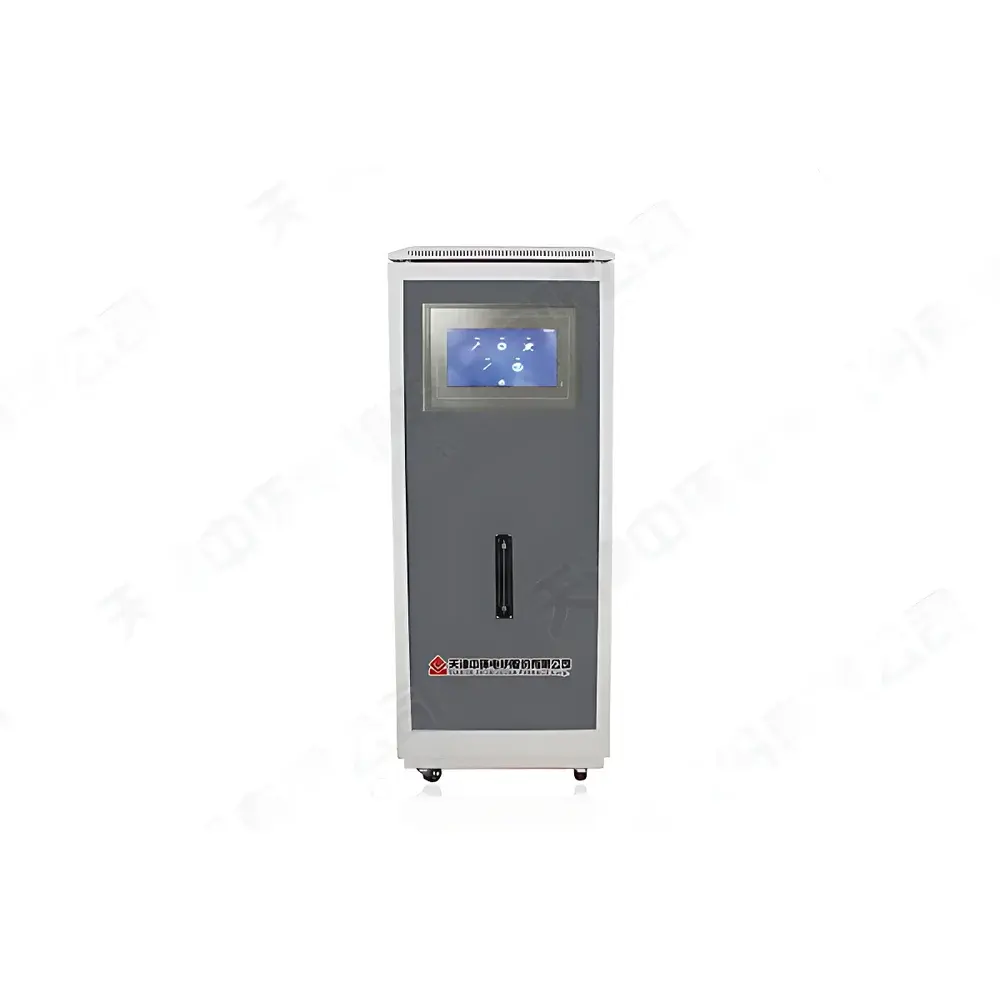
ZHONGHUAN FURNACE Touchscreen Mass Flow Control System
| Brand | ZHONGHUAN FURNACE |
|---|---|
| Origin | Tianjin, China |
| Manufacturer Type | Authorized Distributor |
| Product Origin | Domestic (China) |
| Model | Touchscreen Mass Flow Control System |
| Pricing | Available Upon Request |
Overview
The ZHONGHUAN FURNACE Touchscreen Mass Flow Control System is an engineered solution for precise, repeatable, and safe delivery of process gases in high-temperature thermal processing environments—particularly vacuum and controlled-atmosphere furnaces. Built upon thermal-based mass flow measurement principles (constant temperature anemometry), the system directly measures gas mass flow rate independent of pressure and temperature fluctuations, ensuring traceable, gravimetrically referenced control. It integrates seamlessly with tube furnaces, box furnaces, and vacuum systems requiring inert, reactive, or mixed-gas atmospheres (e.g., N₂, Ar, H₂, O₂, forming gas, or custom blends). Designed for laboratory-scale R&D and pilot production, the system supports stable long-duration operation under dynamic furnace pressure conditions while maintaining compliance with fundamental safety and operational integrity requirements for gas-handling instrumentation.
Key Features
- Integrated 7-inch high-resolution capacitive touchscreen HMI with intuitive graphical workflow navigation—enabling real-time monitoring and stepwise program execution without external PCs.
- Thermal mass flow sensors with ±1% full-scale accuracy and <100 ms response time, calibrated for common industrial gases (N₂-equivalent with gas-specific correction factors).
- Triple-interface hardware compatibility: Swagelok-style double ferrule compression fittings, barbed (Bartell-type) connectors, and KF-16/KF-25 vacuum flanges—facilitating rapid integration into diverse gas train configurations.
- Dual-stage safety architecture: Integrated one-way check valves prevent backflow during pressure transients; a stainless-steel static mixing chamber ensures homogeneous gas blending prior to furnace inlet, minimizing concentration gradients and localized reactivity risks.
- Real-time gas leak detection via differential pressure monitoring across sealed zones—triggers audible/visual alerts and automatic solenoid valve shutdown when threshold deviations exceed configurable limits.
- Modular design supports scalable expansion: Base units configured for 1–4 independent gas channels; multi-channel versions available with synchronized ramp/soak profiling and cross-channel ratio control.
Sample Compatibility & Compliance
The system is compatible with non-corrosive and mildly corrosive process gases (including but not limited to nitrogen, argon, hydrogen, oxygen, carbon monoxide, and 5% H₂/95% N₂ forming gas) at operating pressures from 0.1 to 0.6 MPa (gauge) and ambient temperatures up to 45 °C. All wetted materials—including 316L stainless steel sensor bodies, EPDM or FKM elastomer seals (gas-dependent), and electropolished internal pathways—conform to ASTM F800-22 (Standard Guide for Selection of Materials for Gas Delivery Systems) and ISO 8573-1:2010 Class 4 purity requirements for compressed air and process gases. While not certified to UL/CSA or ATEX standards out-of-the-box, the system may be integrated into Class 1 Div 2 or Zone 2 hazardous area setups when installed per IEC 60079-14 guidelines and paired with appropriately rated external isolation components.
Software & Data Management
The embedded firmware supports local data logging at user-selectable intervals (1–60 seconds), storing timestamped flow rate, setpoint, valve position, and alarm status in CSV format on internal flash memory (≥1 million records). Optional USB export enables post-experiment analysis in Excel or MATLAB. For networked environments, Modbus RTU (RS-485) and optional Ethernet/IP interfaces allow integration into SCADA or MES platforms. Audit trails—including operator login, parameter changes, and emergency stop events—are retained for ≥90 days and comply with GLP-aligned record-keeping expectations. While not FDA 21 CFR Part 11 compliant by default, electronic signatures and enhanced audit functionality can be enabled via firmware upgrade for regulated GMP applications.
Applications
- Controlled-atmosphere sintering of advanced ceramics and metal powders under reducing (H₂), inert (Ar), or oxidizing (O₂-diluted) conditions.
- Thermal annealing of semiconductor wafers and thin-film coatings requiring precise gas stoichiometry and temporal stability.
- In-situ synthesis of nanomaterials (e.g., CNTs, graphene oxides) via CVD processes demanding sub-second flow responsiveness.
- Calibration and validation of furnace atmosphere uniformity using tracer gas dilution methods.
- Multi-step heat treatment cycles involving sequential gas switching (e.g., purge → preheat → reaction → cool-down) with programmable dwell times and ramp rates.
FAQ
What gases are supported out-of-the-box?
The system ships with N₂ calibration; factory calibration for Ar, He, H₂, O₂, CO, and forming gas (5% H₂/95% N₂) is available as an option. Custom calibrations for other gases require gas-specific sensor characterization.
Can the system operate under vacuum conditions?
It is designed for upstream (positive-pressure) gas delivery only. For vacuum furnace applications, it must be installed on the gas inlet side of the vacuum pump, downstream of the foreline valve, and upstream of the furnace chamber.
Is remote monitoring possible without additional hardware?
Yes—via built-in RS-485 Modbus RTU. Ethernet connectivity requires optional module installation and configuration through the system’s setup menu.
How is flow accuracy maintained over time?
Sensors include auto-zero compensation routines executed during idle periods; annual recalibration against NIST-traceable standards is recommended for critical applications.
Does the system support automated recipe loading?
Yes—up to 32 user-defined gas profiles can be stored locally and recalled via touchscreen or Modbus command, including individual channel setpoints, ramp rates, and hold durations.



