
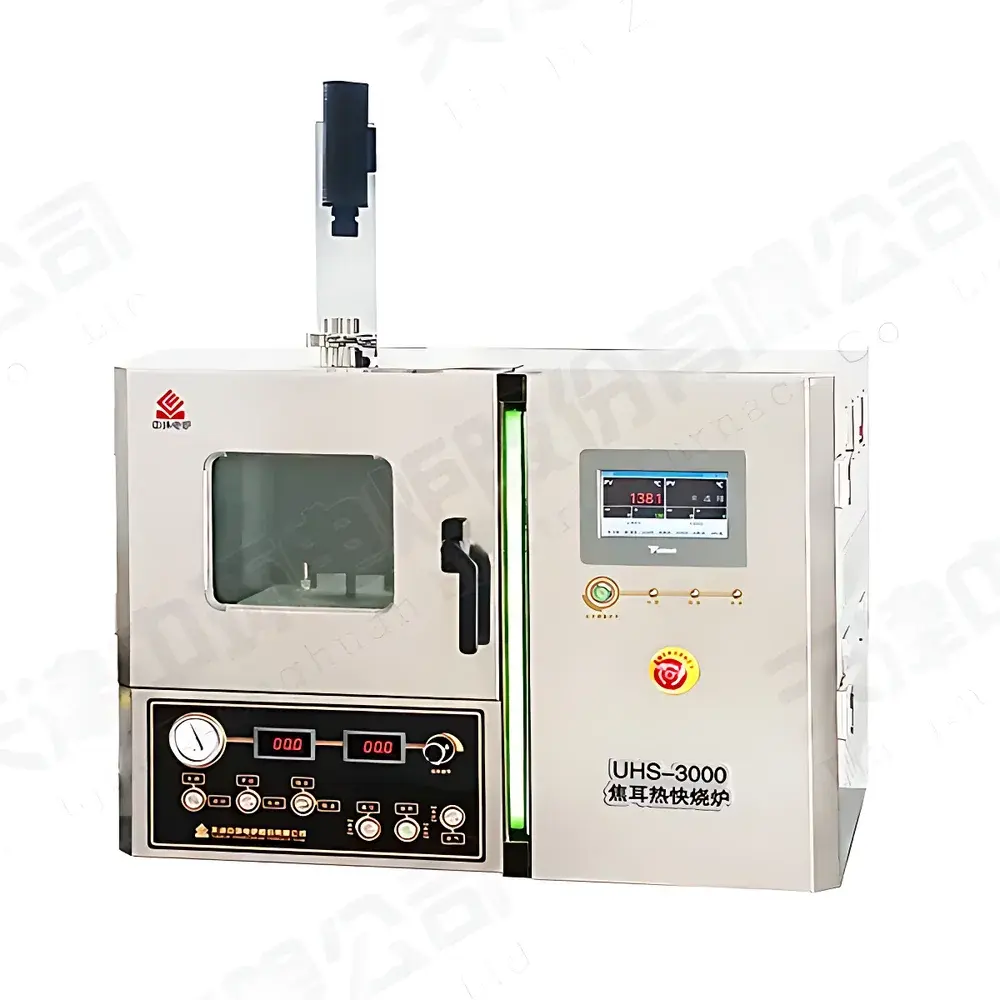
ZHONGHUAN FURNACE UHS-3000 Joule-Heated Ultra-Fast High-Temperature Sintering Furnace
| Brand | ZHONGHUAN FURNACE |
|---|---|
| Origin | Tianjin, China |
| Model | UHS-3000 |
| Instrument Type | Box-Type Furnace |
| Max Temperature | 3000 °C |
| Temperature Control Accuracy | ±2 °C |
| Max Power | 10 kW |
| Heating Rate (to max temp) | 10–500 °C/s |
| Heating Element | Graphite foil, graphite boat, and other conductive carbon-based substrates |
| Cooling Method | Forced-air cooling |
| Vacuum Chamber Material | 304 stainless steel with radiation-shielded viewport |
| Base Vacuum | –0.1 MPa (with 4 L single-stage pump) |
| Gas Control | Three-port system (inlet, exhaust, vacuum) |
| Electrical Supply | 380 V, 3-phase |
Overview
The ZHONGHUAN FURNACE UHS-3000 is a joule-heated ultra-fast sintering furnace engineered for materials synthesis under extreme thermal conditions. Unlike conventional resistance or induction furnaces, it applies direct electrical current across conductive samples—typically graphite-based substrates such as foils, boats, or custom-shaped carriers—to generate heat volumetrically via resistive (Joule) dissipation. This principle enables rapid, uniform heating without reliance on external radiation or convection, achieving temperature ramps up to 500 °C/s and stable operation at 3000 °C. The furnace is designed for transient thermal processing where time-at-temperature must be minimized—critical for preserving metastable phases, suppressing volatile loss (e.g., Li, Na, or halides), limiting grain coarsening, and enabling non-equilibrium reaction pathways. Its architecture supports both continuous and pulsed current modes, making it suitable for millisecond-scale thermal profiling in research-grade solid-state synthesis.
Key Features
- Carbon-based joule heating system capable of sustained operation at 3000 °C, verified by dual-wavelength infrared pyrometry with 20 ms sampling interval
- Programmable temperature ramping from ambient to 3000 °C at rates adjustable between 10 and 500 °C/s, with real-time feedback control
- Integrated 304 stainless steel vacuum chamber featuring radiation-shielded quartz viewport for in-situ observation and optical diagnostics
- Three-port gas handling manifold supporting inert (Ar, N₂), reducing (H₂/Ar), or reactive (O₂-diluted) atmospheres with independent inlet, exhaust, and vacuum lines
- LCD touch-panel interface with preloaded thermal profiles, manual override capability, and data logging of voltage, current, and measured temperature
- Forced-air cooling system optimized for rapid thermal cycling—typical cooldown from 2500 °C to 100 °C in <90 seconds under ambient purge
Sample Compatibility & Compliance
The UHS-3000 accommodates planar, bulk, and powdered specimens mounted directly on graphite carriers (≤100 × 20 × 2 mm). It complies with general laboratory safety standards for high-current DC systems (IEC 61000-4-5 surge immunity, EN 61000-3-2 harmonic limits) and incorporates hardware interlocks for overcurrent, overtemperature, and vacuum loss. While not certified to ISO/IEC 17025 for calibration traceability, its temperature control accuracy (±2 °C) meets typical requirements for academic and industrial R&D workflows involving ASTM C1161 (flexural strength of ceramics), ASTM C1338 (thermal shock resistance), and USP (thermal processing validation for pharmaceutical excipients). All operational parameters—including pulse width, hold time, and ramp rate—are fully configurable to support GLP-compliant experimental documentation when paired with external data acquisition systems.
Software & Data Management
The furnace operates via embedded firmware with no external PC dependency. Thermal programs are stored locally and include up to 32 segments per profile, each defining ramp rate, target temperature, dwell time, and current/voltage limits. Real-time telemetry (voltage, current, IR-measured temperature) is logged at 50 Hz and exportable via USB to CSV format. Optional Ethernet interface enables integration into LabVIEW or Python-based automation frameworks using Modbus TCP. Audit trails—including user login timestamps, program edits, and emergency shutdown events—are retained for ≥30 days. For regulated environments, the system supports 21 CFR Part 11–compliant electronic signatures when deployed with third-party validated software layers.
Applications
- Ceramic densification: Achieves >95% theoretical density in oxide ceramics (e.g., Al₂O₃, ZrO₂, SiC) within 10 s at 3000 °C, minimizing intergranular porosity and secondary phase formation
- Solid-state electrolytes: Synthesizes garnet-type Li₇La₃Zr₂O₁₂ (LLZO) in ≤6 s at 1773 K, reducing Li volatility and improving relative density to 92%, as confirmed by Archimedes’ method and EIS
- Metallurgical catalyst fabrication: Forms Pt-Co-Cu trimetallic nanoparticles on CNT supports via 2 s joule pulses at 1074 K, yielding catalysts with enhanced mass activity for ethanol oxidation (EOR)
- Graphene and 2D material processing: Enables flash annealing of GO films to reduced graphene oxide (rGO) while preserving lateral domain integrity and functional group selectivity
- Refractory alloy development: Supports rapid consolidation of W–Ni–Fe composites and Mo–Si–B systems where traditional sintering induces excessive grain growth or phase segregation
FAQ
What sample geometries are compatible with the UHS-3000?
Planar samples (foils, pellets, thin films) and small bulk specimens (≤10 mm diameter × 5 mm height) mounted on graphite carriers are optimal. Powdered samples require cold-pressing into green bodies prior to loading.
Is vacuum required for all processes?
No—vacuum is optional and application-dependent. Inert gas purging (Ar or N₂) is standard for oxide ceramics; vacuum (<10 Pa) is recommended for volatile-rich systems (e.g., lithium-containing SSEs) to suppress decomposition.
Can the furnace perform multi-step thermal cycles?
Yes—up to 32 programmable segments allow complex profiles including ramp-hold-cool-ramp sequences, with independent control of current/voltage limits per segment.
How is temperature calibrated and verified?
Calibration uses dual-wavelength infrared pyrometry (0.8–1.1 µm spectral band), referenced against NIST-traceable blackbody sources at 1000 °C, 1500 °C, and 2000 °C. Users may perform field verification using tungsten–rhenium thermocouples (Type C) for cross-validation below 2300 °C.
What maintenance is required for long-term reliability?
Graphite heating elements are consumables with typical service life of 50–200 cycles depending on peak temperature and atmosphere. Chamber O-rings and viewport coatings should be inspected after every 10 high-temperature runs (>2500 °C). No routine lubrication or bearing service is required.



