
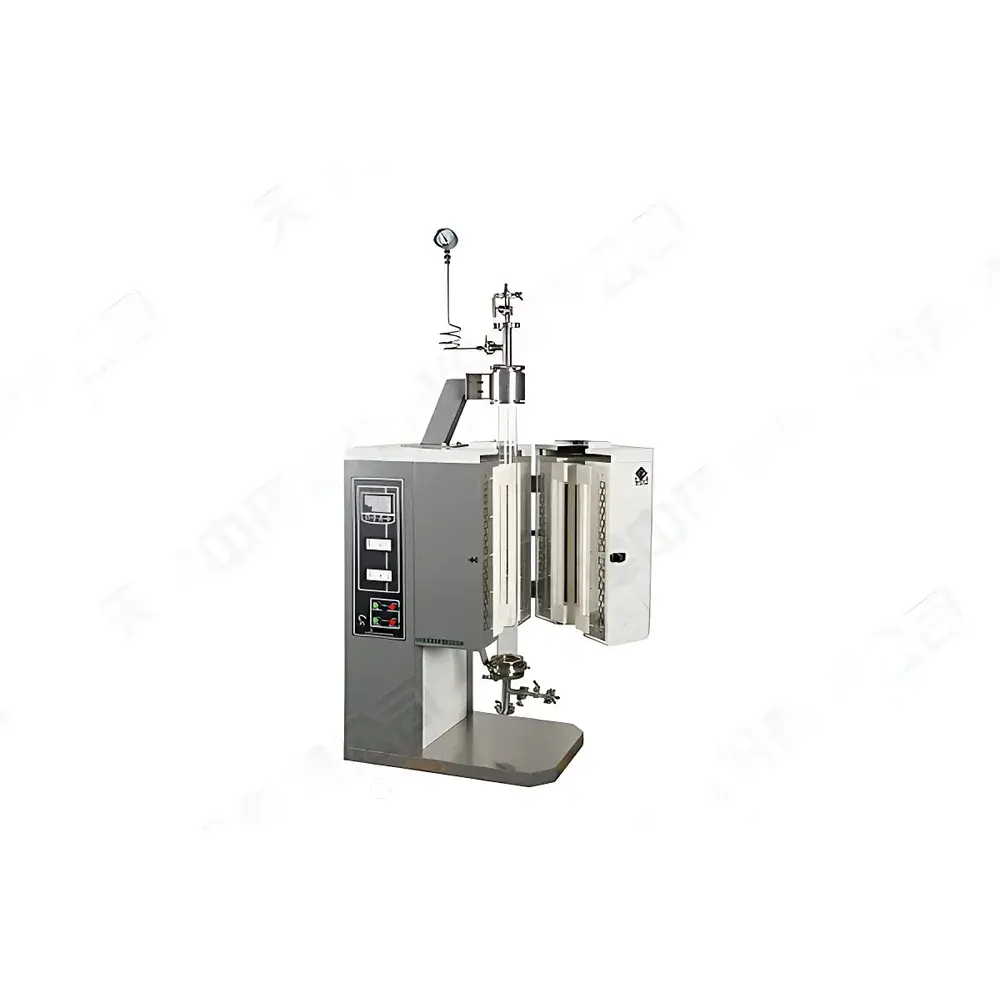
ZHONGHUAN FURNACE VT-1200D Vertical Dual-Zone Tube Furnace
| Brand | ZHONGHUAN FURNACE |
|---|---|
| Origin | Tianjin, China |
| Model | VT-1200D |
| Maximum Temperature | 1200 °C |
| Temperature Control Accuracy | ±1 °C |
| Rated Power | 3.2 kW |
| Heating Rate | ≤5 °C/min (≤500 °C), ≤10 °C/min (500–800 °C), ≤5 °C/min (800–1000 °C), ≤3 °C/min (1000–1200 °C) |
| Heating Element | OCr27Al7Mo2 High-Resistance Alloy Wire |
| Internal Chamber Dimensions | 590 × 420 × 1130 mm (W × D × H) |
| Configuration | Vertical dual-zone tube furnace with independent thermal zones and flip-open right-side furnace chamber |
Overview
The ZHONGHUAN FURNACE VT-1200D is a vertically oriented, dual-zone tube furnace engineered for high-precision thermal processing under controlled atmospheric or vacuum conditions. Designed around the fundamental principles of resistive heating and axial thermal zoning, it enables independent temperature control across two spatially separated heating zones—critical for establishing precise thermal gradients, annealing multi-layered samples, or conducting sequential heat treatments (e.g., pre-heating followed by rapid sintering). Its vertical architecture minimizes floor space requirements while optimizing gravitational stability during sample loading and gas flow uniformity along the tube axis. The furnace accommodates standard quartz or high-purity alumina tubes (up to Ø100 mm, length ≤1200 mm) and supports continuous operation at up to 1200 °C, with thermal uniformity maintained within ±3 °C across each zone’s active heating length (≥300 mm per zone) under steady-state conditions.
Key Features
- Vertical dual-zone configuration with independent PID-controlled heating circuits—enabling programmable thermal gradients (e.g., 800 °C/zone 1 → 1100 °C/zone 2) for diffusion studies or zone melting simulations.
- Right-side furnace chamber pivots open 110° on heavy-duty hinges, granting unobstructed access to the full tube length without disassembly—reducing handling time and mechanical stress on fragile substrates or coated wafers.
- High-efficiency insulation using vacuum-formed polycrystalline mullite fiber (PMF) boards—achieving >50% energy reduction versus traditional ceramic fiber linings while maintaining structural integrity at 1200 °C.
- Double-ring flange sealing system with adjustable compression gaskets ensures leak rates <1×10⁻³ mbar·L/s under vacuum and maintains inert gas integrity (N₂, Ar, forming gas) during long-duration experiments.
- Intelligent thermal safety architecture: automatic power cutoff upon chamber opening, dual-stage overtemperature protection (hardware limit + software alarm), and grounded chassis with RCD (Residual Current Device) compliance.
- Active surface cooling: integrated thermal sensor triggers variable-speed exhaust fans when external casing temperature exceeds 50 °C—ensuring operator safety and prolonging outer shell service life.
Sample Compatibility & Compliance
The VT-1200D accommodates cylindrical samples up to 100 mm in diameter and 1000 mm in length, compatible with quartz, fused silica, alumina, and silicon carbide tubing. It supports ASTM E1113 (Standard Practice for Calibration of High-Temperature Furnaces), ISO 8573-1 (compressed air purity for purge systems), and GLP-compliant workflows when paired with validated data logging. Vacuum compatibility extends from rough vacuum (10⁻² mbar) to medium vacuum (10⁻³ mbar) using optional two-stage rotary vane pumps; high-vacuum integration (≤10⁻⁵ mbar) is achievable via turbomolecular pump add-ons. Gas flow control options include analog float meters (0.1–10 L/min) or digital mass flow controllers (MFCs) compliant with ISO 6326-2 for repeatable atmosphere dosing.
Software & Data Management
The furnace integrates a standard RS-485 interface supporting Modbus RTU protocol for bidirectional communication with SCADA or LIMS platforms. Optional PC software enables centralized control of up to 200 units, with timestamped logging of setpoints, actual temperatures (dual-channel), power draw, and alarm events. All data exports to CSV or Excel-compatible formats; audit trails comply with FDA 21 CFR Part 11 requirements when configured with user authentication, electronic signatures, and immutable record storage. Programmable ramp-soak profiles support up to 50 segments (domestic controller) or 40 segments (imported Eurotherm-equivalent module), with hold times ranging from 1 minute to 999 hours.
Applications
- Solid-state synthesis of functional oxides (e.g., LiCoO₂ cathode precursors, perovskite thin films) under controlled oxygen partial pressure.
- Thermal annealing of CVD-grown 2D materials (graphene, MoS₂) with gradient-driven defect healing.
- Carbonization and graphitization of polymer-derived ceramics under inert or reducing atmospheres.
- Calibration reference furnaces for thermocouple validation per IEC 60584-2 and NIST traceable protocols.
- Pre-treatment of catalyst supports (γ-Al₂O₃, SiO₂) prior to metal impregnation—leveraging staged heating to control pore collapse kinetics.
FAQ
What tube materials are compatible with the VT-1200D?
Quartz (up to 1100 °C), high-purity alumina (up to 1650 °C), and silicon carbide (up to 1500 °C) tubes may be used—selection depends on maximum process temperature and chemical compatibility with reactive gases.
Can the two zones operate at different ramp rates simultaneously?
Yes—the independent PID controllers allow distinct heating/cooling rates per zone, enabling dynamic thermal profiling such as simultaneous pre-heating and sintering.
Is vacuum feedthrough capability included as standard?
No—vacuum feedthroughs (electrical, thermocouple, or gas) are optional accessories; standard configuration includes only sealed flanges with O-ring grooves.
Does the furnace meet CE or UL safety standards?
The VT-1200D complies with IEC 61000-6-3 (EMC emissions) and IEC 61000-6-2 (immunity); CE marking is available upon request with third-party notified body certification.
What maintenance intervals are recommended for the heating elements?
OCr27Al7Mo2 wire elements typically require inspection every 500 operational hours above 1000 °C; replacement is advised after 2000 hours of cumulative exposure at rated temperature.



