
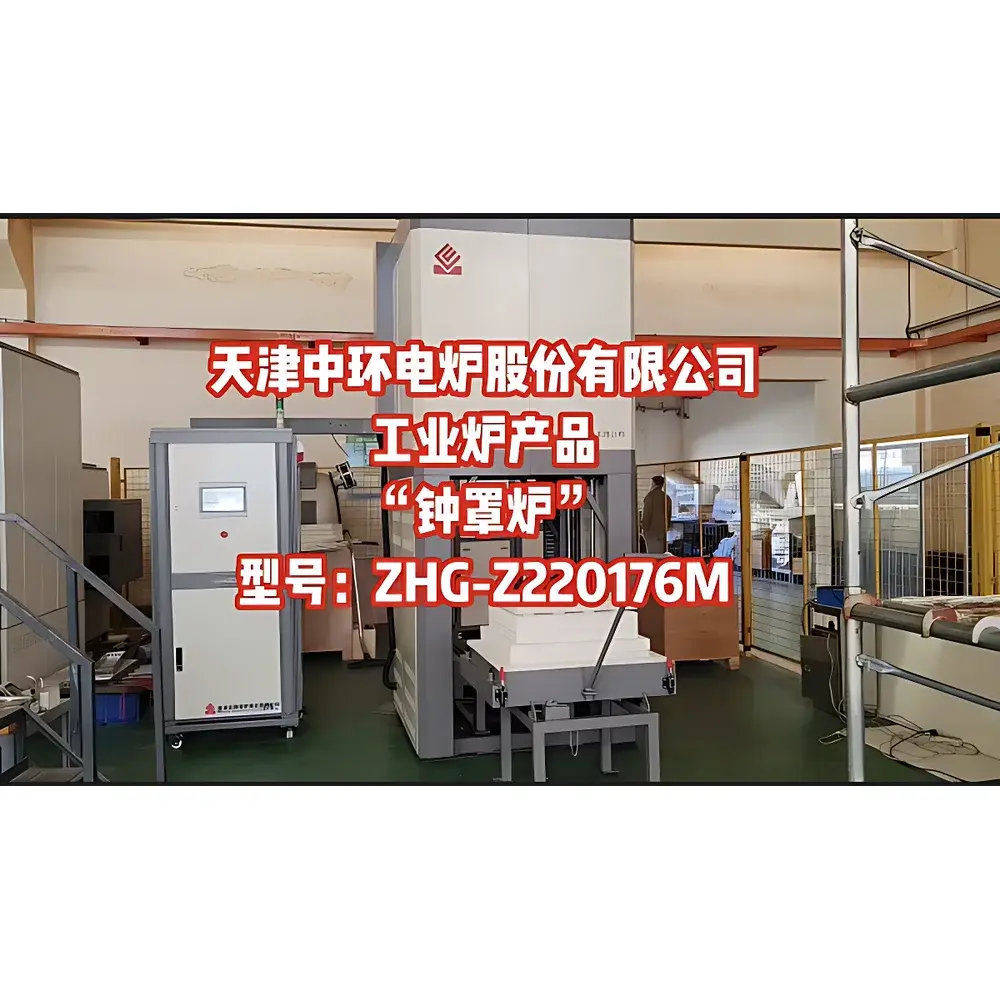
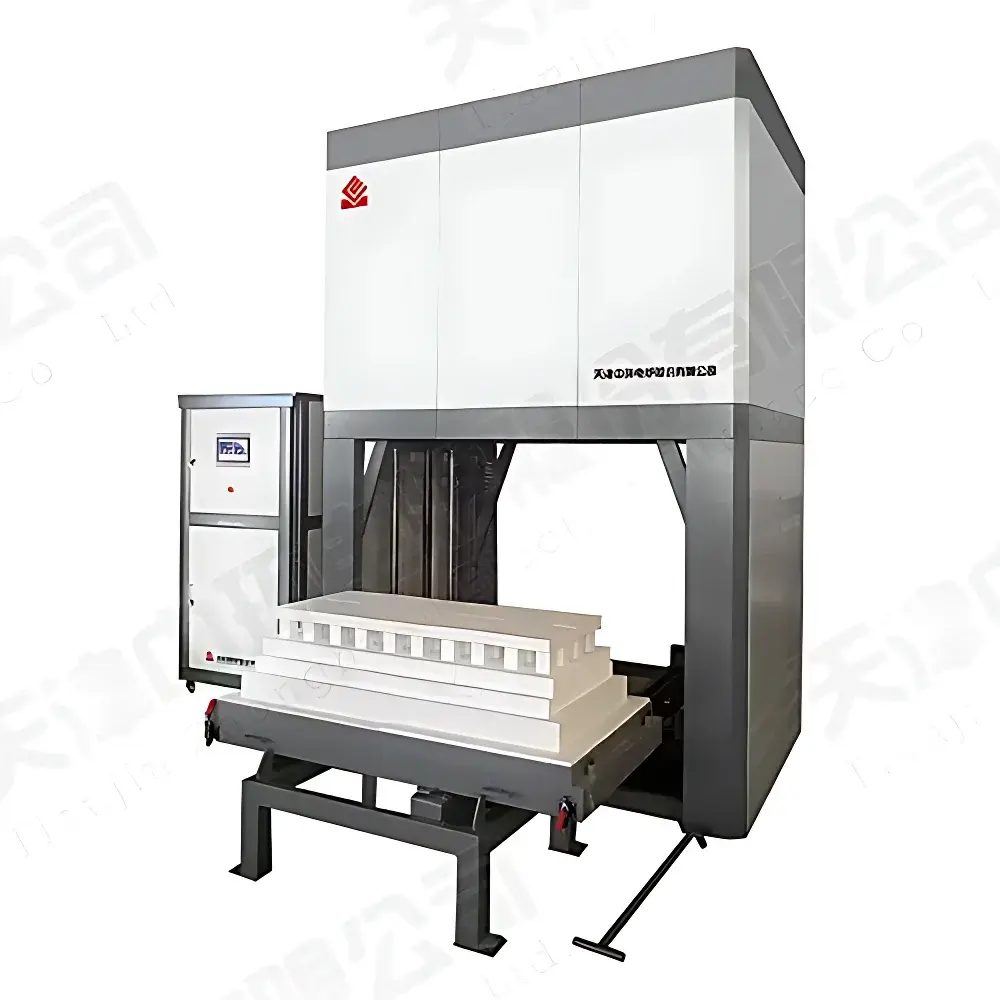
ZHONGHUAN FURNACE ZHG-Z64176M High-Temperature Bell Jar Furnace (Industrial Muffle Furnace)
| Brand | ZHONGHUAN FURNACE |
|---|---|
| Origin | Tianjin, China |
| Model | ZHG-Z64176M |
| Type | Lift-Type Muffle Furnace |
| Max Temperature | 1750 °C |
| Temperature Control Accuracy | ±1 °C |
| Max Power | 30 kW |
| Heating Element | 1800-grade Molybdenum Disilicide (MoSi₂) Rods |
| Internal Chamber Dimensions | 400 × 400 × 400 mm |
| Nominal Volume | 64 L |
| Chamber Lining Material | Advanced Nanoporous Ceramic Foam + Polycrystalline Mullite Fiber Composite |
Overview
The ZHONGHUAN FURNACE ZHG-Z64176M is a high-precision, lift-type bell jar furnace engineered for controlled-atmosphere thermal processing in research laboratories and industrial pilot-scale production. Designed around the fundamental principle of radiant heating via resistive MoSi₂ elements operating in oxidizing or inert ambient conditions, this furnace delivers stable, repeatable thermal profiles up to 1750 °C—suitable for sintering, annealing, pre-firing, and heat treatment of advanced ceramics and refractory materials. Its modular bell-jar architecture enables rapid loading/unloading while maintaining strict thermal isolation between the hot zone and structural frame. The furnace complies with IEC 61000-6-3 (EMC emission standards) and incorporates dual-layer insulation—inner nanoporous ceramic foam and outer polycrystalline mullite fiber—to minimize thermal loss and maximize energy efficiency. Structural rigidity is ensured by vertical column-guided lifting mechanisms and reinforced steel base frames rated for continuous operation under load.
Key Features
- Four-sided symmetrical arrangement of 1800-grade MoSi₂ heating rods ensures exceptional radial and axial temperature uniformity (±3 °C within working zone at 1700 °C), validated per ASTM C1029 for high-temperature furnace qualification.
- Advanced composite chamber lining: inner layer of low-expansion nanoporous ceramic foam (thermal conductivity < 0.15 W/m·K at 1000 °C) bonded to outer polycrystalline mullite fiber panels—resistant to volatilization, alkali corrosion, and thermal shock up to 1750 °C.
- Motorized lift system with dual-limit switch protection and emergency stop interlock; lift height adjustable to 700 mm with programmable descent rate for controlled cooling ramping.
- Standard manual program controller with 30-segment PID algorithm; optional upgrade to 7-inch color touchscreen HMI with USB data logging, real-time curve plotting, and password-protected parameter editing.
- Integrated safety architecture: door-open power cutoff, independent over-temperature cutout (separate from main controller), grounded chassis, and Class H insulation on all electrical feedthroughs.
Sample Compatibility & Compliance
The ZHG-Z64176M accommodates crucibles and fixtures made from high-purity alumina (Al₂O₃ ≥ 99.8%), zirconia (Y₂O₃-stabilized), silicon carbide (SiC), and graphite (with appropriate atmosphere control). It supports batch processing of electronic ceramics (e.g., PZT, BaTiO₃), structural ceramics (ZrO₂, AlN), magnetic ferrites, sputtering targets, and optical substrates including synthetic quartz and sapphire wafers. The furnace meets ISO/IEC 17025 requirements for calibration traceability when operated with NIST-traceable thermocouples (Type S or B). For regulated environments, optional validation packages support IQ/OQ documentation aligned with FDA 21 CFR Part 11 and EU Annex 11 guidelines—enabling audit-ready electronic records, user access control, and change history tracking.
Software & Data Management
The optional integrated control system runs embedded Linux-based firmware compliant with IEEE 11073-10201 (medical device interoperability standard), supporting MODBUS TCP and OPC UA protocols for seamless integration into centralized MES or SCADA platforms. All temperature profiles, alarm logs, and cycle timestamps are stored in encrypted SQLite databases with automatic daily backup to external USB drives. Data export formats include CSV, PDF reports (with digital signature), and XML for LIMS ingestion. Audit trails record operator ID, timestamp, parameter changes, and event severity—fully compliant with GLP and GMP documentation standards.
Applications
- Sintering of multilayer ceramic capacitors (MLCCs) and piezoelectric components under air or nitrogen atmospheres.
- Pre-sintering and final densification of YSZ and CeO₂-based solid oxide fuel cell (SOFC) electrolytes and anodes.
- Thermal annealing of optical-grade sapphire substrates for LED epitaxy, ensuring minimal lattice distortion and surface roughness retention.
- Controlled oxidation of Mo–Si–B alloys and Ni-based superalloys for high-temperature structural testing.
- R&D-scale firing of nanostructured Li-ion battery cathode precursors (e.g., NMC, LFP) with precise dwell-time control at 800–1000 °C.
FAQ
What atmosphere options are supported?
The furnace operates in ambient air, dry nitrogen, argon, or forming gas (5% H₂/95% N₂); vacuum operation requires optional flanged ports and diffusion pump integration.
Can the furnace be validated for GMP use?
Yes—optional IQ/OQ documentation kits include factory calibration certificates, sensor mapping reports, and SOP templates compliant with ASTM E2877 and USP <1031>.
Is remote monitoring available?
Ethernet-enabled controllers support secure web-based access via HTTPS with TLS 1.2 encryption; mobile-responsive interface available for iOS and Android.
What maintenance intervals are recommended?
MoSi₂ rods should be inspected every 200 operational hours above 1400 °C; chamber insulation integrity verified annually using thermal imaging per ISO 18436-7.
How is temperature uniformity verified?
Uniformity mapping is performed using nine-point thermocouple array per AMS 2750E Zone Certification procedures; certificate provided upon request.



