
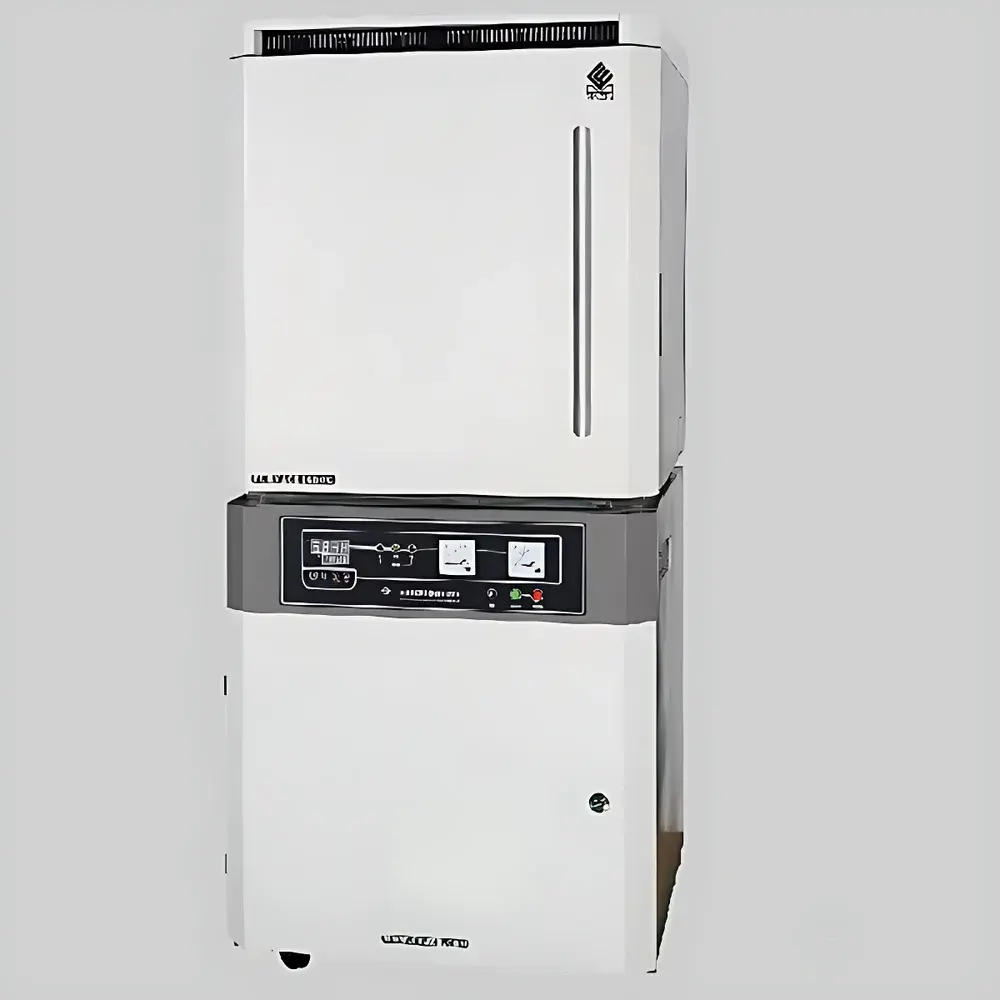
ZHONGHUAN FURNACE ZHX-18173M Vertical High-Temperature Box-Type Muffle Furnace (1700 °C)
| Brand | ZHONGHUAN FURNACE |
|---|---|
| Origin | Tianjin, China |
| Model | ZHX-18173M |
| Instrument Type | Box-Type Muffle Furnace |
| Maximum Temperature | 1700 °C |
| Temperature Control Accuracy | ±1 °C |
| Rated Power | 18 kW |
| Heating Element | Silicon-Molybdenum (MoSi₂) Rods |
| Internal Chamber Dimensions | 300 × 250 × 250 mm (L × W × H) |
| Chamber Volume | 18 L |
| Rated Voltage | 380 V (3-phase) |
| External Dimensions | 765 × 750 × 1600 mm |
| Net Weight | 350 kg |
Overview
The ZHONGHUAN FURNACE ZHX-18173M is a vertically oriented, high-temperature box-type muffle furnace engineered for precision thermal processing in research laboratories, materials science facilities, and quality control environments. It operates on the principle of resistive heating via silicon-molybdenum (MoSi₂) rods, enabling stable, uniform, and contamination-free heat distribution within a fully insulated ceramic fiber chamber. Designed for continuous operation up to 1700 °C, the furnace complies with fundamental thermal stability requirements for sintering, ashing, calcination, heat treatment, and high-temperature synthesis of advanced ceramics, refractory metals, battery cathode materials, and oxide-based composites. Its vertical configuration optimizes floor space utilization while facilitating ergonomic loading/unloading of crucibles and sample boats—particularly critical when handling high-density or thermally sensitive specimens.
Key Features
- Advanced dual-layer thermal insulation: Combines high-purity alumina-silica ceramic fiber modules with an outer air-gap barrier to minimize surface temperature rise and improve energy efficiency.
- Intelligent thermal safety architecture: Includes automatic power cutoff upon door opening, independent over-temperature cut-off (setpoint +10 °C above nominal), and ground-fault circuit interruption (GFCI) protection.
- PID-based intelligent temperature controller with auto-tuning capability: Supports both fixed-setpoint operation and multi-segment programmable ramp-soak profiles—up to 40 segments with import-grade controllers.
- Integrated RS-485 communication interface: Enables centralized monitoring and remote control of up to 200 units via dedicated PC-based software, supporting real-time data logging, historical trend analysis, alarm event reporting, and exportable CSV/Excel reports.
- Current-limiting and soft-start circuitry: Protects MoSi₂ heating elements from thermal shock and extends service life; mitigates inrush current during startup or mid-cycle sample insertion, safeguarding upstream electrical infrastructure.
- Optional color touchscreen HMI: Provides intuitive navigation across real-time temperature curves, bar-graph process visualization, historical trace replay, alarm logs, and bilingual (Chinese/English) menu support.
Sample Compatibility & Compliance
The ZHX-18173M accommodates standard high-purity alumina, zirconia, and silicon carbide crucibles (up to Ø120 mm × 100 mm height), as well as custom fixtures for rod-shaped or powdered samples. Its muffle design ensures complete thermal isolation between heating elements and sample zone—eliminating cross-contamination risks common in direct-heating configurations. The furnace meets baseline mechanical and electrical safety standards per GB/T 10066.1–2004 (General Requirements for Industrial Resistance Furnaces) and conforms to IEC 61000-6-3 (EMC Emission Limits) and IEC 61000-6-2 (Immunity Requirements). While not certified to UL or CE for export without customization, its architecture supports validation under GLP and GMP frameworks—including audit-ready digital record retention when paired with compliant software and timestamped calibration logs.
Software & Data Management
The optional PC control suite provides full SCADA-level functionality: synchronized multi-furnace scheduling, user-access-level permissions (admin/operator/viewer), electronic signature support, and 21 CFR Part 11-compliant audit trails when deployed with validated Windows OS configurations. All temperature data are time-stamped with millisecond resolution and stored locally with configurable retention policies (default: 90 days). Export formats include ISO-standard .csv, .xlsx, and PDF report templates aligned with internal QA documentation workflows. Raw serial data streams (ASCII protocol over RS-485) are also accessible for integration into LIMS or MES platforms via Modbus RTU mapping.
Applications
- Sintering of rare-earth doped phosphors, YSZ electrolytes, and Si₃N₄-based structural ceramics
- Thermal gravimetric analysis (TGA) pre-conditioning and residue quantification per ASTM E1131
- Calcination of LiCoO₂, NMC, and LFP precursors under controlled atmosphere (when used with optional gas purge kit)
- Ash content determination in coal, biomass, and polymer composites per ISO 1171 and ASTM D3174
- Heat treatment of tungsten carbide tooling blanks and molybdenum alloy substrates
- High-temperature annealing of optical glass substrates and infrared-transmitting crystals
FAQ
What is the recommended maintenance interval for MoSi₂ heating elements?
Under normal operation at ≤1600 °C with proper cooling cycles, MoSi₂ rods typically require inspection every 200–300 operational hours; replacement is advised when resistance increases by >15% or visible oxidation spalling occurs.
Can this furnace be operated under inert or reducing atmospheres?
Yes—when equipped with a sealed flange port, gas inlet/outlet fittings, and optional quartz or alumina tube liner, it supports N₂, Ar, or forming gas (5% H₂/95% N₂) environments up to 1500 °C; consult technical documentation for maximum safe partial pressure limits.
Is third-party calibration certification available?
ZHONGHUAN FURNACE provides factory calibration certificates traceable to CNAS-accredited standards; on-site calibration by ISO/IEC 17025-certified providers can be arranged separately.
Does the controller support deviation alarms with configurable thresholds?
Yes—the PID controller allows setting upper/lower deviation limits relative to setpoint, triggering audible/visual alerts and optional relay outputs for external interlock systems.
What is the typical stabilization time after reaching 1700 °C?
At full-rated temperature, thermal equilibrium across the working zone (±5 mm from center) is achieved within 25–35 minutes under no-load conditions, verified per ASTM E220 methodology using three-point NIST-traceable thermocouples.



