
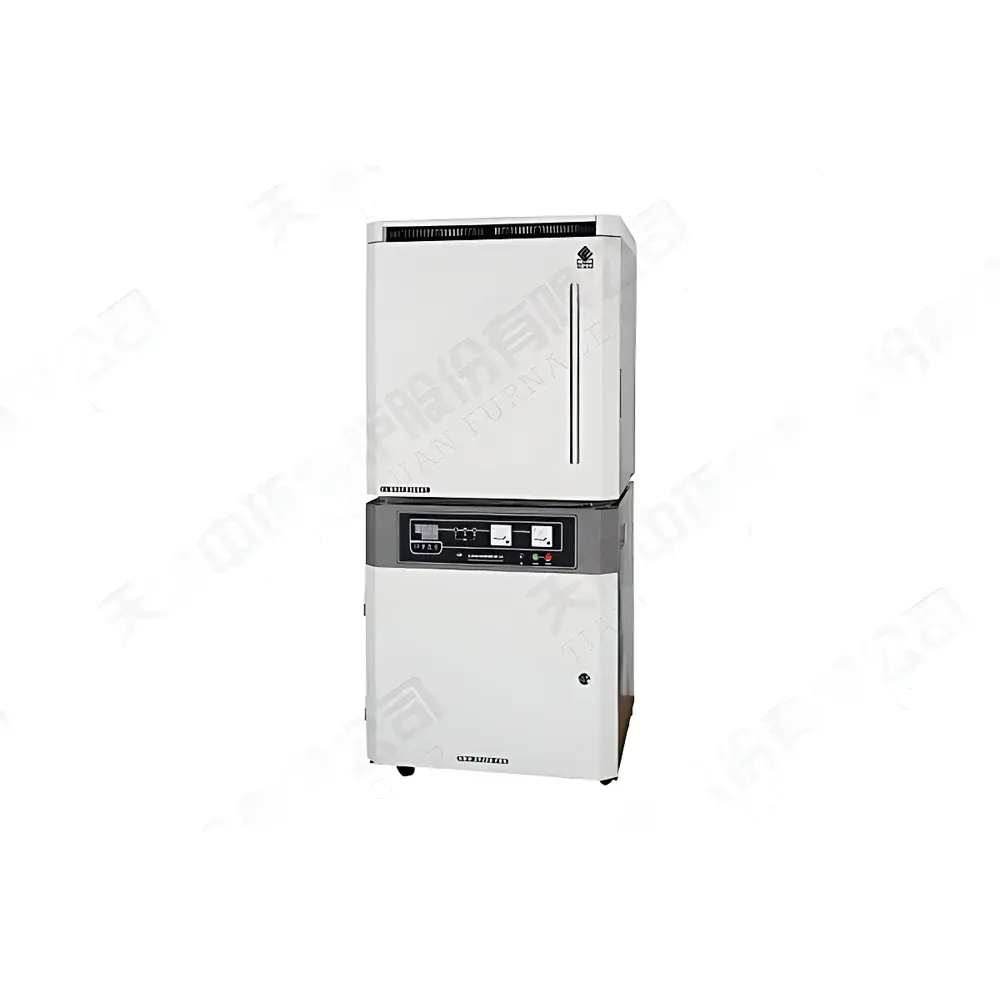
ZHONGHUAN FURNACE ZHX-18183 Vertical High-Temperature Box-Type Resistance Furnace
| Brand | ZHONGHUAN FURNACE |
|---|---|
| Origin | Tianjin, China |
| Model | ZHX-18183 |
| Maximum Temperature | 1800 °C |
| Temperature Uniformity | ±5 °C (at 1750 °C) |
| Control Accuracy | ±1 °C |
| Rated Power | 18 kW |
| Heating Element | Silicon Molybdenum (MoSi₂) Rods (surface rating: 1900 °C) |
| Internal Chamber Dimensions | 300 × 250 × 250 mm (L×W×H) |
| Chamber Volume | 18.75 L |
| Voltage Requirement | 380 V AC, 3-phase |
| 升温 Rate | ≤10 °C/min below 1200 °C |
| Insulation Material | Advanced composite refractory ceramic fiber with low thermal conductivity and high purity |
| Compliance | Meets GB/T 10066.1–2004 (General Requirements for Industrial Resistance Furnaces), ISO 9001 design principles |
Overview
The ZHONGHUAN FURNACE ZHX-18183 is a vertically oriented, high-temperature box-type resistance furnace engineered for precise, repeatable thermal processing in research laboratories and advanced materials development facilities. Operating up to 1800 °C — with continuous service capability at 1750 °C — it employs silicon molybdenum (MoSi₂) heating elements rated to 1900 °C surface temperature, integrated within a multi-layer composite refractory chamber designed for exceptional thermal stability and minimal energy loss. Its vertical architecture optimizes floor space while enabling ergonomic loading/unloading of crucibles, sintering boats, or ceramic substrates. The furnace operates on the fundamental principle of resistive Joule heating, where electrical current passed through MoSi₂ rods generates radiant and convective heat within a thermally isolated cavity. This configuration supports applications requiring strict thermal homogeneity, ultra-low contamination, and long-term operational reliability under aggressive oxidizing atmospheres.
Key Features
- Advanced composite insulation system combining low-conductivity ceramic fiber and reflective air-gap barriers, achieving >40% energy savings versus conventional alumina-fiber furnaces
- Intelligent dual-stage cooling management: surface temperature sensor triggers auxiliary exhaust fans automatically when external casing exceeds 50 °C, maintaining operator safety and structural integrity
- Triple-layer safety architecture: (1) mechanical interlock that cuts power upon door opening, (2) independent over-temperature cut-off relay with audible/visual alarm, and (3) ground-fault circuit interrupter (GFCI) protection
- Programmable temperature control system supporting up to 40-step ramp-soak-hold profiles; includes PID tuning, auto-tuning, and fuzzy logic algorithms for dynamic load compensation
- Current-limiting and soft-start circuitry to suppress inrush current during startup or mid-process sample handling — extending MoSi₂ rod life and protecting facility power infrastructure
- RS-485 communication interface compliant with Modbus RTU protocol, enabling integration into centralized lab monitoring systems for remote operation, real-time data logging, and audit-ready event tracing
Sample Compatibility & Compliance
The ZHX-18183 accommodates standard high-purity ceramic, graphite, and platinum-based crucibles (up to Ø120 mm × 150 mm height) and supports inert, oxidizing, and weakly reducing atmospheres (e.g., air, O₂, N₂, Ar). Its ultra-clean chamber lining — free of volatile binders or organic additives — ensures minimal outgassing, making it suitable for semiconductor precursor synthesis, optical crystal annealing, and high-purity oxide sintering per ASTM C1161 and ISO 6872 standards. All electrical components conform to IEC 61000-4 electromagnetic compatibility requirements. The control system architecture aligns with GLP/GMP documentation practices, supporting 21 CFR Part 11-compliant electronic records when paired with validated software platforms.
Software & Data Management
The furnace interfaces via RS-485 to optional PC-based supervision software capable of managing up to 200 units simultaneously. Functions include synchronized multi-furnace scheduling, time-stamped temperature profiling (0.1 s resolution), deviation alerts with configurable thresholds, automated report generation (PDF/CSV), and secure user-level access control. Audit trails capture all setpoint changes, manual overrides, alarm events, and calibration actions — essential for ISO/IEC 17025-accredited testing labs. Optional touchscreen HMI offers real-time visualization of temperature curves, bar-graph status indicators, historical trend overlays, and alarm log review — all in fully localized English interface.
Applications
- Sintering of advanced ceramics (Al₂O₃, ZrO₂, SiC, Si₃N₄) and metal-ceramic composites
- Heat treatment of refractory metals (Mo, W, Nb) and high-entropy alloys
- Thermal gravimetric analysis (TGA) sample pre-conditioning and ashing protocols
- Glass sealing and frit densification in optoelectronic packaging
- Calibration of high-temperature reference standards (e.g., Pt-Rh thermocouples per ITS-90)
- Research-scale solid-state reaction kinetics under controlled thermal gradients
FAQ
What atmosphere types are compatible with the ZHX-18183?
Air, oxygen, nitrogen, argon, and other non-corrosive gases are supported. For reducing or vacuum environments, optional gas-tight door seals and inlet/outlet ports must be specified at order stage.
Is the furnace suitable for GMP-regulated production environments?
Yes — when deployed with validated software and documented IQ/OQ protocols, its hardware architecture and data integrity features meet core requirements of FDA 21 CFR Part 11 and EU Annex 11 for critical thermal processing steps.
How is temperature uniformity verified across the working zone?
Uniformity is characterized per GB/T 10066.1 using nine-point mapping (center + eight equidistant locations) at 1750 °C; typical deviation is ±5 °C within the central 70% volume.
Can the furnace be integrated into a SCADA or MES system?
Yes — native Modbus RTU support enables direct integration with industrial automation platforms including Siemens SIMATIC, Rockwell FactoryTalk, and Ignition SCADA without middleware.
What maintenance intervals are recommended for MoSi₂ heating elements?
Under normal oxidizing conditions and proper thermal cycling, MoSi₂ rods typically exceed 2,000 hours of service life at 1750 °C; visual inspection and resistance measurement are advised every 500 operating hours.



